


African Startups Reach New Heights in Debt Financing
African technology startups achieved a remarkable $1.64 billion in debt financing in 2025, marking a 63% increase from the $1.01 billion raised in 2024. This figure represents the highest level of debt financing ever recorded on the African continent.
Surge in Debt Transactions
The number of debt transactions also saw a significant rise, increasing 40% to 108 from just 77 a year prior, according to data from Partek Africa. The changing financing landscape illustrates a growing reliance on debt as a viable source of capital for startups across the continent.
Shift in Financing Dynamics
Debt financing now constitutes 41% of all capital invested in Africa’s technology sector, a notable increase from 17% in 2019. This shift underscores a structural evolution in the funding landscape. Unlike equity financing, which often dilutes ownership, debt financing enables growth-stage companies with reliable revenue streams to secure funding while maintaining control over their business.
Case Study: Wave’s $137 Million Debt Raise
Senegal-based fintech company Wave exemplifies this trend, having secured $137 million in debt led by Rand Merchant Bank. With its consistent mobile money revenue, Wave’s decision to pursue debt instead of equity signifies the maturation and revenue predictability of African startups.
Leading Markets and Sectors
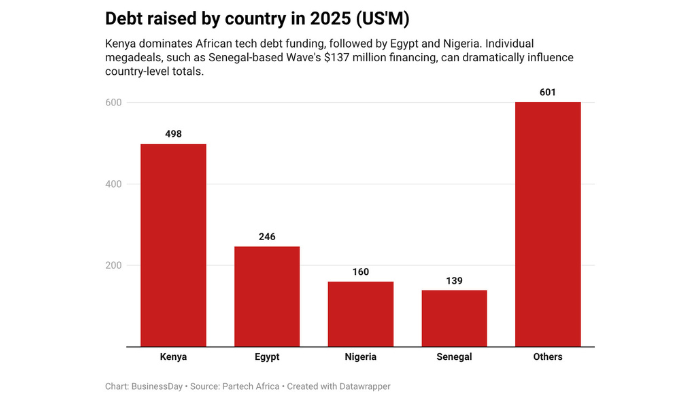
In terms of geographical distribution, Kenya emerged as the frontrunner, raising $498 million, followed by Egypt with $246 million and Nigeria at $160 million. The fintech sector dominated the debt market with $716 million, while the cleantech sector trailed closely with $627 million. Interestingly, this sector was the only one where debt raised surpassed equity, largely driven by the solar power and clean mobility industries. Together, these sectors accounted for 82% of the total debt raised.
Evolution of Debt Capital Supply
The landscape for debt capital is also evolving rapidly. In 2025, a total of 77 unique fixed income investors participated in the market, with 57% classified as bond-only investors, showing an increase from the previous year’s 48%. Key players in this space include British International Investment, IFC, Lendable, Proparco, and Verdant Capital, while commercial banks are increasingly entering the arena, establishing the legitimacy of this asset class.
Debt as a Complement to Equity
Experts emphasize that while debt is gaining ground, it complements rather than replaces equity financing, particularly for growth-stage companies boasting established cash flows. Although there was a slight decline in the number of active equity investors in 2025, seed-stage companies predominantly continue to rely on equity investment.
Confidence in Future Cash Flows
The $1.64 billion milestone is not merely a fundraising record but a significant indicator of maturity within Africa’s technology ecosystem. This achievement reflects that startups have attained a level of scale and stability, instilling confidence among lenders about their future cash flows. As debt financing becomes increasingly integral to tech finance in Africa, the way the ecosystem navigates access, sectoral impacts, and early-stage capital gaps will be pivotal for future innovation across the continent.
