


Florida’s Immigration Funding Strategy Raises Questions
Florida has actively supported the Trump administration’s immigration policies, allocating additional resources to assist local law enforcement in apprehending and detaining individuals. However, the recipients of these state funds might surprise many observers.
A recent review by the Orlando Sentinel indicates that several of the state’s largest law enforcement agencies, including the Orange County Sheriff’s Office, have not taken advantage of the $250 million grant program approved by state lawmakers last year. This grant is intended to bolster local efforts in immigration enforcement.
Interestingly, smaller agencies appear to be leading the charge in applying for these funds. Their expenditures primarily cover essential police gear such as handcuffs and body cameras, in addition to high-tech equipment that would otherwise be financially out of reach. However, the connection between these purchases and immigration enforcement isn’t always clear.
The Sentinel’s examination also revealed a lack of public scrutiny regarding the applications received by review boards. While the decision-making process remains somewhat opaque, it is evident that Florida is channeling significant state tax dollars toward what has traditionally been a federal concern, especially amid the leadership’s ambition to become a national model for immigration enforcement.
Notably, the sheriff’s offices with the highest approved expenditure plans include Lee County ($9.9 million), Polk County ($9.7 million), Osceola County ($9.4 million), and Escambia County ($5.9 million). Ironically, these agencies rank lower in staffing compared to the state’s top four law enforcement departments, with none of them serving the largest counties. The Jackson County Sheriff’s Department, neighboring the Alabama-Georgia border and serving a population of fewer than 50,000, secured fifth place with $3.8 million in approvals.
Over 75% of the approved funding has been earmarked for new equipment. Additionally, bonuses for local police and correctional officers have been authorized, along with requests from some agencies for funding to help cover detainee transport costs for U.S. Immigration and Customs Enforcement (ICE).
Anthony Coker, executive director of the state Immigration Executive Board—responsible for approving these spending requests—has not responded to inquiries regarding local law enforcement’s plans for utilizing state funds.
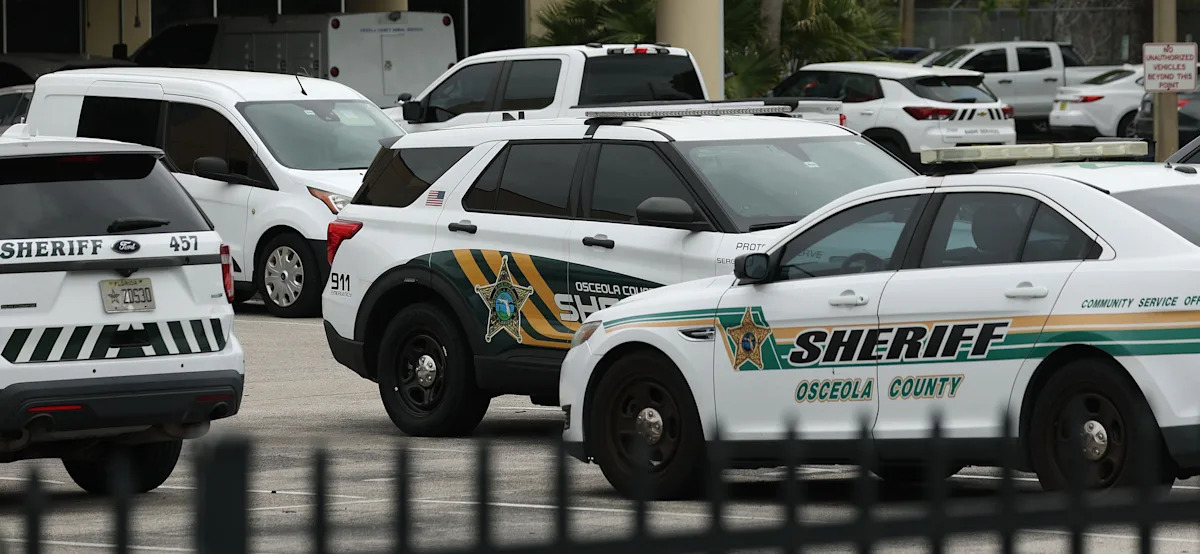
In Central Florida, the Osceola Sheriff’s Office has thus far received the largest share of approved funding. Conversely, smaller departments from Fruitland Park, Altamonte Springs, and St. Cloud received comparatively modest amounts, while county jails in Central Florida have been allocated funds for items such as additional mattresses for detainees.
Osceola Sheriff Christopher Blackmon, who was appointed in June by Governor Ron DeSantis, contends that utilizing state funding is sensible. “When you’re working within a tight budget, access to immigration enforcement grants is invaluable,” he noted, indicating that these resources ease the financial burden on local taxpayers and commissioners.
This funding surge originates from a grant program initiated by the Florida Legislature during a special session last year, championed by DeSantis to enhance the state’s deportation efforts—a key feature of President Donald Trump’s policy during his presidency.
Since September 30, when the first grant approvals were made, the Immigration Committee, including DeSantis and three other statewide officials, has authorized over $60 million in funding applications, which represents approximately 24% of the total grants available. Of this amount, about $46 million, or 77%, is allocated specifically for new equipment.
Among the expenditures, the Osceola County Sheriff’s Office acquired 300 radios for $4 million, invested $2.8 million in upgraded body-worn cameras for its officers, and allocated $1.44 million for “rifle-compatible” ballistic armor for both personnel and patrol vehicles. The agency justified the need for this protective gear due to the heightened risks involved in immigration-related detentions, stating that safeguarding officers during these operations is paramount.
The Osceola Jail has been approved for $182,000 to purchase a scanner capable of detecting weapons, cell phones, and contraband concealed on detainees, as well as $8,400 for new mattresses. Chief E. Keith Neely mentioned that the increase in detainee numbers—from 110 in 2024 to 518 in 2025—prompted these equipment requests.
Florida law enforcement agencies are also eligible for $1,000 bonuses for officers and correctional staff who complete specialized training and work alongside federal agents. The Osceola Sheriff’s Office proposed bonuses for its 500 deputies, emphasizing that all personnel are participating in training to adapt to immigration-related incidents.
While Osceola leads in the quantity of bonuses requested, Polk County follows closely, applying for 280 bonuses for about 22% of its force, while Seminole County’s request covered 50, benefiting around 7% of its officers.
So far, the Florida Immigration Board has approved funding at four meetings, with the most recent on February 24. This board, which includes DeSantis, typically endorses applications with minimal discussion. Despite uncertainties regarding the vetting process, the Lee Sheriff’s Office has emerged as a significant player in grant approvals.
As of now, many law enforcement agencies in Central Florida have yet to apply for these funds, including the largest sheriff’s offices in Miami-Dade and Broward counties, along with the Jacksonville Sheriff’s Office. Approved allocations for the Palm Beach and Hillsborough sheriff’s offices stand at $1.99 million and $490,000, respectively.
The Altamonte Springs police department similarly secured funding for 20 biometric scanners aimed at ensuring accurate identification during immigration operations. St. Cloud received $38,000 for 20 units, an upgrade from the four they currently possess.
On another front, Fruitland Park obtained $59,800 to fund license plate reader cameras and a GPS tracking system, while the Seminole County Sheriff’s Office sought and was granted $1.16 million, primarily for transporting detainees to ICE facilities. This approval included $832,000 earmarked for overtime and benefits along with approximately $72,000 for mileage on the significant number of trips made by deputies.
Although cooperation with ICE has become a mandate for Florida law enforcement agencies, fulfilling this requirement incurs costs. Sheriffs and police chiefs argue for greater budgets to support hiring and adequately equipping officers tasked with these responsibilities.
Jeff Brandes, founder of the Florida Policy Project and former state senator, articulated that the increase of individuals held in immigration detention has local financial implications that the federal government does not address. The Lee Sheriff’s Office, recognized as a frontrunner in immigration enforcement, has notably attempted to expand its operational capabilities with a wide range of technology and resources, including a $4.3 million purchase of body cameras, equipment, and surveillance systems.
Despite the sheriff’s office being noted for its significant “encounters” with over 1,600 immigrants, questions remain regarding the accuracy of the metrics reported, as many agencies often fail to maintain consistent records.
In a surprising move, Lee’s Sheriff’s Office initially sought nearly $23 million in funding, but that request was substantially reduced before the recent meetings.
