


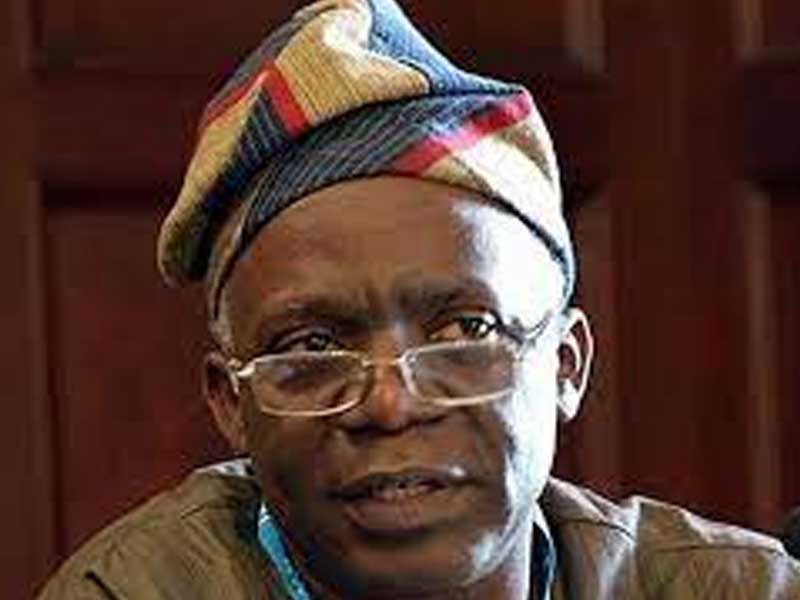
Alarming Rise in Out-of-School Children Attributed to Government Neglect
Femi Falana, a prominent lawyer and human rights advocate, has pointed to the staggering number of out-of-school children in Nigeria—estimated at 20 million—blaming it on the widespread neglect of basic education by various state governments.
Documents obtained from the Universal Basic Education Commission (UBEC) show that, as of March 2026, several state governments, along with the Federal Capital Territory, have denied access to over N97 billion in funds from the commission. This information was revealed in response to a formal request for data on state compliance with the Compulsory and Free Universal Basic Education Act.
Falana expressed concern over not only the inability of state governments to access the Universal Basic Education matching subsidy but also their failure to effectively allocate these funds for critical improvements in infrastructure and teaching conditions in primary and secondary schools nationwide. Such neglect undermines the quality of education available to children.
Details of Unutilized Fund Distribution
According to UBEC documentation, which was signed by General Counsel Mrs. Ademola SA, various states faced challenges in accessing matching grants from 2021 to 2025. Notably, in 2021, Imo State was the only one that failed to utilize a substantial grant totaling GH¢946,646,664.48. This trend continued into subsequent years, with both Imo and Ogun states each missing out on N1,204,452,353.76 in 2022 and N1,395,784,959.14 in 2023.
In 2024, multiple states including Abia, Imo, Niger, Ogun, Oyo, and Rivers collectively had N3,554,642,584.46 in unaccessed funds. Additionally, Ekiti State had N54,642,584.46 that remained untouched, while the Federal Capital Territory had N1,522,793,887.46 still unutilized.
Significant Funds Remain Unallocated Across Multiple States
By 2025, only 15 states managed to access funds from the UBEC. States such as Abia, Adamawa, Akwa Ibom, Anambra, Bayelsa, and others are still facing substantial barriers, with each state having N3,554,642,584.46 in unaccessed funds. Gombe and Kano have remaining unutilized amounts totaling N1,876,121,485.57, while Kwara and Zamfara still have N197,600,386.69 inaccessible.
Legal Guarantees for Compulsory Education Ignored
In a recent press statement, Falana highlighted the provisions of the Children’s Rights Law and the Universal Basic Education Compulsory and Free Law, both of which mandate free and compulsory education for children at both primary and secondary levels. The federal government allocates a block grant, equivalent to 2% of the Consolidated Revenue Fund (CRF), to UBEC to support basic education; however, each state is required to contribute a 50% matching grant in order to access these federal funds.
Falana lamented that numerous state governments, along with the Federal Capital Territory, continually fail to meet the requirements necessary to unlock these crucial funds. This shortfall raises critical concerns regarding the implementation of Nigeria’s education policy and highlights the growing disparities in access to basic education, particularly among vulnerable groups.
Despite several rulings by both the ECOWAS Court and the Federal High Court affirming children’s right to free education, Nigeria’s out-of-school children remain an alarming statistic. Falana accused those in power of neglecting the educational needs of low-income families, effectively condemning many to illiteracy and limiting their opportunities for a better future.
