


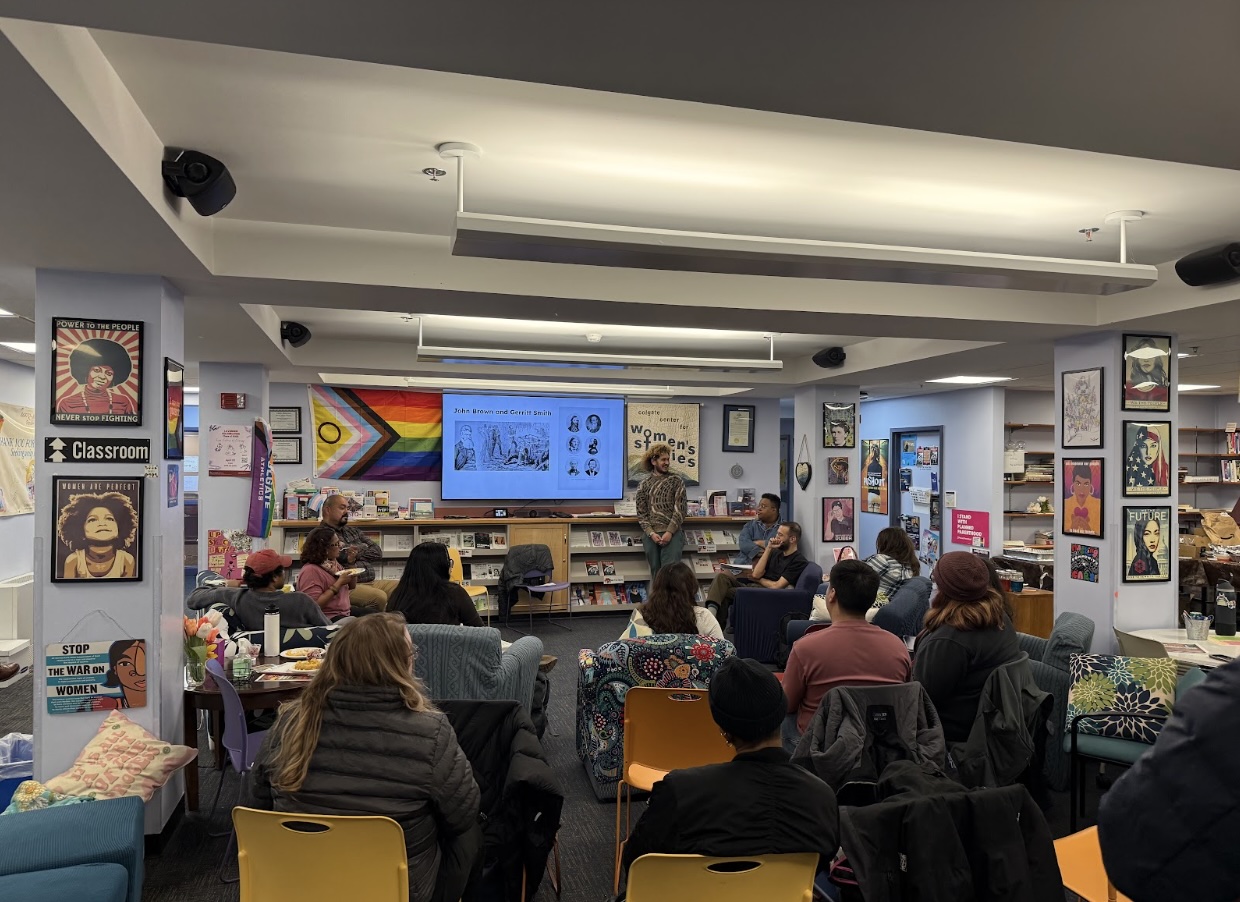
During a recent teach-in, five educators engaged in an in-depth discussion about immigration enforcement and strategies for resistance. The event, sponsored by the Center for Women’s Studies, took place on April 2nd. Teach-ins are a time-honored method, dating back to the Vietnam War, designed to enlighten the community on pressing issues and inspire actionable solutions.
Associate Professor of Anthropology Santiago Juarez initiated the discussion by drawing parallels between contemporary U.S. immigration policies and Guatemala’s tumultuous history. Juarez described the current immigration crackdown as a form of “fascist repression,” underscoring that undercover police operations—often involving masked officers—are not novel to the Americas. He referenced the CIA-supported coup in Guatemala in 1954 that displaced democratically-elected President Jacobo Arbenz and put a military regime in power. During this era, indigenous Maya communities faced severe persecution, a historical cycle that Juarez believes resonates with today’s treatment of immigrant populations in the U.S. The ongoing ramifications of U.S. interventions, he asserted, continue to influence migration trends.
“There’s still migration from those regions into the United States,” Juarez explained. “It’s disheartening when right-wing commentators question why these individuals don’t simply rebuild their countries. The reality is that U.S. policies are driving this migration.”
Nimanthi Rajasingam, an associate professor of English and women, gender, and sexuality studies, contributed by highlighting the intricate connections between U.S. foreign and domestic policy. She pointed out that the Department of Homeland Security was established in the aftermath of the 9/11 attacks, with ICE’s role initially directed at quelling public dissent over the Iraq War. Linking current narratives around Iran to similar falsehoods, Rajasingam remarked on how the post-9/11 climate intensified police militarization, a trend that remains unaddressed.
Omar Al-Sayed, a Visiting Assistant Professor specializing in Women, Gender, and Sexuality Studies, expanded upon the conversation by relating these issues to indigenous rights. He mirrored Rajasingam’s observations, arguing that America’s expansionism reflects a pattern of violence extending from internal conflicts to international interventions, including Iraq and Guatemala. Al-Sayed emphasized that the nation’s foundation in settler colonialism is the root cause of its ongoing imperialistic endeavors abroad.
“While our focus may not always be on settler colonialism or foreign imperialism, we must recognize that there are over 500 officially recognized indigenous nations, with countless others that never relinquished their sovereignty,” Al-Sayed noted. He pointed out that this continued expansion westward exemplifies America’s enduring legacy of violence.
Taryn Jordan, an assistant professor in the same field, discussed practical approaches to resistance, underscoring the effectiveness of mutual aid initiatives. Jordan defined mutual aid as direct support actions for communities. She illustrated this point with examples from Minneapolis, where residents utilized whistles to alert neighbors about ICE operations. Other initiatives included delivering food to neighbors and providing support at local jails, where protests offer comfort and resources to those detained.
Senior Daquan Hart, an environmental studies major with dual minors in economics and women’s, gender, and sexuality studies, reflected on the impact of the event. “These discussions are invaluable; they provide a platform for students, faculty, and staff to engage and break down barriers,” Hart said. “It’s crucial that we create spaces for diverse voices, especially during these challenging times. There remains an urgent need for inclusive narratives that challenge the prevailing rhetoric.”
