


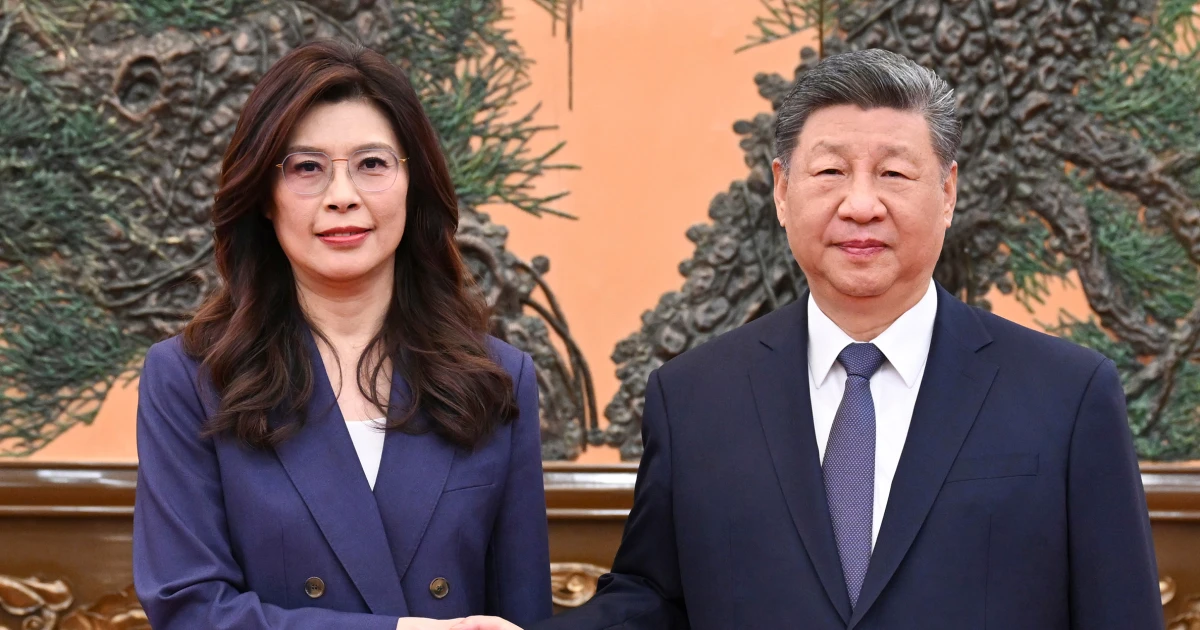
Xi Jinping Emphasizes Historical Necessity of Taiwan’s Unification in Meeting with Opposition Leader
In a significant meeting on Friday, Chinese President Xi Jinping engaged with Cheng Liyun, the leader of Taiwan’s main opposition party, the Kuomintang (KMT). During their discussion, Xi underlined the shared cultural and ancestral ties and described the unification of Taiwan and mainland China as a “historical necessity.”
This meeting took place against a backdrop of increased military activity in the Taiwan Strait and growing concerns about U.S. arms sales to Taiwan, which Beijing has openly criticized. The atmosphere is particularly charged as military exercises by China raise the stakes in the ongoing conflict.
While the gathering did not yield any formal announcements, its timing is notable, occurring mere weeks ahead of a scheduled visit by former President Donald Trump to Beijing. Observers see this as Xi’s attempt to assert China’s political clout and influence over Taiwan amidst rising tensions.
At a subsequent press conference, Cheng Liyun displayed a cautious approach, neither confirming nor refuting Beijing’s long-held aspiration for unification with Taiwan—a self-governing island with a population of 23 million. The specter of a potential Chinese military invasion remains a pressing concern for many in Taiwan.
Cheng expressed a desire to develop stable relations, emphasizing a gradual approach. “This must be done in stages,” he explained, indicating a pragmatic outlook toward relations with China under Xi’s leadership. Cheng’s historically pro-China stance, however, has made him a divisive figure among the Taiwanese populace.
The meeting held significance not just in its symbolic handshake in the Great Hall of the People, but also in illustrating Cheng’s political transition from an independence activist to a leader endorsing closer ties with Beijing. As military support from the United States faces uncertainty, Cheng reasserted the need for Taiwan to cultivate ties with China to ensure peace and avoid conflict.
“We must do everything in our power to prevent war in the Taiwan Strait,” Cheng emphasized in a previous interview, advocating for a role as “peacemakers, not troublemakers.” His recent trip, which included a visit to Nanjing, reflects the long-standing historical connections between Taiwan and the mainland, dating back to the Kuomintang era.
Furthermore, Xi’s outreach to Cheng serves as a pointed critique of Taiwan’s current government, led by President Lai Ching-de, whom Beijing dismisses as a “separatist” for rejecting its claims over Taiwan. Xi publicly condemned “Taiwan independence” as the core threat to peace in the Taiwan Strait, reiterating that China would not tolerate such sentiments.
Notably absent from their discussions were references to the contentious topic of arms sales in U.S.-China relations. In Taiwan, political hurdles remain as Cheng’s opposition complicates government efforts to increase defense spending, potentially endangering a critical $14 billion U.S. arms package already on hold.
In a recent communication with NBC News, Cheng confirmed that U.S. arms sales were not discussed during his meeting with Xi, signaling the complexity of navigating cross-strait relations amid geopolitical challenges.
