


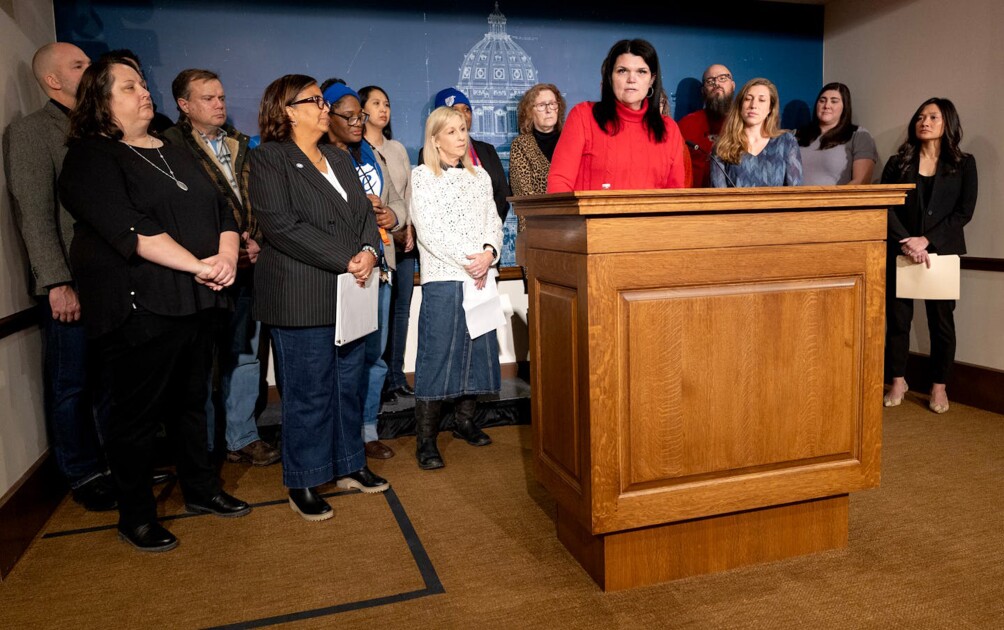
Legal Challenge to Immigration Policy Affecting Schools
Attorneys representing two Minnesota school districts and the state’s primary teachers union have petitioned a federal judge to block a recent policy change by the Trump administration that allows immigration authorities broader discretion to enforce actions in or near educational institutions.
Changes to Immigration Enforcement Policies
In a significant shift, the Department of Homeland Security abolished long-standing nationwide restrictions on immigration enforcement at “sensitive locations” such as schools, school bus stops, churches, and hospitals. This policy change has raised concerns across various communities, given that prior measures provided strict protections against enforcement actions in these environments.
Ongoing Legal Proceedings
The Fridley and Duluth school districts, alongside the Minnesota Education Union, initiated a lawsuit in February to challenge the new policy just as the Department of Homeland Security was deploying approximately 3,000 federal agents to Minnesota as part of Operation Metro Surge. This operation follows a troubling incident in January, where federal agents fatally shot two civilians during a crackdown in Minneapolis.
Seeking Legal Remedies
On Wednesday, the plaintiffs requested the court to issue an injunction or a preliminary injunction that would restore the previous policy restrictions. Amanda Czajkowski, an attorney representing the union and the school districts, expressed uncertainty about whether a ruling in their favor would have implications beyond Minnesota or for other sensitive locations like churches and hospitals.
Effects of Immigration Policies on Education
Educators nationwide are sharing how the immigration enforcement initiatives instigated by the Trump administration have impacted their classrooms and students’ lives. In an ongoing lawsuit filed by the National Teachers Union in federal court in Oregon, teachers reported heightened anxiety among students, with some immigrant families choosing to withdraw their children from school due to fears stemming from rumored enforcement actions, including arrests at bus stops.
Legal Arguments and Challenges
The arguments presented before U.S. District Judge Laura Provingino primarily revolved around whether the school districts and the union had the legal standing to pursue the lawsuit. Additionally, they examined if the new policy represented a definitive agency decision that could be subject to judicial review. Justice Department attorney Jessica Lundberg contended that reverting to last year’s guidelines, as sought by the plaintiffs, would not significantly change the enforcement landscape, stating that enforcement near schools had always been a possibility.
Impact on School Attendance and Resources
Superintendents from both districts attended the court proceedings, voicing deep concerns over the immediate impact of the policy shift on student attendance. Fridley Superintendent Brenda Lewis highlighted that the changes had led to a marked decrease in attendance, with some families reluctant to send their children to school. This decline has resulted in a pivot to virtual learning for many students, further straining limited resources. Lewis reported a loss of 72 students since December, noting the financial implications as the district’s funding is tied to enrollment and meal programs.
Wider Fallout in Minnesota Schools
Even though Operation Metro Surge has officially concluded and Fridley has not seen ICE agents on school grounds for the past eight weeks, the repercussions of this policy change are expected to linger. Duluth Superintendent John Magas mentioned that his district, located about 240 miles from Minneapolis, started experiencing the effects of the policy adjustment long before the surge. Data revealed a notable increase in absenteeism in the Twin Cities, with St. Paul reporting over 9,000 absent students in mid-January, while Minneapolis Public Schools noted that nearly 30% of its student population was absent on the last school day in January, underscoring a worrying trend linked to federal enforcement policies.
