


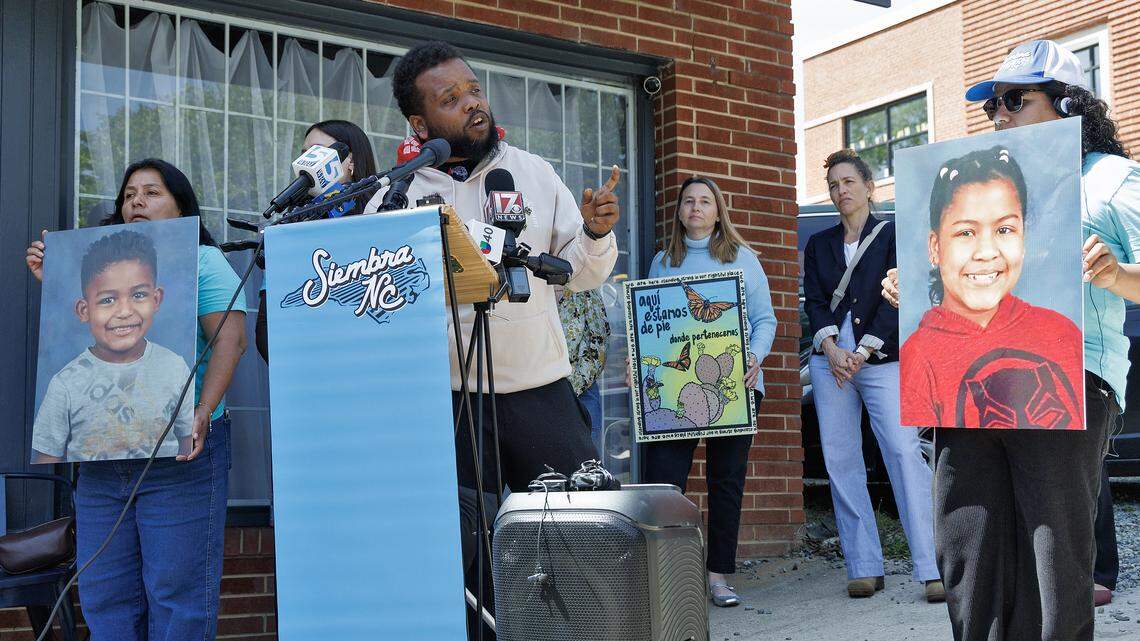
On Monday, a family of four from Durham was detained by Immigration and Customs Enforcement (ICE) during a routine immigration check in Charlotte and subsequently deported to Honduras, according to local officials and immigrant advocacy groups.
The two Durham Public Schools students, Genesis, 11, and Dennis, 6, along with their parents, Nelson Ramon Espinoza Sierra and Dacia Mariela Pacheco Galindo, had been in the U.S. for four years after seeking asylum in 2022.
Immigrant rights organization Siembra NC held a news conference on Thursday, stating that the family had been “doing exactly what was asked of them,” including regular attendance at asylum status check-ins at the Charlotte immigration office.
However, as the children’s aunt waited to pick up the family on Monday, she received a call from a private number, which turned out to be ICE, informing her of their detention.
Andreina Marchi, a defense manager with Siembra, expressed outrage, stating, “This family was lured into a check-in office under the guise of safety and deported within 48 hours.” She highlighted the gravity of the situation, suggesting that children attending schools in Durham could face similar threats, being taken by agents in broad daylight.
Department of Homeland Security Response
A spokesperson for the Department of Homeland Security (DHS) released a statement on Friday explaining that the family was deported for “failure to appear for their (previous) immigration hearing,” asserting that they had no pending asylum or immigration claims at the time of their detention. Additionally, DHS noted that the family crossed into the U.S. illegally in 2021.
The spokesperson stated, “ICE does not separate families,” explaining that parents are asked if they wish to be removed with their children; if not, the children are placed with a designated safe individual. This practice is consistent with immigration protocols from past administrations.
Despite this, Siembra organizers reported that family members claimed they had “faithfully followed” immigration officials’ instructions and were unaware of any missed commitments. Local advocates criticized the deportation as a sign of a due process failure, emphasizing that the family was reportedly detained under misleading circumstances and denied access to their cell phones after the arrest.
The pattern of ICE’s enforcement actions in Charlotte has raised concerns, with reports indicating that arrests have occurred at essential service facilities, including medical offices and courthouses, as well as near schools and even church parking lots.
State Senator Sophia Chytlik announced that local leaders would provide a “protective presence” at immigration hearings and meetings to observe proceedings and ensure community members are supported. “We will be witnesses and document what is happening to the best of our ability,” she said at the press conference.
Community Reactions and Support
Chytlik has also reached out to U.S. senators for more details regarding the family’s deportation and data on other families that may have vanished without due process under ICE custody. “People seeking asylum have legitimate claims of harm in their home countries, so the risk involved in sending them back is extremely high,” she emphasized, stressing the serious nature of the situation.
Crystal Roberts, a spokeswoman for Durham Public Schools, confirmed in a statement that the district is aware of the family’s detention, which occurred during the school’s spring break. “We will continue to provide necessary support services for Barton Elementary School students, families, and staff during this uncertain time,” she stated, expressing sadness over the incident.
Genesis, a fifth-grader at Barton Elementary, has been described as a dedicated student by her teacher, Daniel Barton, who noted that she rarely misses school. “She is a hardworking girl, and her remarkable character reflects her family,” he said, urging the community to support them during this challenging time.
This ongoing story is part of The News & Observer’s commitment to accountable reporting on critical community issues.
This story was first published April 9, 2026 at 6:32 p.m.
