


The Push for Immigration Bill in Delaware Aligns with Sanctuary State Policies
DOVER, Del. (AP) — The Delaware General Assembly is advancing two immigration bills aimed at restricting state and local agencies’ cooperation with federal civilian immigration enforcement. These measures echo the policies adopted by several sanctuary states across the country.
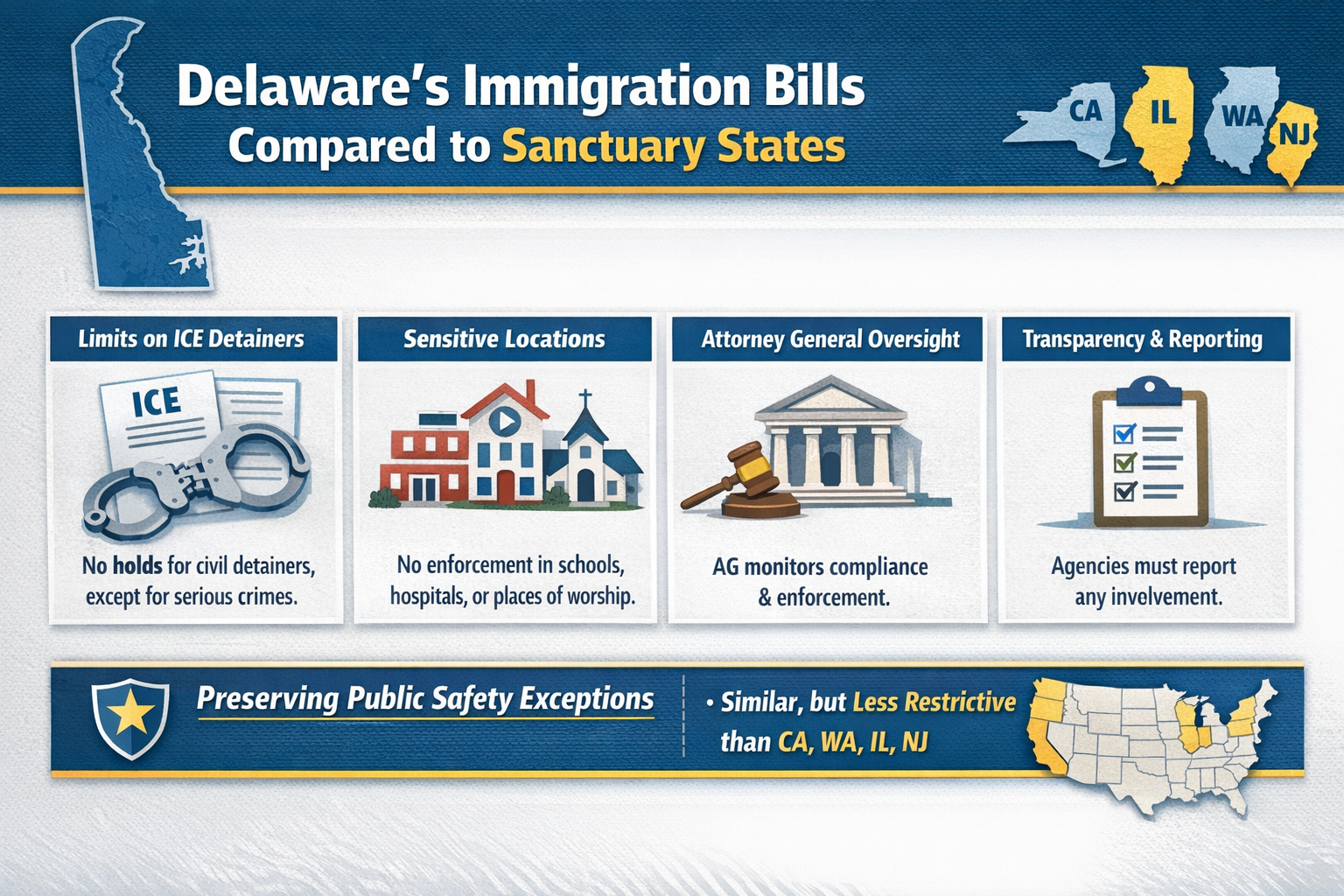
The proposed legislation, which includes House Bill 368 and House Alternative 2 to House Bill 94, seeks to impose limitations on detention practices, restrict enforcement activities in sensitive areas, and enhance transparency in interactions between state agencies and federal immigration authorities.
Understanding the Provisions of the Legislation
House Bill 368 would explicitly prohibit law enforcement in Delaware from detaining individuals solely based on federal immigration detainers or warrants issued by U.S. Immigration and Customs Enforcement (ICE).
This bill outlines exceptions for serious offenses, including violent felonies, sexual crimes, repeat DUI offenses, and domestic violence. Additionally, it aims to limit local involvement in civil immigration enforcement, granting powers to state attorneys general while mandating them to report their actions to the relevant authorities.
Meanwhile, House Alternative 2 to House Bill 94 zeroes in on specific locations from which state and local officials would refrain from assisting federal immigration enforcement. It designates “sensitive locations,” such as schools, hospitals, and places of worship, where enforcement actions would typically be restricted unless there is an imminent threat to public safety.
Delaware’s Position in the National Context
Policy analysts suggest that these proposals would position Delaware among the forefront of states limiting local involvement in federal immigration enforcement. This trend is already seen in states like California, Illinois, Oregon, Washington, and New Jersey.
However, Delaware’s approach remains more cautious than some of those with expansive protection policies, as it retains broad exceptions concerning criminal history while allowing certain forms of cooperation with federal authorities.
Comparative Analysis of Delaware’s Immigration Legislation
Bill/Policy Area | Impact in Delaware | Comparison with Sanctuary States
HB 368 – ICE Detainer Restrictions: Prohibits detaining individuals based solely on civil immigration detainers or warrants, limiting this to serious crimes. Aligns with policies in states like California, Illinois, and New Jersey, yet Delaware’s exceptions are broader.
HB 368 – Limits on Local Cooperation: Restricts local law enforcement agencies’ assistance in civil immigration enforcement, aligning with Washington and Oregon but including more extensive exceptions.
HB 368 – Oversight and Enforcement: Empowers the Attorney General to oversee and ensure compliance, similar to other states that rely on executive directives rather than statutory mandates.
HS 2 of HB 94 – Safeguards for Sensitive Locations: Prohibits assistance to private immigration enforcement at schools, hospitals, and places of worship, unless there’s an imminent threat to public safety, a standard consistent with California and Washington.
HS 2 of HB 94 – Criminal Control Exception: Allows cooperation in criminal cases involving valid court orders, a common practice in most sanctuary states.
Transparency and Reporting Requirements: Mandates detailed reporting on civil immigration enforcement participation, mirroring California’s transparency initiatives.
Community Safety and Trust Under Discussion
The proposed legislation echoes a broader national discourse on the role of local law enforcement in immigration-related matters, particularly given the increased federal enforcement activity in recent years.
Supporters argue that the bill is essential for establishing consistent standards and fostering trust between immigrant communities and public officials. They contend that reducing civilian immigration enforcement, especially in sensitive settings, will encourage people to seek services and report crimes without fear.
On the other hand, opponents express concerns that existing discretion within law enforcement might be undermined by codifying these restrictions. They argue that cooperation with federal officials can be crucial for public safety and that imposing limitations might convey a misleading message amid rising enforcement activities.
Delaware’s Future Decisions on Immigration Policy
The critical question at stake is not solely about stricter immigration enforcement but rather the extent of state involvement in this area.
If passed, Delaware would join a growing number of states opting to limit their role in federal immigration enforcement while retaining the ability to cooperate in serious criminal cases.
As it stands, House Bill 368 is under committee review, whereas the bill approved by the House continues its legislative journey forward.
Next Steps for Legislative Action
House Alternative 2 for HB 94 is poised for further legislative consideration following its passage through the House of Representatives. Should both chambers approve the final version of the bill, it will be sent to Governor Matt Meier for his assent. He will have the option to sign it into law, allow it to take effect without his signature, or veto it. Legislative action is anticipated to progress in the coming weeks, as the Delaware General Assembly is currently in its spring session.
