


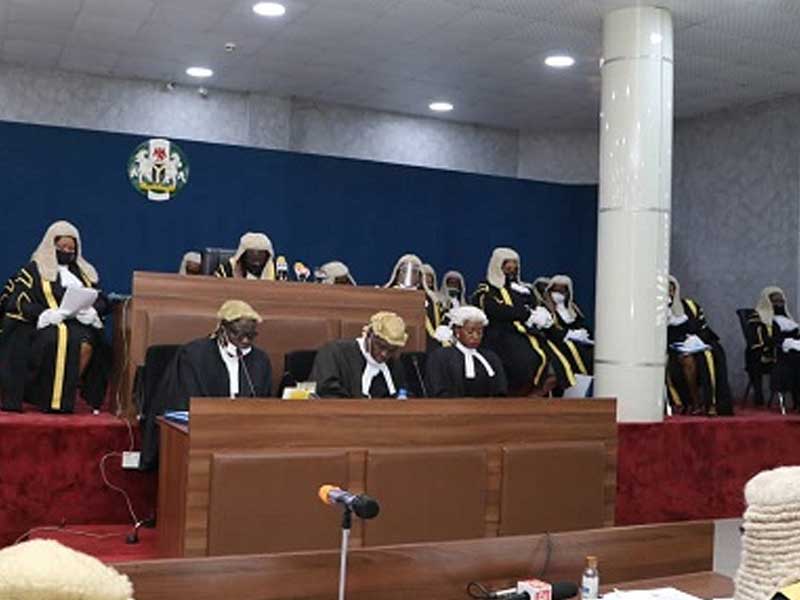
Supreme Court Decision Influences Future of Nigerian Political Landscape
As the Supreme Court deliberates on the protracted leadership dispute between the Peoples Democratic Party (PDP) and the African Democratic Congress (ADC), many Nigerians are questioning whether the court’s ruling will bolster a robust multi-party democracy or facilitate a shift toward a one-party state, reports Ejiofor Arike.
Last Wednesday, the Supreme Court announced it would reserve its decision regarding the appeal filed by the PDP and the ADC concerning their ongoing leadership battle. Prominent figures from both parties, along with their supporters, are now anxiously awaiting the outcome.
The Supreme Court’s five-judge panel made this announcement after attorneys for both parties prepared their arguments for the appeal, highlighting the significance of this case in shaping the political dynamics of the country.
In the PDP, Federal Capital Territory Minister Nyesom Wike and key PDP stakeholders, including Oyo State Governor Seyi Makinde, are vying for control, while former Senate President David Mark and Hon. Jeong Nafiu Bala Gombe are competing for leadership within the ADC.
This contentious legal battle for the PDP’s leadership can be traced back to a national convention held in Ibadan last year, which led to the establishment of a national executive headed by Tanim Turaki. Subsequently, Austin Nwachukwu and other PDP leaders filed a lawsuit against Ambassador Elijah Damagumu’s leadership, claiming violations of party guidelines and electoral laws during the convention.
Additionally, former Jigawa State Governor Sule Lamido has taken similar action, seeking to exclude his party from the convention. Although Justices Omotosho and Rifu initially barred the PDP from proceeding with the convention, the party continued, citing an order from the Oyo State High Court, which led the Court of Appeal to invalidate the Ibadan convention in favor of Wike’s faction.
The Turaki-led PDP subsequently escalated the issue to the Supreme Court, contesting the Court of Appeal’s ruling. PDP’s attorney Chief Chris Uche (SAN) contended that the lower courts mistakenly assumed jurisdiction over the party’s internal matters.
In a parallel crisis, the ADC’s leadership turmoil deepened after the Independent National Electoral Commission (INEC) withdrew recognition from Mark’s leadership, claiming compliance with a Court of Appeal order. This decision raised concerns about potential manipulation by the ruling All Progressives Congress (APC) to destabilize opposition forces ahead of the 2027 general elections.
Given Wike’s control of the PDP’s recognized faction, analysts speculate that the party may fail to field a formidable candidate capable of challenging President Bola Tinubu’s re-election campaign in 2027. Similarly, the absence of recognized leadership within the ADC could hamper its capacity to pose a serious challenge to the current administration.
As such, Jibrin Oktepa (SAN), representing Mark at the Supreme Court, urged a reversal of previous judgments, citing past rulings that stated no court should interfere in political parties’ internal affairs. In contrast, Robert Mkupelo (SAN), representing Gombe, called for the dismissal of the appeal, asserting that the matter was premature.
After hearing from all parties, Justice Mohammed Garba announced that the final judgment would be reserved for a later date, leaving many Nigerians pondering whether the ruling will signify an endorsement of a dynamic multi-party democracy or contribute to a troubling trend toward a one-party state.
The APC currently governs 32 states, raising alarms among citizens about the diminishing role of a vigorous opposition. Political analysts suggest that under Wike’s leadership, the PDP has morphed into an affiliate of the ruling APC, creating fears that the party may lend its support to Tinubu’s re-election efforts.
As the Supreme Court’s decision looms, the perceived alignment between certain factions within both the PDP and ADC and the ruling APC intensifies concerns about the future of democratic accountability in Nigeria. Figures like Wike and ADC ally Leke Abejide, aligned with Gombe, exemplify this worrying trend, with connections to key members of the APC leadership further complicating the political landscape.
Many are left to wonder whether the Supreme Court will inadvertently pave the way for APC-affiliated figures to dominate the opposition landscape or strengthen the participants’ ability to hold the ruling party accountable in accordance with democratic principles.
