


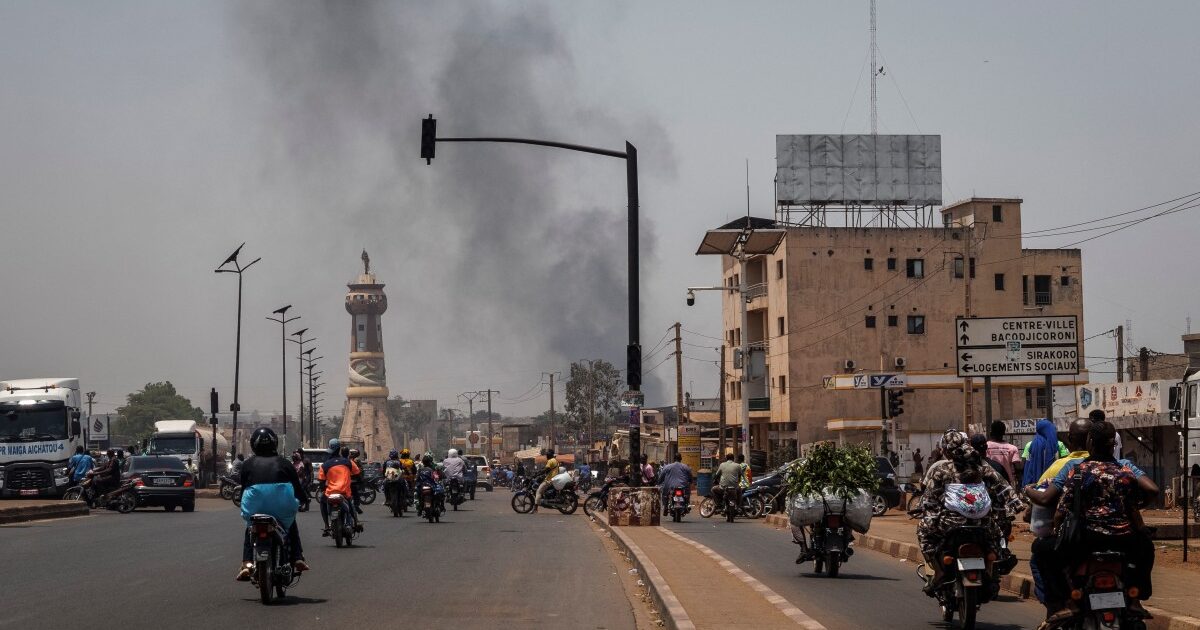
Mali’s Military Government Faces Security Crisis Amid Coordinated Attacks
Mali’s military government is grappling with a severe security crisis following a coordinated attack over the weekend by jihadists and separatist rebels. The assault reportedly resulted in the death of Defense Minister Sadio Camara and left major cities in northern Mali under rebel control.
Silence from Leadership During Crisis
As the violence erupted early Saturday, there has been no communication from junta leader General Assimi Goita, who has not been seen since the attacks began. This absence has raised concerns about the stability of the leadership during a time of intense turmoil.
Overview of the Coordinated Assault
The attack, executed by Tuareg rebels affiliated with the Front for the Liberation of Azawad (FLA) coalition and the Jihad Group Supporting Islam and Muslims (JNIM), targeted multiple locations across the vast arid expanse of Mali. Analysts are describing this offensive as the most significant challenge to the current government since a March 2012 crisis that was only quelled through French military intervention.
Defense Minister’s Death Marks a Critical Blow
Government forces are still engaged in combat across various regions; however, the killing of Minister Camara on Saturday represents a devastating setback for the ruling regime. Reports indicate that Camara, along with his second wife and two grandchildren, lost their lives in a car bomb attack at their residence in Kati, a military stronghold located just outside the capital, Bamako.
Continuing Violence and Territorial Claims
Ongoing clashes were reported Sunday in several regions, including Kati, Kidal, Gao, and central Mali’s Sevare. Tuareg rebels asserted they had reached an agreement allowing the Russian Africa Corps, which supports Malian forces, to withdraw from Kidal, proclaiming that the city is now “completely” under their control. Local residents confirmed the presence of rebel fighters actively occupying the streets.
Impact on Residents and Local Stability
The international airport near Bamako resumed operations by Sunday after significant violence erupted in the neighboring Senou area on Saturday. One terrified resident recounted, “I can still hear the explosion sound in my ears. It’s traumatizing.” In Bamako, military personnel have set up barriers and tires on major roads to restrict access to military facilities, reflecting the heightened security concerns across the city.
International Response to the Crisis
The opposition Coalition Forces of the Republic (CFR) has issued statements declaring that Mali is “in danger.” The junta, for its part, professed its commitment to restoring security and stability. However, UN Secretary-General António Guterres condemned the recent violence and called for a coordinated international effort to combat the escalating threats of extremism and terrorism in the Sahel region.
Reinforcement of Ties with Russia
The situation in Mali continues to draw international scrutiny, with the European Union condemning the “terrorist attack.” Meanwhile, the Russian Afrika Korps has effectively replaced the Wagner Group, now tasked with supporting Mali’s military against jihadists. As Mali’s government strengthens its ties with Russia, it contrasts sharply with its former colonial powers, such as France and western nations, amidst a backdrop of significant resources, including gold and other essential minerals.
