


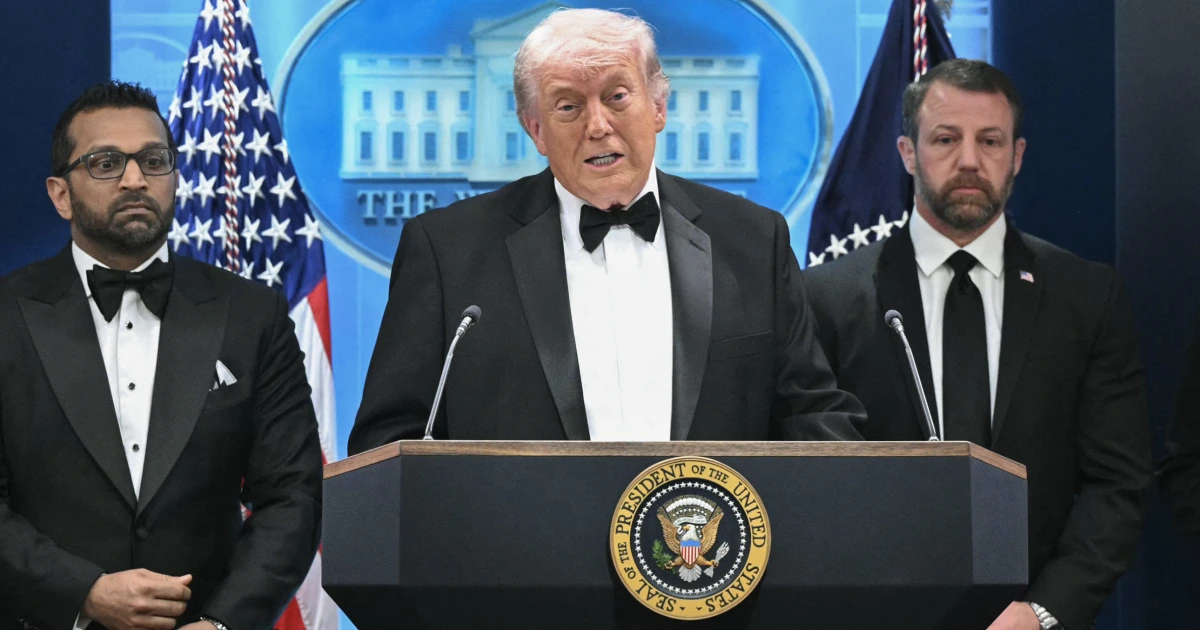
White House Correspondents’ Dinner Shooting Leads to Evacuation
President Donald Trump, Vice President J.D. Vance, and several other administration officials were evacuated following a shooting incident at the White House Correspondents’ Association dinner on Saturday night.
An armed individual managed to enter a security checkpoint at the Washington Hilton Hotel, resulting in a shootout with police. The suspect is currently in custody.
Details Emerge About the Suspect
The shooter has been identified as 31-year-old Cole Thomas Allen from Torrance, California. A federal source familiar with the case informed NBC News that Allen holds multiple titles, including mechanical engineer, video game developer, and educator, and was recently awarded the title of “Teacher of the Month” for 2024.
Acting Attorney General Todd Blanche stated on “Meet the Press” that authorities believe Allen traveled by train from Los Angeles to Chicago, and then from Chicago to Washington, D.C. During this trip, he checked into the hotel where the correspondents were dining just days prior to the incident.
According to a senior administration official, preceding the shooting, Allen expressed anti-Trump views and sent texts to his family indicating his intent to target administration officials.
Multiple Weapons Found with Suspect
Officials reported that Allen had no prior criminal history and was not known to law enforcement. He was found in possession of a shotgun, a handgun, and multiple knives, with the firearms having been purchased legally, as confirmed by law enforcement sources.
In the course of the exchange of gunfire, a Secret Service agent sustained injuries but has since been discharged from the hospital, with no further injuries reported. Washington, D.C. attorney Jeanine Pirro indicated that Alan would face charges including two counts of using a firearm in a violent crime and two counts of assaulting a federal officer with a dangerous weapon, with additional charges anticipated.
Planned Events Postponed Amid Security Concerns
President Trump expressed to reporters his desire to continue the dinner, stating he “fought like hell” to stay at the venue. However, law enforcement concerns led to the decision to evacuate, with Trump announcing plans to reschedule the event within the next 30 days.
Diplomatic Talks Disrupted Following Security Incident
The recent shooting incident has cast a shadow over diplomatic efforts, with President Trump declaring the cancellation of a planned U.S. delegation’s visit to Pakistan. He explained that the Iranian delegation’s offer lacked sufficient merit, further complicating existing tensions in the region.
Special envoy Steve Witkoff and Jared Kushner were slated to lead the U.S. delegation to Islamabad, which has now been indefinitely postponed.
Congressional Developments and Federal Reserve Appointment
In a related political update, Senator Thom Tillis (R-N.C.) announced he would support the confirmation of Kevin Warsh as President Trump’s nominee to lead the Federal Reserve Board after previously blocking the nomination due to concerns surrounding a Justice Department investigation into Federal Reserve Chairman Jerome Powell.
Following assurances from the Justice Department regarding the closure of the investigation, Tillis indicated that he had engaged in extensive discussions to ensure that the Federal Reserve’s independence would not be compromised.
Gaza’s Hardships Persist Post-Ceasefire
As conditions worsen in Gaza over six months post-ceasefire, the humanitarian crisis deepens. Shortages of food and medicine, alongside ongoing Israeli attacks, continue to afflict the region, compounded by the threat of disease and unsanitary living conditions.
Growing Concerns Over Government Surveillance
The ongoing debate around government surveillance has intensified, particularly regarding the use of artificial intelligence. Lawmakers are increasingly apprehensive that AI technologies could amplify the government’s capacity to monitor Americans’ communications without warrants.
As discussions continue over reforms to current surveillance laws, privacy advocates caution that AI could lead to more invasive monitoring practices, sparking urgent calls for legislative action.
