


Nigerian Corporate Landscape Sees a Shift with Champion Breweries Acquisition
For nearly two decades, the narrative surrounding mergers and acquisitions (M&A) in Nigeria has primarily featured multinational corporations acquiring local firms. Heineken, Diageo, and AB InBev exemplified this trend, with Nigerian companies often serving as targets. However, 2026 marks a turning point as Champion Breweries Plc, a 52-year-old company known for its Champion Lager, has taken a bold step by acquiring an 80 percent stake in EnjoyBev BV, a Dutch entity with a portfolio of energy and ready-to-drink beverages. The acquisition, completed quietly on February 26, 2026, signifies a dramatic reversal in the traditional M&A pattern that has characterized the Nigerian market. This deal not only highlights Champion’s ambition but also sets a precedent for other local firms, representing a potential new direction for Nigerian corporate strategy.
Unfolding Landscape of Outbound M&A
Nigeria’s history with outbound M&A is limited, with notable exceptions like Dangote’s extensive ventures in the African cement market and the expansion efforts of banks like Access, UBA, and GTCO. However, Nigerian consumer goods companies have largely shied away from foreign markets, particularly in developed economies. Champion Breweries’ acquisition stands apart; this mid-sized Nigerian firm has invested in a European platform within the burgeoning global beverages sector, aiming to secure hard currency returns that are increasingly elusive in Nigeria’s public markets. Capturing revenue in euros and other foreign currencies will provide a safeguard against the naira’s volatility, a significant advantage in an environment where currency fluctuations can undermine profitability.
Financial Indicators of Growth
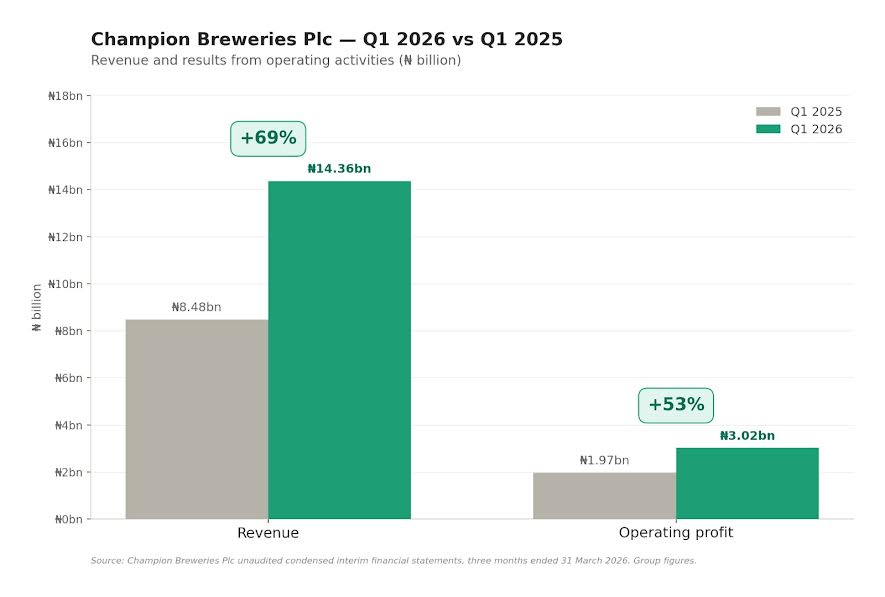
The recent quarterly results, released on April 22, provide an initial insight into Champion’s performance since the acquisition. Group revenue soared by 69 percent year-on-year, reaching N14.36 billion, up from N8.48 billion in the same quarter of 2025. Operating profit rose by 53 percent to N3.02 billion. Notably, these figures reflect only a partial contribution from EnjoyBev, as its integration began in late February. Consequently, most of the revenue growth stems from Champion’s existing Nigerian operations, with the potential for further expansion as Bullet’s contributions increase. Additionally, Champion’s balance sheet has undergone a significant transformation, with total capital climbing from N13.08 billion at the end of 2025 to N68.29 billion by March 31, 2026. This includes a substantial equity raise of N36.97 billion, as well as a repayment of N11.9 billion in debt, leaving the company with N16.07 billion in cash and a significantly improved leverage profile.
Implications for Future Corporate Strategies
The implications of the Champion acquisition extend beyond the company’s financial metrics. For years, many listed Nigerian companies have adopted a defensive stance, focusing on protecting margins and conserving cash amidst challenging macroeconomic conditions. Meanwhile, foreign investment was often viewed as a luxury. Champion Breweries, however, has chosen a proactive strategy, opting to diversify its capital structure, enter high-growth markets, and better balance its currency exposure. Other mid-cap Nigerian companies may take note of this approach, although their ability to do so will hinge on factors like capital access, managerial vision, and overall economic conditions. The energy drinks and RTD sector, where Bullet operates, is rapidly growing in popularity, benefiting from strong consumer trends in both European and African markets.
Anticipation for the Upcoming Quarter
The second quarter of 2026 is poised to be particularly significant, as it will be the first comprehensive reporting period for Champion Breweries as a fully integrated entity, showcasing three complete months of Bullet’s contributions. Analysts will closely examine this period to gauge the true run-rate of the newly restructured Champion Breweries as it embarks on its journey as a multinational corporation. This development has broader implications for Nigeria’s corporate environment, historically defined by inbound trade flows. While the overall landscape may not be shifting dramatically yet, the developments in Akwa Ibom suggest that a new current is forming.
