


Zenith Bank and Other Banks Experience Surge in AMCON and NDIC Expenses
In 2025, Zenith Bank and seven other Depository Banks (DMBs) allocated approximately N993.34 billion towards expenses related to the Asset Management Corporation of Nigeria (AMCON) and the Nigeria Deposit Insurance Corporation (NDIC). This represents a significant increase of 38.62% from the N716.5 billion spent by these banks in 2024, reflecting the mounting operational costs within the financial sector.
The banks involved in this expenditure are Zenith Bank Plc, First Holdco Plc, FCMB Group Plc, Guaranty Trust Holding Company Plc (GTCO), United Bank for Africa Plc (UBA), Wema Bank Plc, Stanbic IBTC Holdings Plc, and Access Holdings Plc.
Detailed Breakdown of 2025 Contributions
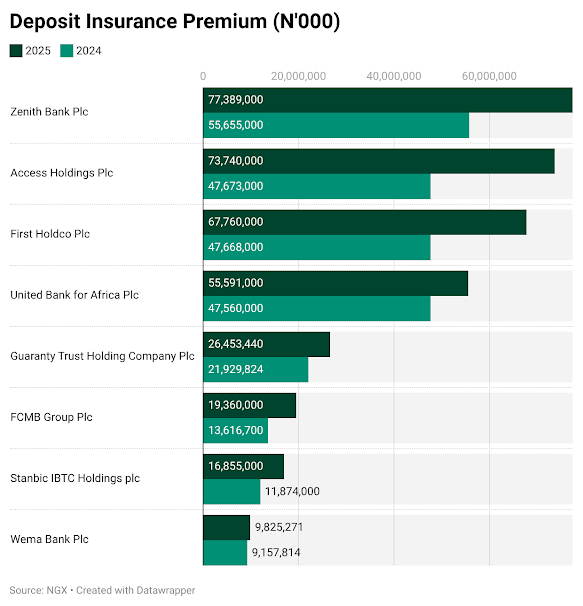
An analysis of the banks’ audited and unaudited financial results for the fiscal year ending December 31 reveals that AMCON’s levy for 2025 was N646.88 billion, up from N448.87 billion in 2024. Additionally, deposit insurance premiums rose by 29% to N346.46 billion in 2025, compared to N267.65 billion the previous year. These increases signal a growing trend in banking sector resolution costs linked to the AMCON levy, which is calculated as 0.5% of a bank’s total assets, including off-balance sheet assets, as per the AMCON Act of 2015.
Importance of Financial Sector Stability
The critical role of the financial services sector, particularly regarding public funds, underscores the necessity for protective measures in the event of bank failures or liquidations. This need highlights the importance of deposit insurance, which serves to safeguard public finances while facilitating stability in the banking landscape. The framework of deposit insurance and AMCON levies is designed to protect public funds and promote confidence in Nigeria’s banking sector.
NDIC and Bank Contributions
Deposit insurance premiums are mandated payments made by banks that accept deposits, with the NDIC acting as the insurance provider responsible for covering depositors’ funds up to a legal maximum of 5 million naira in case of bank insolvency. As expected, banks with substantial deposits tend to contribute the most in terms of NDIC premiums, although the amount can vary based on their individual pricing mechanisms.
Individual Bank Performance on AMCON and NDIC Payments
A recent analysis indicated that Access Holdings bore the highest AMCON levy in 2025, while Zenith Bank was responsible for the largest deposit insurance premium. According to their audited 2025 financial results, Access Holdings, with total assets of N51.56 trillion, paid an AMCON levy of N154.33 billion—a 37.5% rise from N112.23 billion in 2024. In the same year, Access Holdings’ NDIC premiums climbed to N73.7 billion, reflecting a 54.7% increase from N47.67 billion.
For Zenith Bank, the NDIC premium amounted to N77.39 billion in 2025, marking a 39.1% increase from N55.7 billion in the previous year. The bank also contributed N142.59 billion as an AMCON levy, a notable increase of about 55% from N92.2 billion in 2024. Recent findings suggest that First Holdco is expected to join the ranks of the top three Tier 1 banks facing elevated AMCON and NDIC levies in the upcoming year.
AMCON’s Establishment and Funding Mechanism
Founded in 2010, AMCON aims to stabilize Nigeria’s banking system by effectively resolving the non-performing assets plaguing banks. The corporation is currently funded through a combination of loan recoveries, contributions from the Central Bank of Nigeria (CBN), and sales of collateralized assets, as well as sinking funds assessed by banks themselves. Initially, AMCON was designed for a 10-year term in response to an urgent need to curb non-performing loans and avert the potential collapse of the banking sector. The AMCON Act 2019 (as amended) empowers the corporation to pursue debtors for outstanding liabilities and facilitate the efficient disposal of eligible bank assets.
Stakeholder Perspectives on AMCON Levies
Opinions among stakeholders regarding the 0.5% tax imposed by AMCON on banks are mixed. Investment banker Tajudeen Olayinka expressed concern that AMCON’s ongoing imposition of annual levies indicates that it is struggling to meet its debt obligations. He criticized the establishment of AMCON, stating that alternative resolution strategies could have been more effective in managing distressed banks. According to Olayinka, this situation is a legacy issue stemming from decisions made during the tenure of former CBN Governor, Sanusi Lamido Sanusi.
