


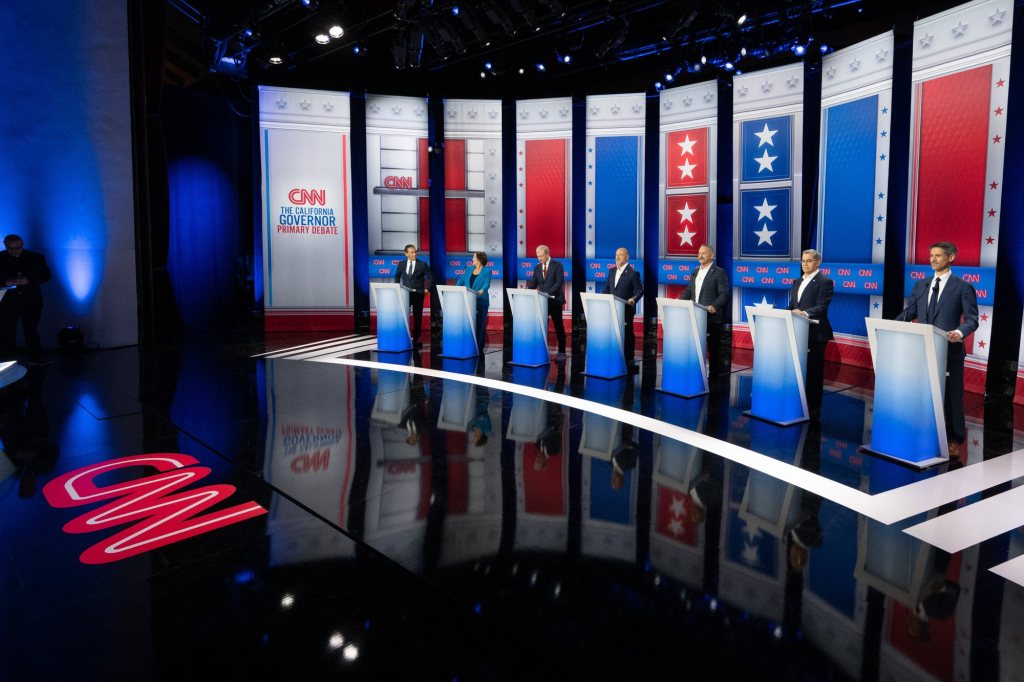
Candidates Clash Over Key Issues in California Gubernatorial Debate
The latest debate among California’s gubernatorial candidates highlighted a range of critical topics, including health care, immigration, affordability, and the influence of former President Donald Trump. The event, broadcast live on CNN from East LA College, featured prominent figures such as Chad Bianco, Steve Hilton, Xavier Becerra, Matt Mahan, Katie Porter, Tom Steyer, and Antonio Villaraigosa. After a notably tense exchange at Pomona College just a week prior, the candidates engaged in a two-hour discussion that quickly turned contentious.
Immigration Takes Center Stage
Immigration emerged as a particularly divisive issue throughout the debate. Hilton, representing Republican viewpoints, faced sharp criticism from several Democratic candidates. Notably, Republican commentators refrained from committing to the deportation of undocumented farm workers in California, suggesting that such decisions should rest with the presidency rather than the state governorship. Porter countered these remarks, asserting that it is indeed a governor’s responsibility to protect all Californians.
Disagreement Over Sanctuary Policies
Bianco, the only Republican present, argued against state sanctuary policies, which limit cooperation between local law enforcement and federal immigration authorities. Villaraigosa challenged Bianco’s understanding of these laws, emphasizing that they were not enacted to shield violent offenders. This exchange underscored the candidates’ contrasting views on public safety and immigration enforcement. Bianco urged Villaraigosa to justify protections for families of individuals harmed by undocumented immigrants, to which Villaraigosa firmly responded that anyone who commits murder, regardless of their immigration status, must face justice.
State-Level Accountability and Health Care Debates
In addition to immigration, the debate further explored issues related to health care, climate change, and housing. The candidates were at odds over a proposed tax targeting billionaires, which will be on the ballot in the upcoming general election. Since Steyer supported the measure while Porter opposed it, tensions rose. Steyer, who himself is a billionaire, remarked that the proposal was insufficient, indicating that tax reforms require more aggressive measures to effectively address California’s financial challenges.
Character and Controversy Surface
The debate also touched on candidates’ past actions and affiliations. Villaraigosa confronted Bianco about his prior involvement with the Oath Keepers, a group known for extremist views, to which Bianco defiantly responded with pride. While he later attempted to downplay his association, the discussion brought accountability into focus, especially after multiple candidates scrutinized Becerra’s handling of the Department of Health and Human Services regarding the welfare of immigrant children.
Polling and Political Landscape
Recent polling indicates a complex political landscape in California, highlighting the popularity of candidates like Becerra and Hilton, each polling at 18%, with Bianco at 14% and Steyer at 12%. This data reflects a growing concern among Democrats regarding their positions in such a crowded field. With concerns that Republican candidates like Hilton and Bianco might advance in California’s non-partisan jungle primary, the stakes are high for all participants.
Anticipation for Future Debates
As the primary date of June 2 approaches, the candidates are set to engage in another debate hosted by KNBC Channel 4, Telemundo’s KVEA Channel 52, and Loyola Marymount University. California’s voter registration shows a significant Democratic advantage, but the mix of personalities and issues promises a competitive election season. Registered voters have begun to receive their ballots, setting the stage for a critical decision that will shape California’s political future.
