


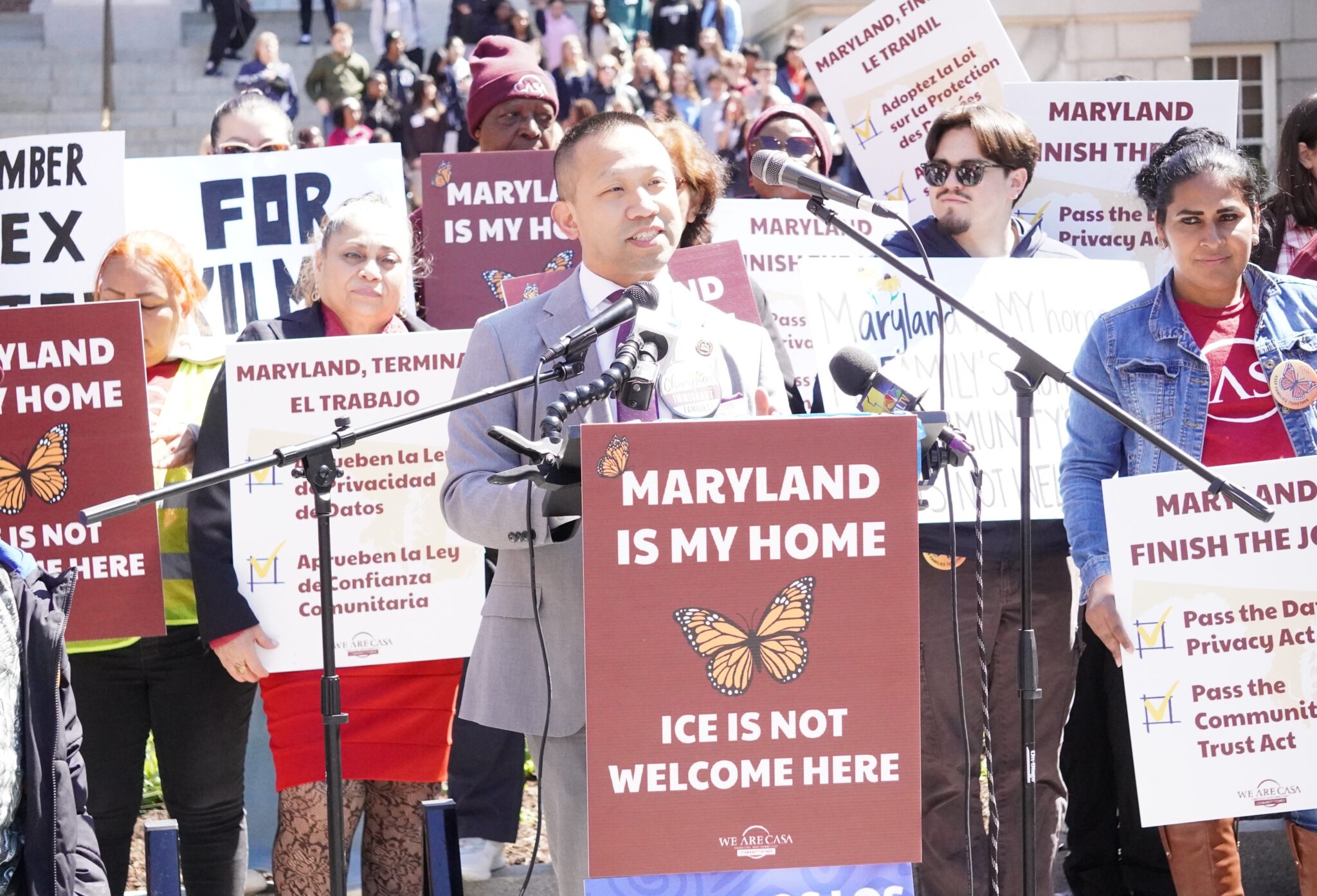
Advocacy Groups Urge Governor to Sign Key Immigration Bills
On Monday, a coalition of twenty immigrant advocacy and civil rights organizations reached out to Governor Wes Moore (D), prompting him to endorse two critical immigrant protection bills that were passed during the final day of the 2026 legislative session.
The Community Trust Act and Data Privacy Act were significant priorities for advocates throughout the session, yet remain unsigned as the deadline for the year’s last bill signing approaches next week.
Several additional immigrant protection measures introduced this session, including one aimed at repealing the 287(g) agreement and restricting the establishment of immigration detention centers, have already received gubernatorial approval. However, the remaining two bills are described in the letter, spearheaded by the advocacy group We Are CASA, as vital steps in ensuring the full protection of Maryland residents.
In the letter, advocates highlighted the attention Maryland is receiving, stating, “Just as advocates and families across the country have looked to states like Illinois and California for leadership, many are now looking to Maryland to help set the standard.” They urged the Governor to continue guiding Maryland and, by extension, the nation, by signing these bills into law.
The governor’s office did not provide a comment regarding the status of the bills on Monday.
Key Provisions of the Community Trust Act
The Community Trust Act, introduced by Senator Clarence Lamb (D-Anne Arundel, R-Howard), serves as an emergency measure restricting local and state police from detaining individuals for the purposes of U.S. Immigration and Customs Enforcement (ICE), with limited exceptions. These exceptions apply to individuals who are registered sex offenders, those serving a sentence of 12 to 18 months in state prison, or individuals convicted of crimes in other states with sentences of at least five years.
The legislation primarily prohibits the use of administrative warrants by ICE for detaining individuals, allowing local officials to require only judicial warrants for such actions.
The Community Trust Act is expected to enhance previous emergency legislation enacted earlier that prohibits 287(g) agreements between ICE and local law enforcement agencies.
Senator Lamb noted, “The Community Trust Act effectively closes a loophole that became evident after the passage of the 287(g) law, due largely to the remarks from local sheriffs. This bill is essential to ensure that local jails and law enforcement agencies are not creating informal opportunities for ICE to intervene.”
Following the implementation of the prior law, all nine Maryland sheriffs who had signed 287(g) agreements eventually opted to abandon their collaborations with ICE, despite initial indications that some may continue working with the agency informally or challenge the legislation.
Concerns Surrounding Potential Legal Conflicts
Reports indicate that sheriffs are currently evaluating legal options regarding how the Community Trust Act may restrict their communication with federal authorities and whether it might compel them to navigate any conflicts between federal and state laws. Washington County Sheriff Brian Albert and others have expressed their anticipation of a potential veto from the governor concerning this legislation.
Key Goals of the Data Privacy Act
The Data Privacy Act, championed by Representative Lorig Chalkudian (D-Montgomery), seeks to amend the state’s public information law by preventing companies from selling individuals’ personal data “for immigration purposes.” A Senate version of the Data Privacy Act, supported by Senator Lamb, was passed in the Senate but did not gain approval in the House.
Over 100 witnesses provided testimonies on the House bill, with a majority expressing support. However, there were concerns among opponents that the bill might weaken public information protections and impose a burden on state officials to ascertain whether data requests are for immigration-related use.
The Impact of These Legislative Measures
We Are CASA emphasized that “Together, these bills deliver a powerful one-two punch: restoring trust between communities and law enforcement while shutting down data pipelines that are being exploited to target immigrant families,” in a press release accompanying the letter.
Once signed into law, the Community Trust Act will take immediate effect as an emergency measure, while the Data Privacy Act is set to come into effect on July 1, should it receive the governor’s approval.
“These bills are crucial for our communities and must be signed,” Lamb asserted on Monday. According to state guidelines, the majority of bills passed by the General Assembly should be presented to the governor within 20 days following the session’s adjournment (April 13 this year), granting the governor a 30-day window to either sign, veto, or allow the bills to become law without a signature.
Albert indicated on Friday that if the governor permits the bill to become law without endorsing it, it would take effect by June 3. “We are contemplating several legal actions; it feels like we are in a no-win situation,” he added.
