


New Initiative to Support Refugees in Education
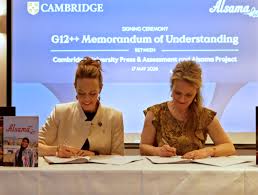
Cambridge University Press and Evaluation has partnered with the Alsama Project to create new educational qualifications aimed at assisting refugee and displaced young people in gaining access to higher education, vocational training, and employment in Nigeria and globally.
Launch of the G12++ Qualification
This agreement, formalized during the World Forum on Education in the presence of representatives from UNESCO and the UK Foreign, Commonwealth and Development Office, will facilitate the introduction of the G12++ qualification. This alternative to traditional secondary school exit qualifications is specifically designed for youth whose educational journeys have been disrupted by conflict or displacement.
The Displacement Crisis
Nigeria is currently home to approximately 3.6 million forcibly displaced individuals, contributing to a staggering global total of around 117.3 million displaced persons, including 49 million children. The dire statistics reveal that merely 9% of refugees worldwide have access to higher education, a stark contrast to the global average of 42%.
Development of Recognized Learning Alternatives
The G12++ qualification was established by the Alsama Project, a non-governmental organization operating in the Shatila refugee camp in Beirut, Lebanon. This initiative aims to provide displaced youth with officially recognized proof of learning that takes place outside traditional educational frameworks.
Helping Young People Reclaim Their Futures
Jane Mann, managing director of the Cambridge Education Partnership, highlighted the significance of this initiative in restoring educational and employment opportunities for displaced youth. She emphasized the need for global qualifications that help young individuals rebuild their future after being forced to abandon their education.
Expanding Global Reach and Visibility
Following the initial G12++ examination in the Shatila refugee camp in February 2026, in which many students successfully qualified, the partnership aims to enhance the qualification’s offerings. This will include increasing its visibility among universities and employers, engaging governments and international organizations, and securing funding for broader implementation.
Empowering Displaced Youth
Meike Ziafogel, co-founder and CEO of the Alsama Project, characterized this partnership as a pivotal advancement for displaced youth, who frequently lack access to education beyond traditional systems. She stressed the importance of raising awareness about the competencies and potential of these young individuals.
Personal Aspirations and Academic Goals
Syrian refugee student Wissal Al Jaber shared her desire to study psychology, highlighting how the G12++ qualification offers her a pathway to pursue her academic dreams despite her interrupted education. Professor Bhaskar Villa from the University of Cambridge underscored the initiative’s role in demonstrating the feasibility of quality assessments for displaced learners worldwide, labeling G12++ as a transformative opportunity for refugee youth and the global education community.
