


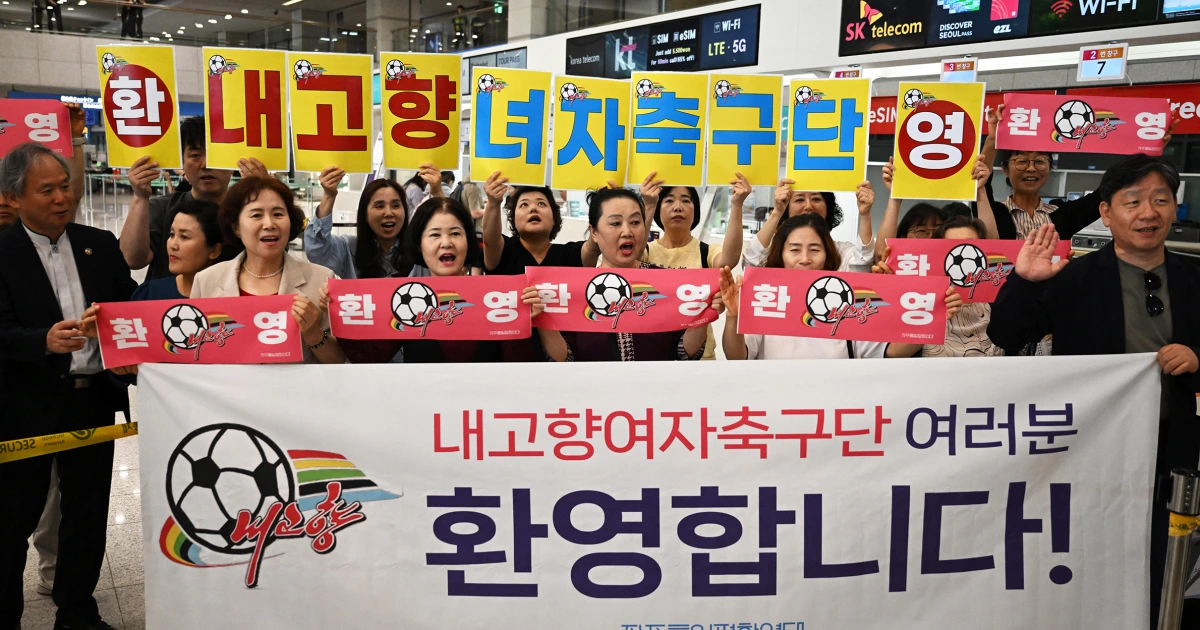
North Korean Women’s Soccer Team Visits South Korea for Historic Match
In a significant sports moment, North Korea’s women’s soccer team is set to play in South Korea on Wednesday. This marks the first visit by a sports team from the isolated nuclear-armed nation to the democratic South in nearly eight years, underscoring the ongoing complexities of inter-Korean relations.
High Stakes and National Pride
The upcoming match has generated considerable excitement and serves as a prominent showcase for Kim Jong Un’s regime, highlighting its ambition to strengthen ties with South Korea, a country with which it remains technically at war. The event not only symbolizes a rare sports encounter but also reflects broader political themes including nationalism and diplomacy.
Kim Jong Un’s Stance on South Korea
Despite this sporting event, Kim has intensified a confrontational stance towards South Korea, designating it as the North’s “main enemy.” He has dismissed various overtures for dialogue from South Korea’s liberal President, Lee Jae-myung, complicating the narrative surrounding the match.
Competition Highlights
Naegohyang, the North Korean team, will compete against South Korea’s Suwon FC Women in the semi-finals of the Asian Football Confederation Women’s Champions League. This encounter holds a potent mix of athleticism and political symbolism, as the teams battle not only for victory but also for national pride.
Public Interest in the Match
Interest in the event is soaring, with general admission tickets quickly selling out, indicating strong public engagement. In addition, approximately 3,000 spectators, organized by citizen groups backed by the Seoul Ministry of Unification, will support both teams from the stands, emphasizing the match’s significance beyond mere sport.
Expectations from Coaches and Analysts
Ri Yu-il, the coach of North Korea’s team, has remarked that the focus remains solely on the game and not on the external political ramifications. Analysts suggest that North Korea may utilize this event to project strength and stability, while concurrently, South Korea’s liberal factions may see it as a chance to fortify diplomatic ties.
Potential for Future Dialogue
Experts like Lim Eul-chul from Kyungnam University underline the importance of such events as potential catalysts for improved relations, reflecting the minimal yet vital channels of communication that remain open between the North and South. However, some caution that North Korean athletes might be subject to increased restrictions during their stay, limiting their interactions with Southerners.
The Role of Sports Diplomacy
Historically, sports diplomacy has played a pivotal role in fostering ties between the two Koreas. Notable historical moments include the formation of a joint table tennis team in 1991, as well as appearances under the unification flag at various international events. The last time North Korea’s national women’s soccer team visited South Korea was over a decade ago during the 2014 Incheon Asian Games, emphasizing the rarity of this current occasion.
