


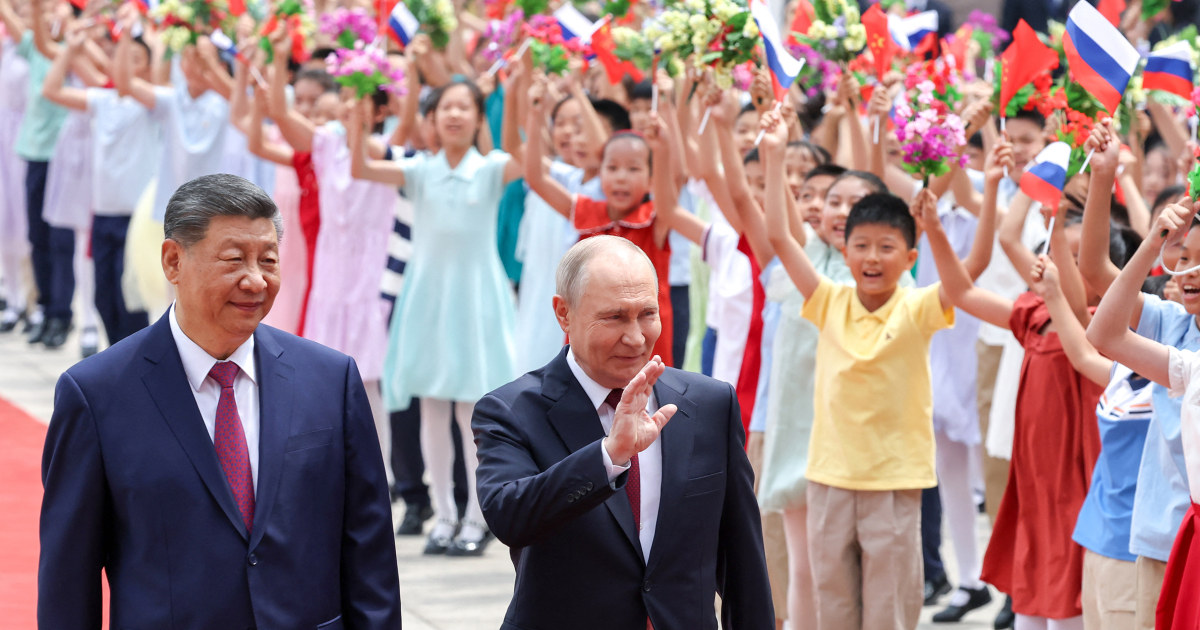
Xi Jinping and Vladimir Putin Strengthen Ties in Beijing
HONG KONG – Chinese President Xi Jinping met with Russian President Vladimir Putin in Beijing on Wednesday, shortly after welcoming U.S. President Donald Trump. Xi emphasized that Sino-Russian relations are currently at a “historic high.”
During the bilateral meeting, Xi remarked on the significant changes in the global landscape, stating, “The international situation is undergoing major changes, and the world faces the danger of reverting to the survival of the fittest.” He asserted that cooperation between China and Russia serves as a stabilizing force in an increasingly chaotic world.
Prior to their discussions, President Xi greeted President Putin during a ceremony outside the Great Hall of the People, reminiscent of the official welcome given to President Trump. The event featured military honors, including a band playing the national anthems of both nations and a 21-gun salute fired in Tiananmen Square.
Putin’s two-day visit to China is aimed at reinforcing a crucial alliance, particularly in light of Trump’s recent visit, which has stirred tensions between Beijing and Washington. While neither leader made direct references to the U.S., Xi seemed to critique the current global dynamics when he remarked on the increase of “unilateral hegemony.”
Both leaders expressed criticism of the ongoing U.S.-Israel conflict, with Xi condemning it as a breach of international law. He has consistently called for de-escalation to mitigate disruptions to global energy supplies. Putin highlighted that the Sino-Russian relationship had reached an “unprecedented level,” emphasizing Russia’s role as a reliable energy partner amidst turmoil.
In addition to these commitments, Xi and Putin reaffirmed their dedication to a “comprehensive strategic partnership” and advocated for a multipolar world. They also agreed to extend the China-Russia Treaty of Friendship, originally signed in 2001.
Details of the U.S.-China Agreement Revealed
In a related development on the same day, China’s Ministry of Commerce disclosed details of a U.S.-China accord previously outlined by the White House. This includes China’s commitment to purchase 200 aircraft from Boeing, marking the first significant deal with the U.S. in nearly a decade.
The ministry reported that the U.S. government would provide “adequate supply guarantees” for aircraft engines and parts, which have been a point of contention. Furthermore, China plans to restore market access for U.S. beef and resume poultry imports from regions deemed free of bird flu, while establishing trade and investment committees to facilitate tariff discussions.
Neither the U.S. Commerce Department nor the Foreign Department confirmed a reported agreement for China to acquire $17 billion in U.S. agricultural goods annually through 2028. Meanwhile, U.S. Treasury Secretary Scott Bessent noted that there is “no hurry” to extend the tariff ceasefire with China, hinting at a stabilized situation.
United Nations Secretary-General António Guterres commented on the recent Xi-Trump summit, indicating that while tensions seemed to ease, the absence of a substantial agreement heightened the importance of a potential visit to Washington by President Xi in September.
Looking ahead, meetings between Trump and Xi could occur multiple times this year, with Xi potentially attending the G20 summit in Miami in December and Trump visiting China for an APEC summit in November. Russian officials suggested that a Trump-Putin meeting may also be on the agenda during the APEC summit.
