


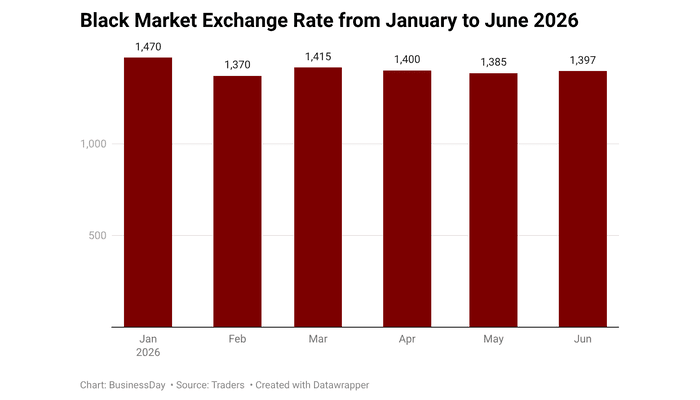
Black Market Interest Rate Drops to Naira 1,425/$
Nigeria’s currency, the naira, faces renewed pressure in the parallel foreign exchange (FX) market due to rising seasonal demand for dollars, driven primarily by summer travel, overseas tuition payments, and business travel. This has resulted in a widening gap between the official exchange rate and the black market rate.
Data from currency dealers indicates that after appreciating to approximately 1,370 naira per dollar in February 2026, the naira has depreciated to 1,425 naira per dollar as of Thursday—a drop of 55 naira or 3.86 percent. Consequently, the disparity between the official and parallel market rates has expanded to around 46 naira, up from the almost negligible difference recorded just four months prior.
In contrast, the naira remained relatively stable in the official market. According to figures from the Nigerian Foreign Exchange Market (NFEM), the local currency closed at 1,378.43 naira per dollar on Thursday, reflecting a modest increase of 64 kobo from 1,379.07 naira per dollar the previous day. During the trading session, the highest bid rate reached 1,380 naira per dollar.
Despite the pressures from the parallel market, Nigeria’s foreign exchange reserves continue to grow, providing the Central Bank of Nigeria (CBN) with resources to bolster the naira and service external debts. As reported on the CBN website, total reserves rose to $51.71 billion as of July 8, 2026, marking a significant increase of 38.71 percent compared to $37.28 billion during the same period in 2025.
Ayokunle Olubunmi, Head of Financial Institutions Ratings at Agusto & Company, attributed the recent market fluctuations to seasonal demand. He noted that this increase is largely driven by costs associated with summer travel and educational expenses. Additional factors, such as the impact of Dangote’s IPO and ongoing pre-election political activities, have also contributed to heightened foreign exchange demand.
Professor Uche Uwaleke, a capital markets expert at Nasarawa State University and President of the Nigerian Institute of Capital Markets, echoed this sentiment. He acknowledged that seasonal pressures typically amplify the demand for foreign exchange but emphasized that these factors alone cannot fully elucidate the widening gap between the official and parallel market exchange rates.
Uwaleke explained that the increasing disparity often stems from a combination of elements, including a limited supply in the official market, expectations of further naira depreciation, delays in portfolio transactions, and speculative dollar purchases. “While school fees and summer travel contribute to the pressure, they do not comprehensively account for the significant difference in exchange rates,” he noted.
The CBN’s February 2026 Monthly Economic Report revealed a decline in net foreign exchange inflows, which fell to $6.92 billion from $9.22 billion in January. During the same timeframe, total foreign exchange inflows decreased from $12.23 billion to $9.43 billion, alongside a drop in total foreign exchange outflows from $3.01 billion to $2.5 billion. The report highlighted that demand for foreign currency remains heavily concentrated in the productive sectors, with the industrial sector accounting for nearly 38 percent of exchange usage for visible imports, followed by industrial products and petroleum goods.
In response to the ongoing challenges in the FX market, the CBN introduced adjustments to its cashless policy regarding Personal Travel Allowance (PTA) and Business Travel Allowance (BTA) in May. Effective June 1, 2026, the revised framework allows for 75 percent of PTA and BTA disbursements to be processed electronically, with 25 percent available in cash, partially reversing earlier mandates for electronic-only transactions.
The newly revised exchange manual also enhances various provisions, including increasing the prepayment allowance for imported goods from 15 percent to 30 percent, offering free processing of Form NXP, and permitting tuition payments up to $25,000 per semester for studies abroad, among other changes. CBN Governor Olayemi Cardoso stated that these revisions aim to align Nigeria’s foreign exchange management with international best practices, enhancing transparency and operational efficiency while fostering investor confidence and strengthening the overall macroeconomic framework.
