


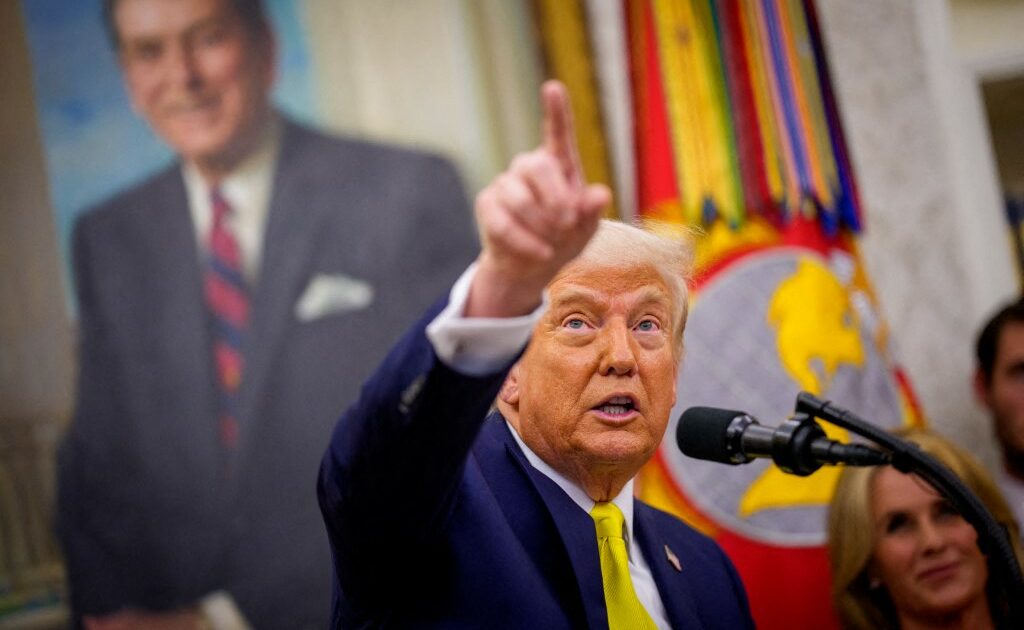
Nigerians living in the US share their thoughts with BIODUN BUSARI on the expiry date of the three-month single-entry nonimmigrant visa imposed by US President Donald Trump on Nigerian applicants
Nigerians in the US argued that President Donald Trump’s administration has the right to conduct any foreign policy in the best interests of the American people.
They made this point in reaction to a new non-immigrant restrictive policy that imposes a three-month single-entry visa on Nigerians wishing to travel to the United States.
On Tuesday, the U.S. Department of State, through its embassy in Abuja, announced updates to its nonimmigrant visa policy for Nigerian applicants.
“The US government would like to emphasize that, as is the norm worldwide, visa reciprocity is an ongoing process and is subject to review and changes at any time, including increasing or decreasing permitted entry and validity period,” the US government said in a statement.
The federal government on Thursday reacted, condemning US government claims that Nigeria had not complied with its five-year multiple entry visa policy.
In a statement by Bayo Onanuga, Special Assistant to President Bola Tinubu on Information and Strategy, the President described the allegations as “misinformation and fake news”.
“We would like to reiterate that the U.S. government’s claims of reciprocity as the reason for its current visa policy toward Nigeria do not accurately reflect the actual situation,” the statement read.
Some Nigerians living in the US spoke to Punch Diaspora Tales about the visa-restrictive policy. The policy took effect immediately, but did not cover those issued before July 8, 2025.
Dr. Tina Ekayeme, a North Carolina-based oncology researcher, said the U.S. move will cause the Nigerian government to adjust its policies toward Americans and other foreign nationals.
He noted that countries with benign or friendly visa entry policies are business-oriented, thereby attracting foreigners, and the Nigerian government should adopt this as a means to help the country grow through tourism.
“I think this is a reciprocal policy, a kind of retaliation. The United States gave Nigerians multiple-entry visas, but Nigeria did not do the same. The American government extended it from two years to five years.”
“But what did the Americans get in return? They can’t afford to spend exorbitant amounts of money to go to Nigeria on a first-entry visa when Nigerians are coming to the United States on a multiple-entry visa,” Ekayeme said.
He stressed that the Nigerian government should implement visa policies that encourage foreign tourists to invest in Nigeria.
“Jamaica is visa-free for Americans. The Nigerian government should think about that. I would also like to add that they should be happy that they were not banned from entering the country,” the doctor added.
Kehinde Owolabi, a Texas software engineer, described the policy in a filing as a “diplomatic slap in the face” to the Nigerian government.
He noted that it was unclear whether the gesture should be described as retaliation, since US President Donald Trump implemented a similar policy during his first administration.
“This policy shift feels like a diplomatic slap in the face, which is to be expected since there was a similar rule during President Trump’s first term that affected many Nigerians,” Owolabi said.
He said it was unclear what happened between the two countries, but “this policy sends a strong and unfriendly signal to Nigerians who contribute meaningfully to American society.”
“The US may call it ‘reciprocity’, but I have seen no public evidence that Nigeria restricts US citizens in a similar way. If Nigeria restricts US citizens, it would be a mistake because we (Nigerians) would benefit more from the US,” he added.
However, the Texas resident insisted that Nigerians need not worry about the policy, urging those wishing to travel to be strategic and insisting that the federal government should provide diplomatic remedies to address the issue.
“My advice is not to panic and plan wisely. Now that the period is shorter, you need to be more careful about timing your travel. If you are applying for a visa now, be strategic about your travel dates and make sure you have a clear, documented purpose for your visit.”
“Also, watch out for policy shifts. Diplomatic engagement could reinstate the previous conditions. This will have a negative impact on Nigerians, so I think the Tinubu government should step in and find a solution.”
Commenting on the matter, another Nigerian resident in North Dakota, speaking on condition of anonymity, said the government’s decision may have been influenced by the large number of unimmigrant Nigerians carrying invalid travel documents, creating a burden for the U.S. government.
“The U.S. government is trying to stop the large number of nonimmigrant visa holders from Nigeria who refuse to return home after scheduled visits,” the official said.
There are many Nigerians who are overstaying their welcome, and the government is looking at ways to reduce this practice by shortening the validity and use of visas. ”
A Nigerian based in North Dakota says the Trump administration may have wanted to use the policy as a bargaining chip with the federal government on certain initiatives.
“On the other hand, the Nigerian government may be interested in what Nigeria has, which could make it difficult for the Nigerian government to visit the United States and bring the Nigerian government to the negotiating table.
“The US government knows that Nigerians are wealthy, so making it harder for them to enter the US means more money for the US government,” the official stressed.
The official warned Nigerians planning to immigrate to the US with illegal travel documents, stressing that becoming a US citizen is also a daunting task for immigrants.
“We encourage Nigerians planning to travel to the United States to visit with legal documents and to leave the country if they are required to do so, to avoid jeopardizing their potential return.
“Furthermore, staying in the United States as a citizen or green card holder is not as easy as people think. It is more stressful for undocumented immigrants because they are not employed by companies registered with the government.”
“They can’t drive a car, especially if there’s no public transportation, and they can’t get medical care,” the official said.
The official emphasized the dangers associated with staying in the U.S. mainland as an immigrant without valid documentation, saying, “Apartment managers will need complete information about your rental and employment history.
“Information such as your Social Security number must be kept on their file. Even if you could pay 12 months’ worth of rent at once, they won’t accept it from you. They would rather you pay monthly through your bank.”
“They don’t accept cash, so you need a paper trail. The system is structured so you can’t hide. So it’s going to be frustrating if you’re not in the U.S. legally.”
“Let me tell you, no legal resident wants to go to jail for an illegal alien, because harboring an illegal alien is a crime. Education is the easiest route for a family to get to the U.S., if either the husband or wife has the education and money,” the official added.
Another Nigerian resident in Maryland, who chose not to be identified, argued that the U.S. government may have implemented the policy as part of an effort to advance the Trump campaign on immigration and mass deportation.
“All countries have the right to assert foreign policy goals that are in their national interest,” the official said, adding that “President Trump has made it clear that immigration and mass deportation are key parts of his campaign promise.”
The Nigerian argued that restricting visas for Nigerians to three months and one entry appears to be an extension of his foreign policy goals. ”
The official called on the two governments to come to the negotiating table to resolve their diplomatic differences, but said Nigeria was on friendly terms with the United States.
“For Nigeria’s side, we have had very friendly relations with the United States for many years and we have shared a lot. I would like to believe that this is a diplomatic dispute that needs to be renegotiated in the interests of both sides.”
“While there may be underlying issues that we are not aware of at this time, the new visa policy is very tough for everyone involved,” the official said.
The Maryland resident added: “How will an F1 student come in on a three-month single-entry visa, or how will a businessman with multiple activities come in? I sincerely hope that the diplomatic departments of Nigeria and the United States can negotiate and come up with a clear path to a solution.”
In his advice to Nigerians, the official said: “Nigerians planning to travel should keep an eye on and listen to developments in the news and the government’s response to issues raised.”
I advise them to reschedule if necessary and understand the policy direction before embarking on new travel plans. If all goes well, within the next few weeks there may be a new negotiated outcome that is more palatable to Nigerians. ”
