


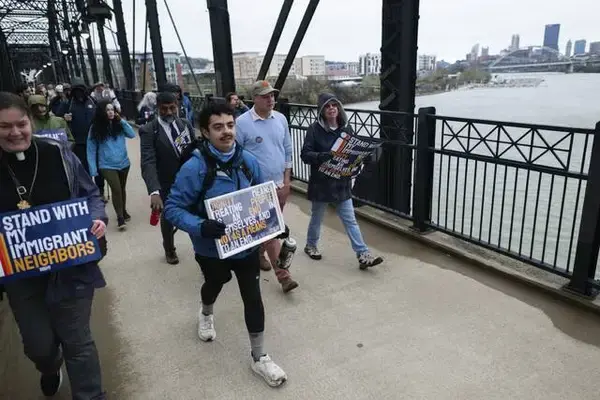
Amid the U.S. Immigration and Customs Enforcement facility on Pittsburgh’s South Side, immigrant rights activist Jaime Martinez urged local residents to recognize the humanity of their foreign-born neighbors during a gathering on Sunday morning.
Dignity is not conditional, Martinez emphasized. As the founder of the activist group Frontline Dignity, established last year, he insisted that dignity cannot be stripped away by authority figures or reinforced barriers.
Clad in a blue windbreaker, black shorts layered with tights, and white Hoka walking shoes, Martinez plans to embark on an eight-day journey covering approximately 130 miles. His destination is the Moshannon Valley Processing Center, a significant immigrant detention facility situated in Clearfield County.
“Every mile you run is a refusal to accept the status quo,” Martinez remarked, highlighting the purpose behind his demanding trek.
Around 50 activists joined him for part of the march, although only a few are expected to complete the entire route. Supporters are welcome to join along the way.
By the end of Sunday, Martinez aims to reach Monroeville, having covered 35 miles to Apollo on Monday before tackling another 34 miles en route to Indiana by Tuesday. His itinerary includes stops in North Cambria, Loretto, Tyrone, Osceola Mills, and Phillipsburg, where the detention center is located.
The march traverses rural Pennsylvania, a region notably supportive of the Trump administration’s stringent immigration policies. Carlos Mora, a Pennsylvania United organizer based in Erie, plans to join Martinez soon and aims to engage with community members who may feel compelled to stay silent due to fear.
In addressing his critics, Martinez stated, “You may believe in law and order. So are we. However, if those values come at the expense of our humanity, we risk losing the very essence that we sought to protect.”
Conditions at the Moshannon Valley Processing Center
With nearly 1,900 beds, the Moshannon Valley Processing Center stands as ICE’s largest detention facility in the Northeast. Operated by Geo Group, a Florida-based for-profit prison provider, the facility has drawn significant scrutiny.
A 2021 agreement between ICE and Clearfield County allowed for the conversion of this complex from a Federal Bureau of Prisons site to one dedicated to immigration detainees. This contract promises the county an annual income of $200,000 but is set to expire in September, leaving the commission divided on its renewal prospects.
Martinez and organizations like Frontline Dignity are advocating for the closure of the facility, citing reports from the Scherer Center for Social Justice at Temple University’s Beasley School of Law, which outline the alleged punitive and hazardous conditions detainees face.
The culmination of Martinez’s march will occur on April 12 outside the detention center, accompanied by a vigil for those currently held within its confines.
Despite ongoing advocacy, the facility remains operational, confining residents from southwestern Pennsylvania. Randy Cordova-Flores, a native of Peru, is one such detainee. His sister, Paulette Cordova, shared details of her brother’s detention experience ahead of the march. Randy has been held there since borough police referred him to ICE following a traffic stop in February. He has no criminal record and possesses a pending asylum claim.
Paulette reported that an immigration judge has yet to hear his case while Randy awaits another hearing, which could take months. The family’s legal expenses have already surpassed $25,000, leaving them feeling helpless. “We can’t help him,” she said, reflecting on their visits, which are limited to interactions through glass.
