


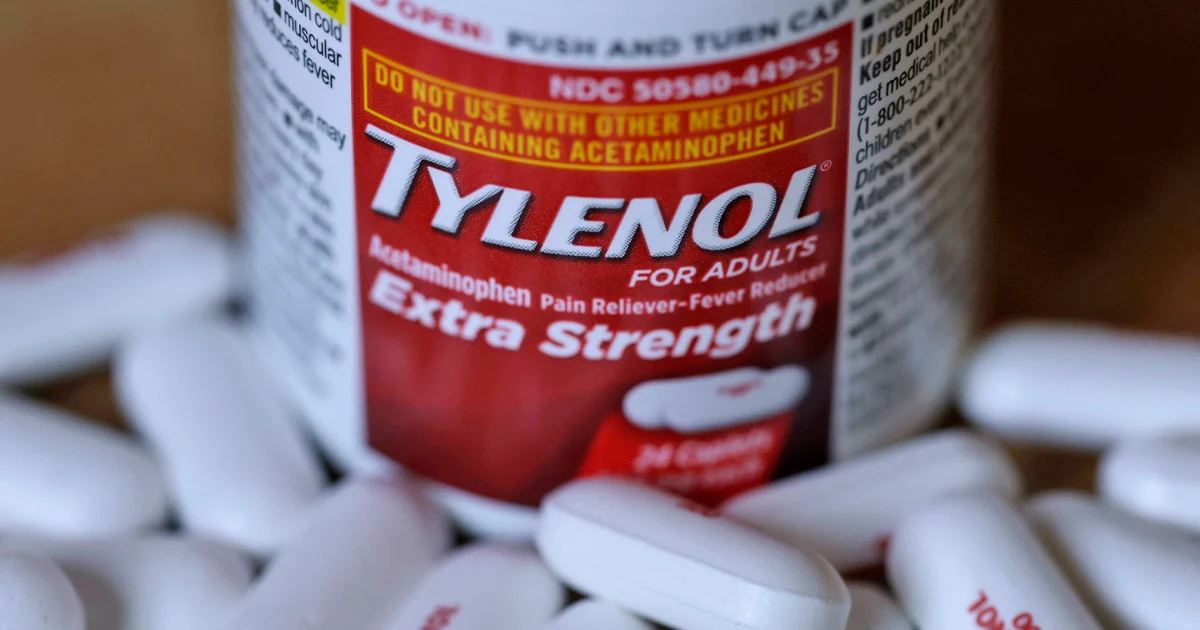
“Don’t take Tylenol. Don’t take it. Fight like hell not to take it.”
That was the message President Donald Trump and Secretary of Health Robert F. Kennedy Jr. sent in September when they announced that women should avoid Tylenol during pregnancy because of its link to autism.
At the time President Trump issued his warning, the risks had not been substantiated by solid scientific evidence. Now, a group of researchers has responded with what may be the most thorough analysis of existing science on the subject yet.
Their review, published Friday in the medical journal Lancet Obstetrics, Gynecology and Women’s Health, found no link between acetaminophen (the active ingredient in Tylenol, also known as paracetamol) taken during pregnancy and autism, attention-deficit hyperactivity disorder or intellectual disability.
The authors said they conducted the study in part to clear up confusion after President Trump’s comments, as untreated fever can pose a health risk to mother and child.
“After this declaration, many mothers were actually afraid to take paracetamol,” says Dr. Francesco D’Antonio, one of the study’s authors and professor of fetal medicine at the University of Chieti in Italy. “Actually, the day after this declaration, the number of calls and emails from women increased dramatically.”
The main takeaway from the report is that acetaminophen is safe during pregnancy, said Dr Asma Khalil, another author of the paper and a consultant obstetrician and fetal medicine specialist at St George’s Hospital in London.
“It remains the first-line treatment that we recommend for pregnant women with pain and fever,” he said in a phone call with reporters.
In a press release, The Lancet called the paper a “gold standard evidence review.”
The “Golden Rule” reference echoes language used by President Kennedy in his September announcement, when he said the National Institutes of Health would unleash “unbiased, depoliticized Golden Rule scientific research and academic freedom” in research into the causes of autism.
Four researchers not involved in the new paper praised its rigor.
“I don’t think there’s a better way to analyze the data than in the Lancet paper,” said David Mandel, a professor of psychiatry at the University of Pennsylvania.
The seven-person team from the UK, Italy and Sweden behind the new paper used three methods to evaluate research published up to September.
First, we excluded studies that did not compare pregnancies that used Tylenol with those that did not, or that did not disclose the health history of pregnant women or the medications they were taking. Also not included were studies in which women were asked to self-report whether they took Tylenol or whether their children had autism. Instead, the researchers relied only on studies that used medical records or questionnaires administered or reviewed by health care providers. Out of thousands of studies, 43 were successful.
The researchers then evaluated the studies based on their quality and whether any factors were biasing the results. They excluded studies of poor quality, such as those that did not follow study participants for long periods of time or whose health outcomes were not clearly defined.
Finally, they more closely evaluated the two most robust studies on Tylenol use and autism, each comparing large sibling groups (those exposed to Tylenol in utero and those not). Because the siblings shared genetic characteristics and grew up in roughly the same environment with the same socio-economic and educational backgrounds, the researchers could assume that those factors did not influence the study results.
All three methods reached the same conclusion. There was no association between Tylenol use during pregnancy and neurodevelopmental disorders.
“No matter how you analyze it, we know that acetaminophen does not cause ADHD, autism, or intellectual disability,” Mandel said.
Asked about the study’s findings, Health and Human Services officials said the analysis does not resolve the question of whether Tylenol use is associated with autism. The official claimed the paper falsified its findings by excluding evidence and designing a biased study that did not show a link.
“According to HHS, many experts have expressed concerns about the use of acetaminophen during pregnancy,” said department spokesman Andrew Nixon.
President Nixon specifically named Dr. Andrea Vaccarelli, dean of the Harvard T. H. Chan School of Public Health, whose review published last year in the journal Environmental Health found a link between autism and Tylenol use during pregnancy. The Trump administration cited this study as evidence of Tylenol’s supposed risks. Mr. Vaccarelli did not respond to requests for comment.
Khalil said Vaccarelli’s review and other small studies that found such an association were probably not enough to rule out confounding factors.
Mandel also said that Baccarelli’s review did not examine as many papers as the new analysis.
“At the very least, it suggests a sloppy investigation,” he said.
In the months since his initial comments about Tylenol, President Trump has gone from strength to strength, writing on Truth Social earlier this month: “Pregnant women, please do not use Tylenol unless absolutely necessary.”
But the Food and Drug Administration’s written warning to doctors (which Presidents Trump and Kennedy announced in September) simply said, “Consider minimizing the use of acetaminophen.” The warning also said the drug is the safest over-the-counter drug for reducing pain and fever during pregnancy, and said the link between Tylenol and autism is “an area of ongoing scientific debate.”
Autism researchers say there is no reason to discuss the topic further.
“The question has been answered,” said Alicia Halladay, chief scientific officer of the Autism Science Foundation. He was not involved in the new paper. “There was never a connection between acetaminophen and autism. We can stop talking about this anymore and focus on the causes of autism instead of confusing the family and continuing to blame the mother.”
