


146
Written by Tracy Moses
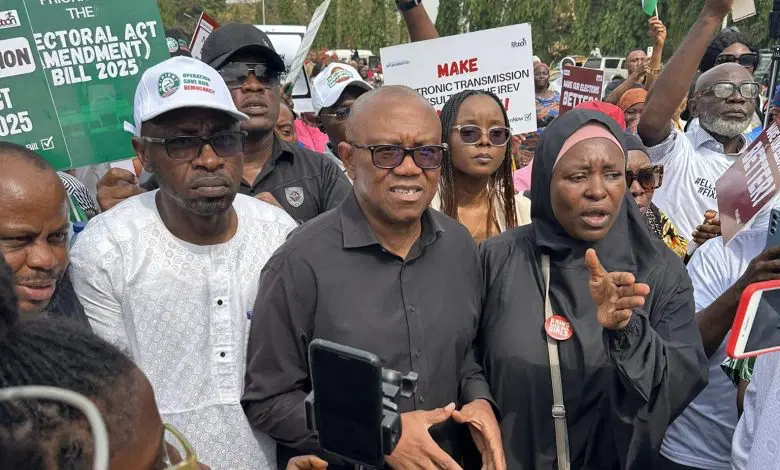
Former Rivers State Governor Rotimi Amaechi and Labor’s 2023 presidential candidate Peter Obi led thousands of demonstrators to the Abuja National Assembly on Tuesday, accusing the ruling All Progressives Congress (APC) of deliberately undermining election transparency by opposing the real-time electronic transmission of election results.
The protests followed the Senate’s decision to remove the phrase “real-time electronic transmission” from the 2026 Electoral Law Amendment Bill, which is currently before parliament, a move that has sparked widespread backlash from opposition parties and civil society groups.
The protests, tagged “Occupy of Parliament,” began on Monday, with hundreds of young people gathering at the Federal Secretariat and then marching to Parliament House, demanding the reinstatement of clear provisions guaranteeing real-time electronic transmission of results.
Amaechi, who attended Tuesday’s protest with his son, accused the APC of resisting a transparent electoral process for fear that technology-backed elections would erode its political advantage.
Speaking to reporters, the former transport minister dismissed claims that the protests were politically motivated, insisting that opposition parties have a responsibility to squarely confront the public’s demand for credible elections.
“The reason we are here is because there should be more Nigerians here,” Amaechi said. “Some people claim that politicians are sponsoring protests while children are abroad. This is my eldest son. I took him. He is a doctor. His duty is to treat anyone who may be injured.”
“If the opposition joins the protests, they will say we have hijacked the demonstrations. But what about the APC? Are they not involved? What are they afraid of?” he asked.
Earlier, Mr. Obi joined demonstrators outside the main gates of Parliament, warning that the removal of clear provisions on real-time electronic transmission would represent a dangerous setback in Nigeria’s democratic progress.
“We must dismantle this criminality and show that Nigeria can still be a beacon of hope for Africa,” Obi said, urging lawmakers to clearly provide for real-time electronic transmission of results in the revised law.
Opposition parties and civil society organizations at the rally argued that real-time electronic transmission is essential to protect the integrity of elections, limit human interference, and restore public confidence in Nigeria’s democratic process.
They noted that current electoral law ambiguities leave room for manual manipulation of results between voting bodies and collation centers, a practice that contributes to post-election disputes, prolonged litigation, and diminished voter confidence.
The agitation took on new urgency after the Senate’s decision to replace the deleted language with broader discretion for the Independent National Electoral Commission (INEC), a move that critics say weakens legal guarantees and opens elections to political interference.
Civil society groups argued that Nigeria’s recent election experience shows that technology reduces falsification of results and increases transparency when clearly backed by law.
Prominent figures at the rally included activist Aisha Yesufu. Tanko Yunusa, National Coordinator of the Global Obedience Movement. Several election reform supporters held signs that read “Our votes must be counted” and “Defend our democracy now.”
Women’s groups, human rights groups, and members of the African Democratic Congress also actively participated in the protests.
Meanwhile, the Nigeria Labor Congress (NLC) has weighed in on calls for comprehensive electoral reform, warning that failure to address the issue could trigger broader national action.
Security around the Houses of Parliament was tight, with members of the Nigeria Police Force, the Nigerian Army and the Nigeria Security and Civil Defense Corps deployed to maintain order and prevent protesters from accessing the Houses of Parliament.
