


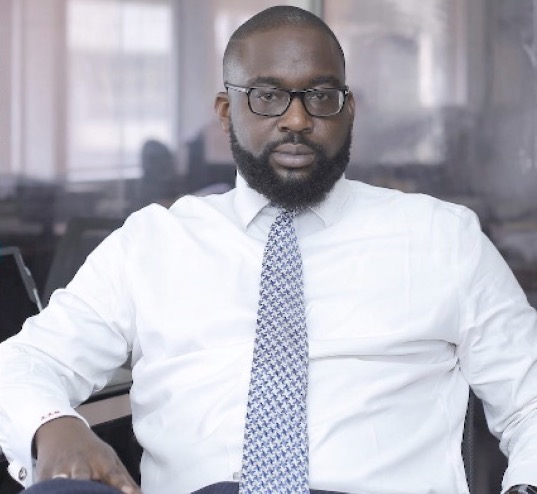
Lagos Lawyer Carves His Own Path While Honoring a Renowned Legacy
In a historic building on Broad Street in Lagos, a young professional carries the weight of a prestigious name. Abiodun Adesanya, a lawyer with a significant pedigree, is committed to not only protecting but also surpassing the legacy of his father, the late Professor Safiriyu Abiodun Adesanya. Adedayo Adejobi reports on his journey and aspirations.
The storied Bookshop House, completed in 1973 by architects Godwin and Hopwood, stands as a modernist landmark on Lagos Island. It houses Nigeria’s oldest CMS Bookshop, serving as a vital hub for the bustling old business district. For decades, this iconic structure has seen lawyers, merchants, clergy, and civil servants ascend its steps in pursuit of contracts, inspiration, and sometimes even redemption.
Dr. Abiodun Adesanya, director of the second-generation law firm established by his father, reflects on his upbringing in a household steeped in legal discussions. While he shares the same professional landscape as his father, Abiodun has his own unique presence that he seeks to cultivate.
Though following in his father’s footsteps might seem expected, Abiodun finds humor in his upbringing. “Becoming a lawyer and a pilot were the only two options I ever considered,” he says with a smile. Ultimately, the allure of law won out, although he continues to pursue his passion for aviation as a hobby and is in the process of obtaining his commercial pilot’s license.
Law was not merely a career choice for Abiodun; it was the environment in which he was raised. With a renowned professor for a father and a mother, Justice YA Adesanya, who transitioned from academia to the court, discussions at home often revolved around legal principles rather than casual chatter. It was during his education in the UK that he first recognized the full extent of his father’s influence in the field. He recalls a lecturer mentioning Professor Adesanya, leading many in his class to look his way, sparking an awareness of the legacy he represents.
The pressures of such a legacy became unmistakable following his father’s passing. At that time, Abiodun had only just completed four years as a practicing lawyer and was working on his PhD. “I put my PhD on hold and returned to manage my practice,” he explains. “There were moments of self-doubt and instances when I sought guidance from senior colleagues.”
Early in his career, the challenges that often face successors to established legal legacies became evident. His surname often preceded his arguments in court, leading some judges to challenge him to assess his knowledge and skills. An encounter with a Court of Appeal judge illustrated this; upon learning of his lineage, the judge expressed hope that Abiodun would live up to his father’s reputation. With humility, he responded, “Lord, we are doing our best. With time, we will get there.”
Despite the unavoidable comparisons, Abiodun is adamant about forging his own identity. “I don’t aspire to simply imitate my father,” he asserts. “While we share the same profession, I am focused on becoming my own person.” He honors his father’s legacy but aims to create one of his own, aspiring not just to replicate but to surpass the achievements of the past.
This vision has influenced the evolution of the family law firm, which has transitioned from being primarily focused on litigation to embracing a broader array of corporate and regulatory practices. While litigation remains a core strength, the firm has deliberately expanded its expertise. Abiodun, a Fellow of the Chartered Institute of Arbitrators, has strategically positioned the firm within emerging legal landscapes.
As a result of his academic interests, particularly in telecommunications law, the firm has forged new relationships with key players in the technology and communications sectors. Among current engagements is the representation of the Nigerian Communications Commission (NCC) in a public interest litigation against rising telecommunications tariffs. This type of work demonstrates the firm’s increasing involvement in regulatory matters and its adaptation to industry needs.
In addition to telecommunications, the firm has handled significant tax and constitutional issues, including representing the Federal Internal Revenue Service (FIRS) in a landmark dispute with Shell Oil Development Company that culminated in a substantial settlement. The firm also successfully navigated legal challenges related to the 2023 Budget Process and the provisions of the Petroleum Industry Act, affirming the constitutionality of key legislative measures.
Abiodun’s leadership reflects a shift in philosophy for the firm, moving beyond a traditional aversion to government briefs that characterized previous years. While his father was known to decline work from politically exposed persons, Abiodun acknowledges the need to adapt to changing circumstances. “My father would question my decisions, but I remind him that times have changed,” he notes.
This evolution also tackles the myth that law firms cannot survive without their founders. “Many traditional firms close when their leaders pass away,” he observes. In contrast, Abiodun believes that both preservation of legacy and innovative growth are crucial for continuity. As he has built his reputation as an independent lawyer, he acknowledges the journey of stepping out from under his father’s shadow.
Feedback from clients speaks volumes; around 75% of his clientele comprises new clients attracted during his tenure. This shift has altered the firm’s revenue dynamic, illustrating the impact of his approach to management and client relationships.
Beyond professional excellence, Abiodun reflects on the personal values instilled in him growing up. “In my family, excellence was expected,” he shares. The realization that mediocrity was unacceptable has fueled his ambition, as he strives to elevate both the family name and the standards of the legal profession. He recognizes that his legacy will be measured not only by professional achievements but by the successes of future generations, including his sister Bukola, who has also pursued a career in law.
His father’s candid discussions about mortality and responsibility served as vital preparations for leadership. In reflecting on his father’s legacy, Abiodun seeks recognition not just as the son of a prominent lawyer but as a figure of merit in his own right. “I’m still writing my story,” he affirms, aiming to be remembered as someone who made the most of his privileged start while advancing the legacy he inherited.
Outside the legal sphere, Abiodun remains connected to his passions, enjoying football, archery, horseback riding, and gaming with his children. Although he acknowledges that law may have chosen him, he retains a sense of curiosity and pursuit for other interests, including his long-standing dream of piloting aircraft.
