


Nigeria’s Trillion Naira Club Expands in 2025
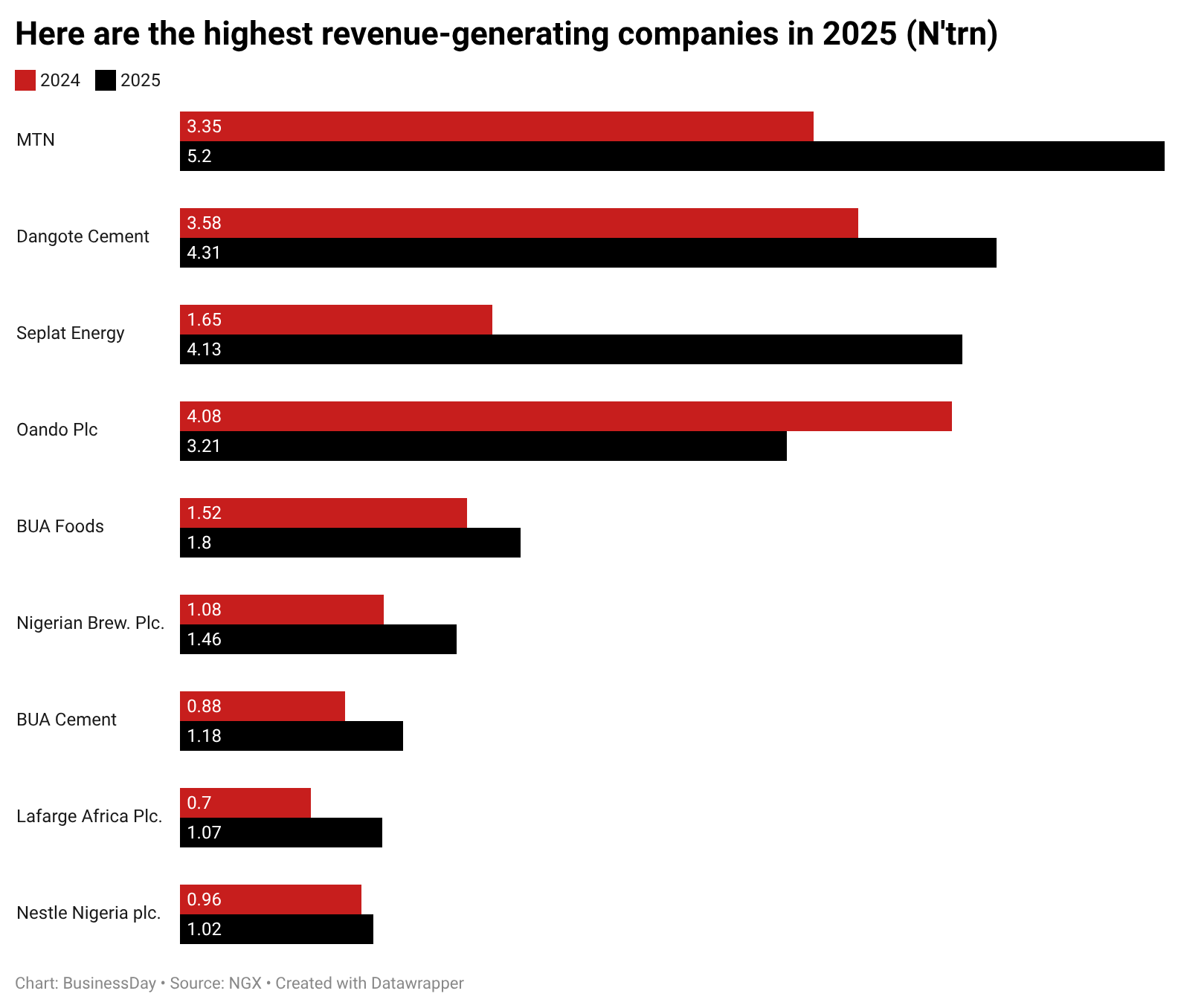
Nigeria’s business landscape sees significant developments as three major companies—BUA Cement, Lafarge Africa, and Nestlé Nigeria Ltd—have crossed the N1 trillion revenue mark in 2025. This growth is attributed to enhanced macroeconomic stability, eased inflationary pressures, and strategic price adjustments.
Impressive Financial Gains for Industry Leaders
According to the audited financial statements, BUA Cement’s revenue surged from N876 billion in 2024 to N1.18 trillion in 2025. Lafarge Africa experienced a notable boost, reaching N1.7 trillion, up from N696 billion the previous year. Nestlé also saw an increase from N958 billion to N1.2 trillion, underscoring the robust performance of these industry leaders.
Established Giants Maintain Competitive Edge
These companies now join the ranks of established giants like MTN Nigeria, which leads with a revenue of N5.2 trillion, and Dangote Cement, with N4.31 trillion, solidifying its position as Africa’s top cement producer. Seplat Energy continues to be a strong competitor as well, reporting N4.13 trillion in revenue, bolstered by increased crude oil production and favorable pricing in the energy sector.
Growth in the Fast-Moving Consumer Goods Sector
In the fast-moving consumer goods (FMCG) sector, BUA Foods achieved significant growth, with revenue rising from N1.52 trillion to N1.8 trillion, driven by strong market demand for its food products. Similarly, Nigeria Breweries Limited reported a revenue increase to N1.46 trillion, featuring price-led growth amid ongoing cost pressures.
Oando Adapts Amid Revenue Fluctuations
Despite a slight decline in revenue, Oando Plc maintained its position within the trillion-naira framework, posting N3.21 trillion in 2025 compared to N4.8 trillion in the previous year. This adjustment reflects the company’s responses to changing market dynamics and operational strategies.
Positive Economic Shift and Currency Stability
Nigeria’s economy has started to stabilize following the high volatility experienced during 2023 and 2024. This recovery accelerated after President Bola Tinubu eliminated costly fuel subsidies and unified the exchange rates. Although these policies caused an initial spike in prices and led to a sharp decline of over 70% in the naira, the currency gained 7.5% in value in 2025, marking its most stable performance in over a decade.
Inflation Trends and Business Conditions Show Improvement
Headline inflation has also receded from multi-year highs, aided by revisions and new approaches aimed at curbing inflation. The National Bureau of Statistics (NBS) reported a real GDP growth rate of 3.87% in 2025, a notable rise from 3.38% in 2024. This marks Nigeria’s strongest performance since the pandemic-related contraction of 2020, as growth gradually recovers from a low of 0.95% in 2021 and peaks at 4.32% in 2022.
Analysts Observe Sector-Wide Revenue Growth
Analysts have attributed much of the revenue growth across various sectors to strategic pricing and the gradual stabilization of the naira, which has enabled companies to better manage costs. Profitability trends reflect this positive shift, with notable improvements across key sectors. Both Dangote Cement and MTN Nigeria registered profits exceeding N1 trillion. Other companies, including BUA Cement and Lafarge Africa, also reported substantial profit increases, while firms like Nestlé and Nigeria Breweries returned to profitability after facing losses in 2024.
Private Sector Expands Amid Improved Economic Indicators
The latest PMI survey highlights that Nigeria’s private sector has returned to growth, with the composite PMI rising to 53.2 in February, up from 49.7 in January. This improvement signals enhanced business conditions, supported by a stable exchange rate that has contributed to lower input and output prices. Analysts suggest that while global conflicts may introduce new inflationary pressures, continued currency stability and a focus on local content will present opportunities for further growth in the coming years.
