


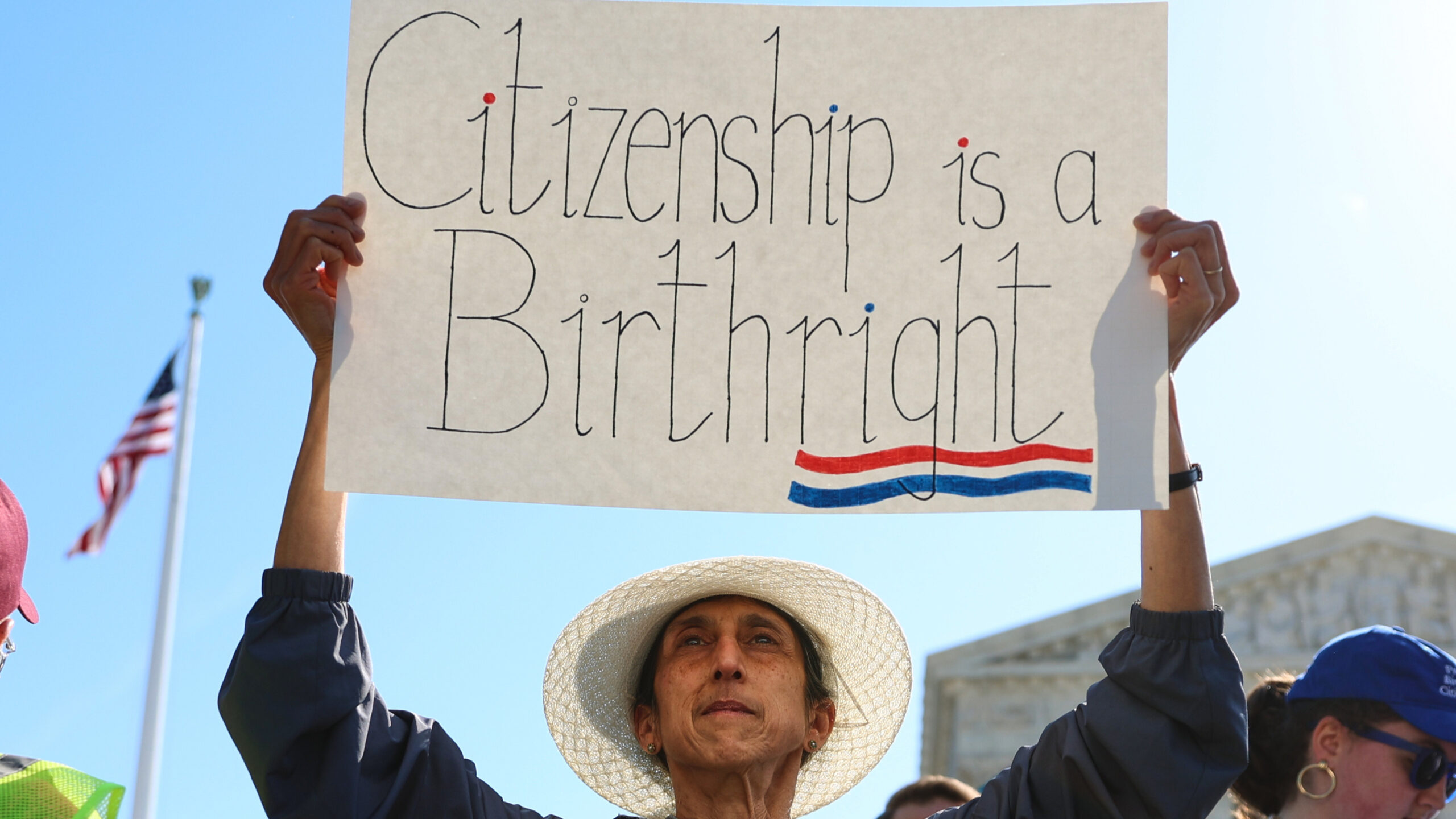
The issue of American identity and citizenship is now at the forefront of national debate.
This week, the Supreme Court deliberated on whether President Donald Trump can utilize executive orders to restrict birthright citizenship, potentially limiting the rights of children born in the U.S. to parents who are citizens or legal residents.
This could represent a significant shift in the interpretation of the 14th Amendment, which has traditionally been understood to grant citizenship to all individuals born on U.S. soil.
The conversation surrounding citizenship is deeply rooted and particularly relevant in California, where immigration history offers a unique lens on these issues.
Jane Hong, an associate professor of history at Occidental College and a scholar on U.S. immigration, shared her insights during an interview with Insight host Vicki Gonzalez, discussing the evolution of immigration policy in the Golden State.
This conversation has been edited for length and clarity.
California’s Distinct Role in Immigration History
California’s immigration landscape is notable for its diversity. While many may challenge the idea of “California exceptionalism,” its history reveals a unique narrative. From its early days, California boasted a multiethnic population, contrasting sharply with other regions, particularly the Northeast. Before the Gold Rush, indigenous peoples, Latinos, Asian Americans, and both black and white residents shaped this diverse society, which complicates contemporary discussions about race.
Today, the demographics continue to reflect this diversity. While the national average of foreign-born residents is around 15%, over a quarter of California’s population comprises immigrants, demonstrating its ongoing role as a melting pot.
Impact of Early Diversity on Immigration Policy
The formative years of California saw the emergence of laws aimed at restricting entry, which were often not only directed at black Americans but specifically targeted Chinese immigrants. Historical legislation dictated where various ethnic groups could settle, reflecting the broader tensions of the time.
Additionally, California’s pre-American roots are significant; it was once part of Mexico. Following the Mexican-American War in 1848, the region that had long been home to a sizeable Mexican population suddenly found itself under a new government. The changes did not displace existing communities but rather altered the governance of a land that continued to be inhabited by indigenous peoples.
The Complexity of Immigration Policy Through California’s Lens
California illustrates how historical contexts have shaped immigration policymaking. For instance, while it is sometimes posited that the U.S. enjoyed open borders before the late 19th century, states were actively trying to limit immigration. Massachusetts and New York sought to restrict Irish immigration, while Oregon attempted to ban black residents in the 1840s.
Federal legislation established the framework for immigration restrictions, with the late 19th century marking the onset of concerted federal efforts targeting Chinese individuals. The Immigration Act of 1882 laid the groundwork for what would evolve into a comprehensive immigration bureaucracy, subsequently impacting numerous groups beyond the Chinese population.
Racial Considerations in Immigration Legislation
Race has undeniably been a factor in the formulation of U.S. immigration policy. The passage of the Chinese Exclusion Act in the same year as the Immigration Act of 1882 underscores how racial considerations influenced legal frameworks delineating who could be part of the American identity.
Historical legislation, such as the Naturalization Act of 1790, restricted citizenship to “free white people,” establishing a precedent for racialized notions of belonging. Although these dimensions have evolved—especially with the enactment of the Fourteenth Amendment to guarantee birthright citizenship—the legacy of exclusion persists.
Understanding Birthright Citizenship Today
Currently, the United States stands among approximately 30 to 35 countries that offer unconditional birthright citizenship. Children born on U.S. soil are granted citizenship, irrespective of their parents’ status. This policy is a hallmark of America’s identity as a nation of immigrants, a concept articulated by abolitionist Frederick Douglass in the 1860s, envisioning a multiracial democracy.
Nonetheless, the path to U.S. citizenship remains arduous. Many are unaware of the extensive backlogs and lengthy waiting periods that characterize the immigration system. Historically, barriers have made the process inherently complex and often arbitrary, illustrating the need for empathy towards those navigating these challenges.
