


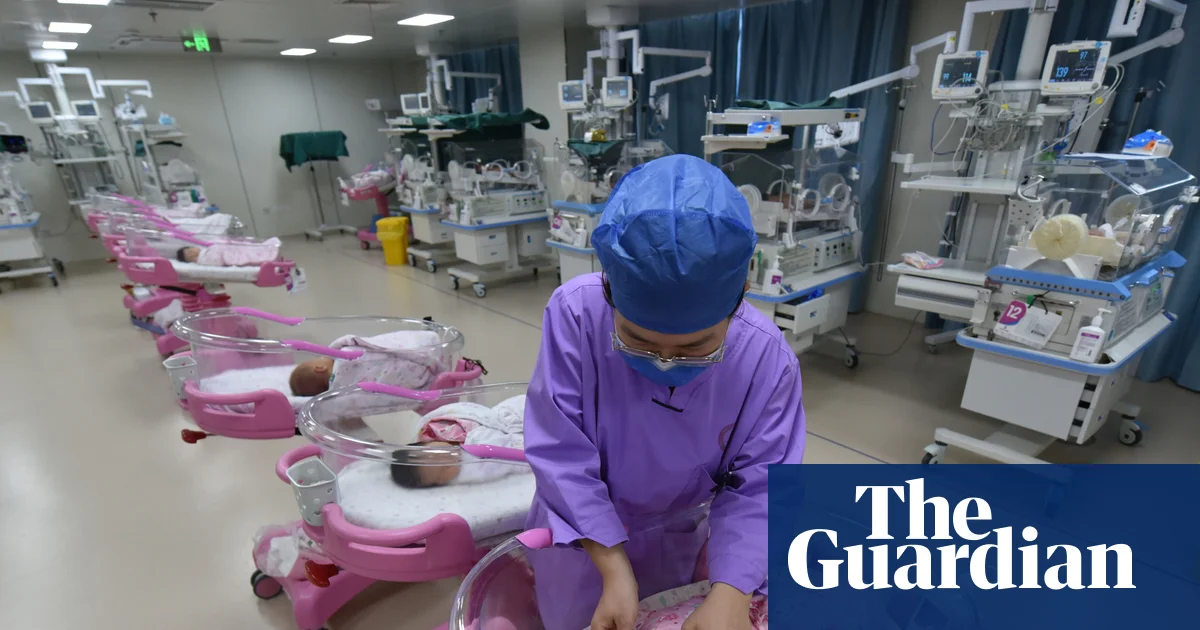
Despite the introduction of policies aimed at encouraging people to have children, China’s population fell for the fourth straight year in 2025 as the birth rate once again fell to record lows.
The number of registered births will fall to 7.92 million, or 5.63 per 1,000 people, in 2025, down 17% from 9.54 million in 2024 and the lowest since records began in 1949.
According to statistics from China’s National Bureau of Statistics (NBS), the population decreased by 3.39 million to 1.405 billion, a faster decline than in 2024, but the number of deaths increased from 10.93 million in 2024 to 11.31 million.
Yi Fuxian, a demographer at the University of Wisconsin-Madison, said the number of births in 2025 will be “about the same level as in 1738, when China’s population was only about 150 million.”
This decline occurred despite years of Chinese government policy aimed at boosting stagnant birth rates. This year, the government allocated 90 billion yuan for the first national child care subsidy program for children under 3 years old. There are also plans to expand the national medical insurance system, which covers all childbirth-related expenses, including in vitro fertilization treatment.
But young people still feel that having children is too expensive, especially at a time of high unemployment and slow economic growth. “Given the current environment, it’s a miracle that anyone would want to have children,” one Weibo user wrote.
According to the Chinese Population Research Think Tank, the average cost to raise a child in China up to the age of 18 is 538,000 yuan, more than 6.3 times the per capita GDP, compared to 4.11 times the cost in the United States and 4.26 times the cost in Japan. It costs even more in Chinese cities.
Decades of one-child policies mean that the current adult generation of child-bearing age has been socially conditioned to prefer one-child households. The impact of this policy, which was lifted in 2017, means that as China’s population ages rapidly, the number of people of childbearing age is shrinking.
This year, China also removed condoms from the list of value-added tax exempt items. This means condoms will be taxed at 13%, raising concerns that the government is trying to make it harder to avoid pregnancy. Free contraceptives are still available through government-funded programs. However, many Chinese internet users predicted that the birth rate would continue to decline.
China’s death rate in 2025 was 8.04 per 1,000 people, the highest since 1968. China’s population is shrinking from 2022 and aging rapidly, complicating Beijing’s plans to boost domestic consumption and rein in debt.
According to NBS data, people aged 60 and over account for about 23% of the total population. By 2035, the number of people over the age of 60 is expected to reach 400 million, roughly the same as the populations of the United States and Italy combined. This means hundreds of millions of people are likely to leave the workforce at a time when pension budgets are already stretched to the limit.
China has already raised its retirement age, with men now expected to work until age 63 instead of 60 and women until age 58 instead of 55.
The number of marriages in China will plummet by one-fifth in 2024, the largest drop ever, with the number of registered couples exceeding 6.1 million, down from 7.68 million in 2023. The number of marriages is usually a leading indicator of China’s birth rate.
Demographers say the decision in May 2025 to allow couples to marry anywhere in the country, not just where they live, is likely to cause a temporary increase in births.
The number of marriages in the third quarter of 2025 rose 22.5% year-on-year to 1.61 million, putting China on track to halt nearly a decade of annual decline. Complete data for 2025 will be released later this year.
Authorities are also trying to promote “positive views on marriage and childbearing” to counter the long-term effects of the one-child policy, which was implemented from 1980 to 2015 and helped reduce poverty but reshaped Chinese society.
Population migration is exacerbating demographic challenges, with many people moving from rural areas to urban areas where raising children is more expensive. China’s urbanization rate will be 68% in 2025, up from about 43% in 2005.
Policymakers have made population planning an important part of a country’s economic strategy. The Chinese government faces a potential cost of around 180 billion yuan ($25.8 billion/£19.3 billion) to increase births this year, according to Reuters estimates.
Hu Xijin, former editor-in-chief of the nationalist tabloid Global Times, wrote on Weibo that local leaders should be judged by their region’s birth rate and GDP performance. “Once this indicator is incorporated, there will be a qualitative leap in government attention to society,” Hu wrote.
China has one of the lowest birthrates in the world, with approximately one birth per woman, well below the replacement rate of 2.1. Other East Asian countries, including Taiwan, South Korea, and Singapore, have similarly low fertility rates, with approximately 1.1 births per woman.
China’s number of women of reproductive age (defined by the United Nations as women between the ages of 15 and 49) is projected to decline by more than two-thirds to fewer than 100 million by the end of this century.
Additional research by Lillian Yang. Reuters contributed to this report
