


Escalating Food Prices Create Public Health Crisis in Nigeria
The rapid surge in food prices across Nigeria is emerging as a public health emergency. With double-digit inflation affecting essential proteins, many families are compelled to ration their meals, jeopardizing the growth and development of millions of children.
Staple foods, including beef, eggs, and milk, are increasingly unaffordable, putting immense pressure on a population where only 2.4% earn more than 200,000 naira monthly. For 39-year-old Fatima Ibrahim, a mother of five in Taraba State, this economic reality has made feeding her children a daily struggle.
“I used to buy five eggs for each child for 50 naira, but now I can only buy two eggs for 250 naira, so I divide it among all five of them,” Ibrahim explains, highlighting the harsh adjustments families face. Similarly, Lagos resident Igbagbo Farade notes that skyrocketing food prices have forced his family to alter their diet. “In 2023, a kilogram of chicken was about 2,000 naira, but it’s now nearly 6,000 naira, so I’ve had to switch to cheaper options,” he adds.
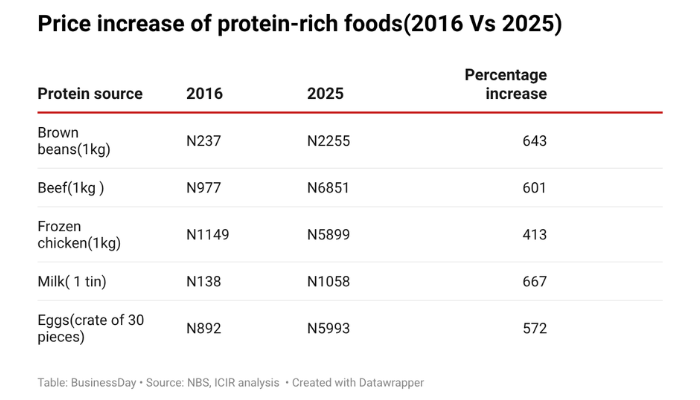
Data from the Office for National Statistics illustrates this alarming trend, revealing that a box of eggs (30 pieces), previously priced between 2,700 and 3,000 naira, has surged to over 5,700 naira, marking an increase of more than 100%. Beef prices follow suit, climbing from 2,900-3,500 naira in 2023 to between 7,000 and 9,000 naira today—a staggering rise exceeding 140%.
Alarming Malnutrition Statistics
The escalation in food prices correlates directly with a decline in child nutrition. A 2025 Dataphyte report revealed that around 86% of children under five in Nigeria do not receive the necessary dietary requirements for healthy growth and development. Alarmingly, only 14% consume foods from five essential food groups. The Global Protein Project further indicates that one in three children under five suffers from protein deficiency.
Nigeria holds the second-highest burden of stunting in children under five globally, and experts are sounding the alarm about the public health implications of widespread malnutrition. The Food and Agriculture Organization (FAO) estimates that roughly 39 million Nigerians are malnourished, with projections indicating that 35 million may face a hunger crisis by 2026. Recent NBS data reveals the cost of an adequate balanced meal is approximately 1,611 naira, a figure well beyond reach for most families, particularly those earning below 200,000 naira per month.
In September 2024, Nigeria’s food inflation rate peaked at 37.7%, the highest in two decades, though it decreased to 12.12% by February 2026. Yet, regions like Kogi (26.9%), Adamawa (23%), and Benue (21%) continue to experience alarmingly high inflation rates, exacerbating food access issues.
The Consequences of Rising Food Prices
Experts emphasize that the ramifications of escalating food prices extend beyond mere financial strain. Increased food inflation erodes purchasing power, decreases food quality, exacerbates malnutrition, and raises the incidence of child stunting, underweight, and wasting. Registered dietitian Enoabasi Nta warns, “Food inflation poses one of the most significant threats to public health in Nigeria, subtly changing the nutritional landscape for children and contributing to a looming national crisis.”
Mercy Etim, a nutrition expert based in Bristol, UK, underscores the unique challenges facing breastfeeding mothers. “The heightened cost of essential foods like eggs and meat increases vulnerability among both children and women,” she emphasizes. “If breastfeeding mothers cannot access nutritious meals, their health and milk production suffer, potentially leading to infant malnutrition.”
Future Strategies to Combat Food Inflation
To address this growing crisis, experts recommend strategies such as bulk purchasing, decentralizing markets, fostering cross-sector cooperation, and reducing food waste. Adebayo Adeleke, founder of Supply Chain Africa, highlights that Nigeria’s issues lie not in production but in supply chain inefficiencies. “By improving the supply chain, we can significantly mitigate food inflation,” he states.
Food security expert Afioluwa Mogaji argues for enhanced collaboration across the agricultural value chain, calling for partnerships between corn and poultry farmers to optimize resource sharing and improve food security. He also advocates for the segmentation of major food markets to facilitate consumer access and help temper food inflation.
Government Initiatives to Alleviate Food Inflation
In response to the escalating crisis, the government is initiating various measures to combat food inflation through investments, public-private partnerships, and comprehensive policy interventions. Mogaji notes, “We are observing increased collaboration between private and public sectors.” Additional tactics include boosting local production, enhancing mechanization, implementing temporary import duty suspensions on critical goods, and promoting dry season agriculture.
