


Significant structural changes are reshaping the financing landscape for African technology companies, a trend often overlooked in discussions about startup funding on the continent.
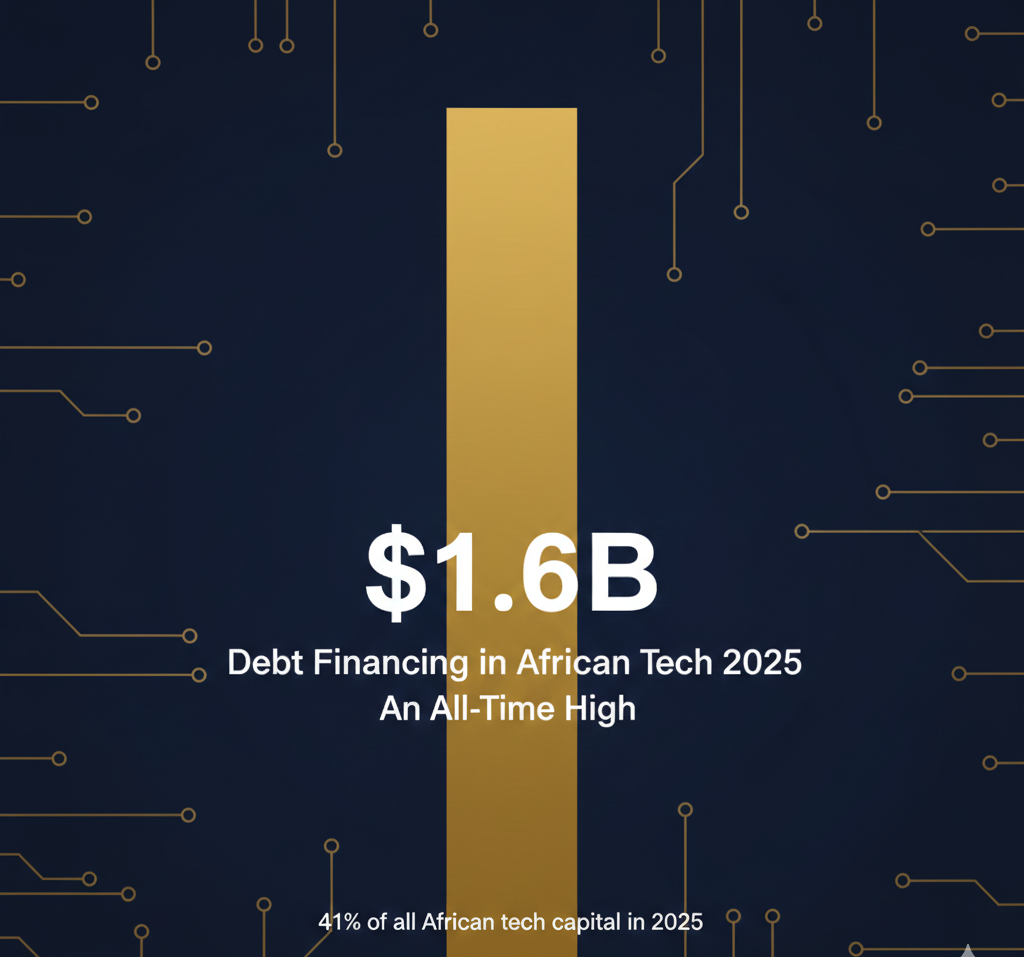
In 2025, African tech startups raised an impressive $1.64 billion through debt financing, marking a staggering 63% increase from $1.01 billion in 2024. This figure represents the highest amount raised in the continent’s history. Additionally, the number of debt transactions soared to a record 108, up 40% from 77 in the previous year. Notably, debt now constitutes 41% of all capital invested in Africa’s technology sector, a steep rise from just 17% in 2019.
This shift is not merely a trend; it reflects a robust transformation within Africa’s startup ecosystem, revealing what it truly means for companies to achieve scale.
The Significance of Debt Financing for Startups
Contrary to equity financing, which grants investors ownership stakes in exchange for capital, debt requires repayment with interest. Historically, most startups in Africa struggled to access debt due to a lack of predictable revenue and cash flow visibility—key criteria lenders typically demand. However, this situation is changing.
A growing cohort of African high-tech companies has demonstrated operational scale and financial stability, making them more appealing to banks. Debt financing provides these companies a way to secure capital without diluting returns for founders or existing investors. This is particularly advantageous in a climate where stock valuations have faced downward pressure following the corrections of 2021-2022.
For instance, Senegal-based fintech firm Wave secured $137 million in debt financing in 2025, led by Rand Merchant Bank. This decision was not driven by an inability to raise equity capital; rather, Wave opted for debt as a more strategic choice. With a stable income from mobile money transactions, the company maintained ownership while accessing necessary funds.
Examining the Data Behind the Growth
Data from Partek reveals that the increase in debt is due not just to a few outlier deals but also to a broader expansion in volume and scope. The average debt raised in 2025 stood at approximately $15.3 million, consistent with previous years—indicating that more companies are now successfully accessing debt financing.
Geographically, Kenya emerged as the leader in Africa’s bond market, raising a substantial $498 million, which accounted for nearly a third of the continent’s bond funds. Egypt followed with $246 million (up 73% year-over-year), while Nigeria raised $160 million (a 132% increase). Senegal’s total of $139 million was largely boosted by the Wave deal, highlighting how significant individual transactions can heavily influence national figures.
Sector-wise, fintech dominated the landscape, securing $716 million, or 44% of the total debt deployed. Cleantech was a notable second, with $627 million, marking the only major sector where debt financing outpaced equity due to its capital-intensive nature. Together, fintech and cleantech accounted for 82% of all capital raised through debt in 2025.
The Emergence of Professional Bond Investors
The supply side of Africa’s debt market is also undergoing transformation. In 2025, 77 unique fixed-income investors were active in the technology sector—a 10% increase from the previous year. Even more telling is that 57% of these investors were solely focused on debt, an improvement from 48-49% in 2022-2023. This shift indicates a growing specialization among dedicated debt funds and non-bank lenders developing tailored practices for underwriting without requiring equity co-investment.
Key players in the bond market include UK International Investment, International Finance Corporation, and Proparco, among others. The participation of established commercial banks in transactions like Sun King’s solar securitization signals significant credibility for high-tech bonds, extending beyond an early adopter investor base.
The Relationship Between Debt and Equity Financing
This development raises an important question: does debt financing replace or complement equity? According to analysis from The Next Africa, while total startup funding in Africa is expected to grow in 2025, the equity share may decrease in absolute terms compared to the previous year, with debt stepping in to fill the void. Given that the average equity deal hovers around $3 million, a decline of $700 million in equity would suggest around 233 fewer startups bolstered by equity financing.
Conversely, Partek’s data paints a somewhat rosier picture, indicating that total equity raised was $2.4 billion—an 8% increase year-over-year. The reduction in equity was primarily due to a 7% decline in the number of unique equity investors engaged in the market. Early-stage capital continues to soften, with deal numbers down 1% and deployed capital down 4%.
This scenario illustrates a more nuanced dynamic where growth-stage companies increasingly favor debt financing, as it aligns with their established cash flow visibility, while early-stage ventures remain reliant on equity, albeit with more selectivity in funding opportunities.
Implications for Founders
Debt is evolving beyond being a last resort for growth-stage startups with established metrics. It is now a mainstream option that enables companies to extend their financial runway, finance capital-heavy expansions, and bridge equity rounds without relinquishing additional ownership stakes. The structured debt equity model exemplified by M-Kopa in Kenya serves as a blueprint for other companies seeking similar paths.
Nonetheless, not all startups can tap into debt financing. This option necessitates stable revenues, transparent governance, and repayment capabilities even during challenging periods. Consequently, startups still navigating product-market fit may find equity financing a more suitable choice, underscoring the need for the ecosystem to address shrinking seed capital pipelines seriously.
A Significant Milestone
The $1.64 billion raised through debt financing represents more than just a record for fundraising; it reflects the maturity of a substantial segment of African tech companies. Lenders are now betting not merely on potential but on predictable future cash flows. This milestone is distinct from the excitement of unicorn valuations or mega-deal announcements, characterized instead by its stability and sustainability.
In less than a decade, debt financing has transitioned from an afterthought to a cornerstone of Africa’s tech funding ecosystem. The ongoing evolution of this landscape—who gets access, which sectors stand to benefit, and whether the gap in early-stage capital is bridged—will shape the narrative of African technology in the years ahead.
