


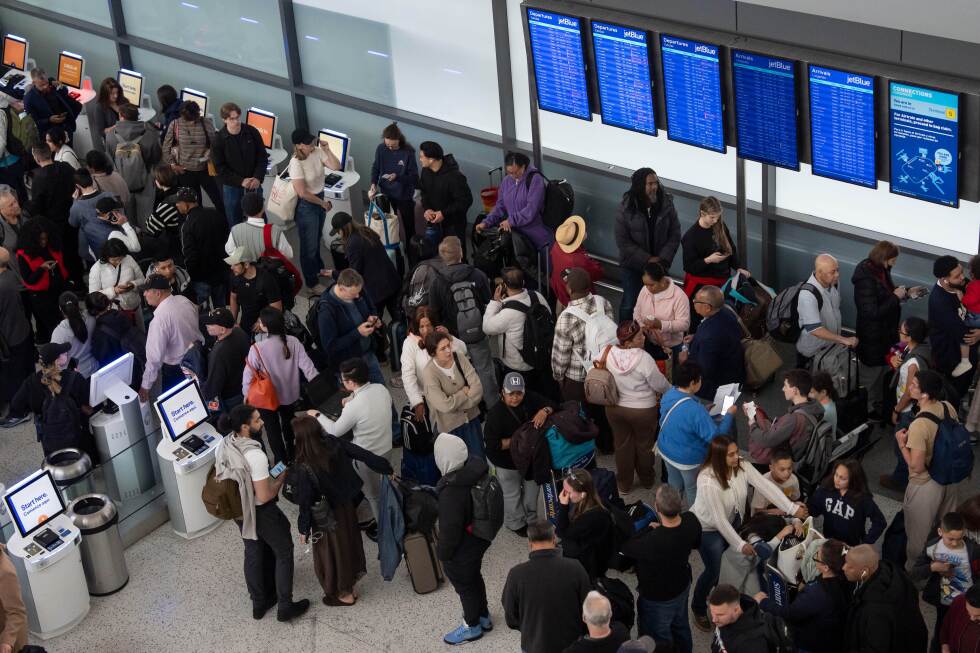
President Donald Trump’s recent decision to deploy federal immigration officials to U.S. airports amid a government shutdown has raised alarms over potential tensions at security checkpoints. This move aims to enhance safety protocols, yet comes at a time when air travelers are already experiencing lengthy delays, and Transportation Security Administration (TSA) agents are working without pay.
On Sunday, President Trump announced plans to integrate immigration officials into the TSA’s operations, instructing them to assist with tasks such as monitoring exit lanes and verifying passenger IDs. This decision hinges on funding negotiations with congressional Democrats, who are seeking significant reforms to federal immigration policies and show little indication of compromising.
During the ongoing budget stalemate, hundreds of thousands of Department of Homeland Security employees, including TSA and U.S. Secret Service personnel, have been working without compensation since Congress failed to pass a funding bill last month.
Senator Lisa Murkowski of Alaska expressed her disapproval of the proposed airport security strategy, stating, “What we need to do is address the issues at DHS and ensure TSA employees are paid.” She emphasized that adding more personnel during this crisis could exacerbate the frustrations faced by both travelers and security staff already grappling with the repercussions of the budget impasse.
Border Security Officials Facilitate Enhanced Airport Operations
Tom Homan, who has been appointed to oversee airport security by the White House, is engaging with a bipartisan group of senators regarding the impact of the partial shutdown. Homan described these discussions as productive but noted that consensus has yet to be reached.
He indicated that the deployment of U.S. Immigration and Customs Enforcement (ICE) agents at airports would be closely coordinated with TSA officials. While DHS has confirmed that “hundreds” of ICE agents will be sent to various locations, specific deployment details remain undisclosed for security purposes. “Our focus is on major airports where wait times can be excessive,” Homan remarked, underscoring safety as the primary concern.
In Atlanta, Mayor Andre Dickens announced that ICE and Homeland Security Investigations agents would begin their operations at Hartsfield-Jackson Atlanta International Airport. This follows reports of travelers waiting for nearly six hours at security checkpoints, resulting in numerous missed flights. Dickens reassured the public that the federal personnel would not engage in immigration enforcement but would assist with crowd control and other logistical tasks.
Challenges Persist Amid Ongoing Budget Negotiations
Democrats are open to funding the TSA and other DHS sectors to implement reforms, particularly in light of recent tragic incidents related to immigration enforcement. Senate Majority Leader John Thune remarked on the need for solutions, acknowledging that various proposals are currently being considered.
However, the a lack of transparency from budget discussions leaves many questions unanswered regarding the specific allocation of resources and deployment of immigration officials. Some legislators believe the additional personnel could offer relief. Senator Mike Rounds of South Dakota commented, “I don’t think it will do any harm; they will help alleviate some of the pressure.”
In a social media message, Trump reiterated his support for TSA personnel, applauding their dedication despite the ongoing shutdown while criticizing Democratic opposition. Airports across the country, including Atlanta and New York’s JFK, reported chaotic scenes as anxious travelers struggled to navigate long lines. U.S. Transportation Secretary Sean Duffy expressed concern over travelers’ uncertainty regarding wait times: “Do I need to arrive an hour and a half early, or four hours early? They simply don’t know until the day of their flight.”
Homan has been active in media discussions regarding these issues, emphasizing the pressing nature of the situation. This evolving narrative continues to capture public and governmental attention, reflecting broader implications for aviation security and immigration policy amid a contentious political landscape.
