


Investment Showcase at Africa Tech Summit Highlights Realities of Innovation
The atmosphere at the Africa Tech Summit’s investment showcase was not one of unbridled optimism. Instead, it resembled a focused working session where founders faced investors with a keen interest in their ideas. Many had already encountered the stark reality of conducting business in Africa, questioning whether their innovative concepts could withstand the continent’s challenges.
This tension permeated the discussions at Mony Point throughout the afternoon. Conversations ranged from retail software to robotics to agricultural finance, yet they consistently gravitated back to a core issue: the harsh realities faced by technology in African markets. Here, challenges such as inadequate infrastructure, deeply rooted habits, and institutional limitations present significant hurdles to innovation.
The Investor Committee, chaired by Neanda Salvaterra, instilled a serious tone. Stanley Mukasa, Associate Director of Entrepreneurship at Carnegie Mellon University Africa, pressed founders on aspects of distribution and user engagement. Cynthia Mwaura, Senior Investment Associate at E3 Capital, focused on retention and revenue models, raising crucial questions about actual user demographics and the onboarding experience amid diverse levels of digital literacy. Investors were eager to know how these startups were addressing challenges beyond urban networks.
Insights gleaned from these presentations revealed a shift in the venture capital landscape in Africa. Novelty alone is no longer a sufficient draw; sustainability and practicality are becoming the new measures of success.
Small Businesses, Paper Records, and the Cost of Invisibility
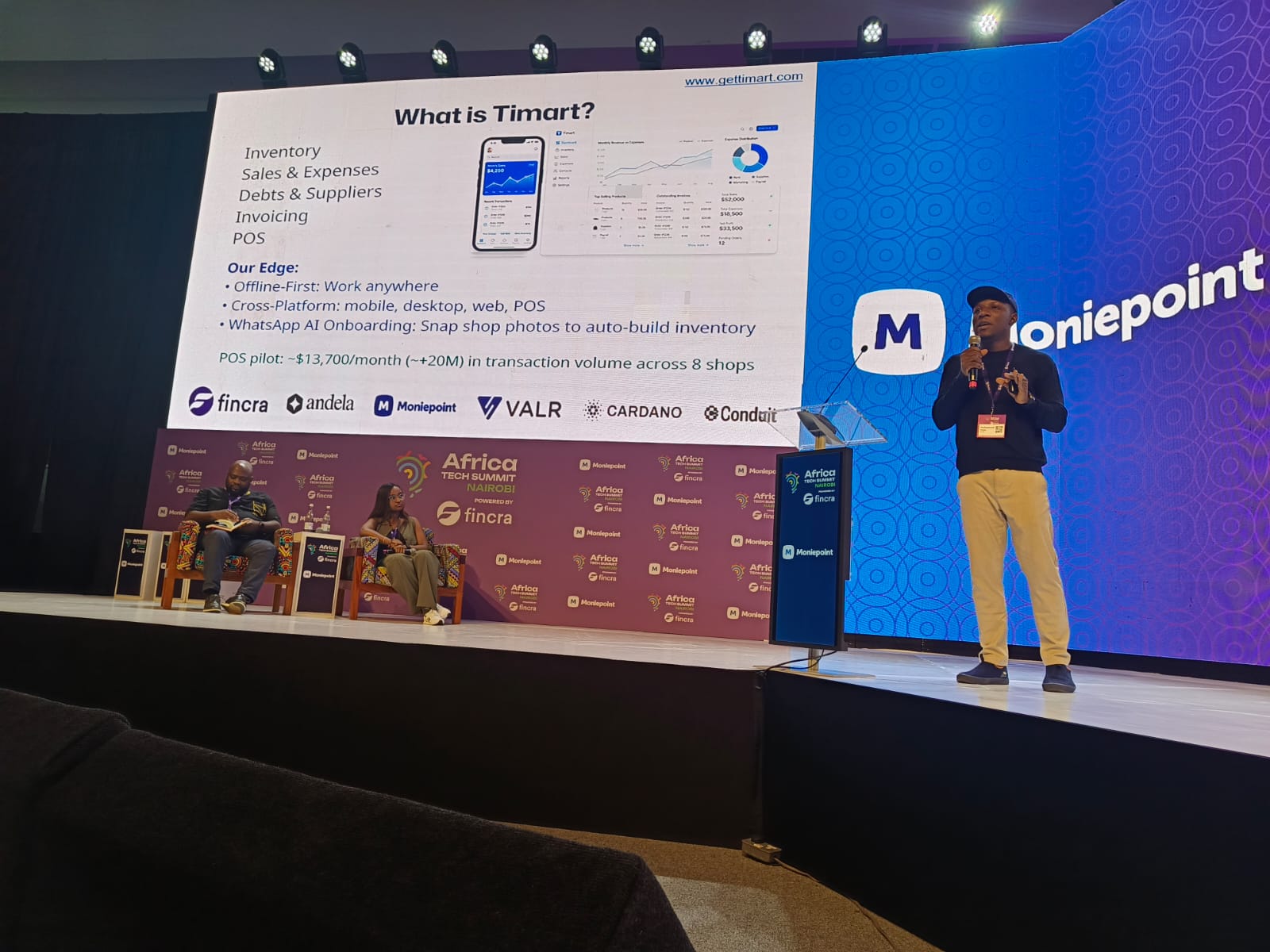
When Muhammad Jitu Ndako introduced Timart, technology was not the focal point; instead, it illuminated a prevalent issue. Small retail businesses, often bustling yet hindered by inadequate cash flow tracking, inventory management, and informal credit practices, reveal a troubling reliance on paper records and disparate applications.
Timart’s approach embraces an offline-first model, operating under the premise that connectivity can be unreliable. The software enables localized tracking of inventory, sales, and payments, syncing data later when connections improve. The platform claims 605,000 subscribers and a 95.2% retention rate with monthly fees ranging from $3 to $15. While these figures suggest momentum, they also underscore the difficulties of achieving scale, as profit margins in small business software remain precariously thin without broader adoption.
Central to Timart’s success is the understanding that many African SMEs operate in semi-formal environments, prioritizing survival over compliance. While digital solutions may increase visibility, they also bring the burden of taxation and financial scrutiny. Hence, trust and usability become critical factors in user adoption.
Investors seem attuned to this dilemma, recognizing that offline features alone do not address behavioral inertia. Lowering initial hurdles for adoption is essential.
Assistive Robotics and the Economics of Inclusion
Nora Kimachi’s presentation introduced Zerobionic, which has developed a robotic system that translates spoken instructions into sign language—an initiative designed to support hearing-impaired students in engaging with STEM education. The project is said to serve over 510,000 students, partnering with organizations such as UNDP and NVIDIA Kenya.
However, Zerobionic’s ambitions raise significant questions regarding the competitiveness of locally developed hardware against global manufacturers, particularly in terms of cost and maintenance in a market with limited purchasing power.
Zerobionic’s strategy hinges on material choices and distribution methods, opting for recycled plastic to reduce production costs. Their model integrates hardware sales with subscription access to an educational platform, built to last 20 years to alleviate concerns about durability and replacement cycles.
Nevertheless, assistive technologies often depend heavily on institutional investors such as schools, governments, and NGOs. Procurement processes are frequently slow, and funding is inconsistent, leading to delays in adoption compared to startup projections. If successful, however, these technologies could have a long-lasting impact on education systems.
Agriculture, Finance, and the Long Road to Formalization
At the summit, pitches focusing on agriculture showcased familiar themes of digitalization. Riches Attai from Winich Farms highlighted an infrastructure-driven approach, positioning the company as a commerce network connecting farmers, processors, and retailers, layered with financial services.
The initiative has issued over 103,000 prepaid cards to farmers across 27 states, with last year’s circulation reaching $8 million. Now, Winich Farms aims to secure a microfinance license for in-house credit and insurance offerings.
Notably, it was revealed that many farmers are not directly using the application; instead, agents manage it on their behalf. This reflects a crucial reality often overlooked in discussions about digital finance: technology adoption in rural areas typically involves intermediaries rather than direct user interaction.
While this model addresses access issues, it introduces challenges such as the need for ongoing monitoring of agent networks and potential fraud risks. Still, it aligns with the evolution of financial inclusion across Africa, where human infrastructure has historically preceded digital independence.
Payments, Stablecoins, and the Quest for Certainty Across Borders
Presentations by Oluwagbenga Agunbiade and Faith Kinyua broadened the dialogue to encompass payments and procurement challenges. Both stablecoin-based payment systems and AI-driven procurement platforms aim to tackle the high costs and complexities of cross-border commerce, particularly for SMEs lacking access to traditional banking.
The appeal of digital currencies lies in their potential to expedite transactions and reduce expenses, while procurement platforms can open supply chains to small vendors, including women and youth entrepreneurs.
However, unresolved regulatory issues loom large. Stablecoins operate under varying policy frameworks across jurisdictions, and automated procurement raises concerns about verification and accountability in decision-making, particularly regarding credit access and supplier involvement. Investors are increasingly prioritizing regulatory stability over technological innovation.
Investment Climate Shows Growing Caution
A discernible pattern emerged at the showcase: while founders discussed growth, investors concentrated on execution metrics—customer integration, distribution effectiveness, and alignment with existing payment systems. The inquiries resembled a business audit more than a pitch session, reflecting a significant shift in venture capital dynamics across Africa over the past two years.
Funding is becoming increasingly selective, with investors now seeking clarity on revenue, retention metrics, and feasible deployment strategies. Institutions such as CMU-Africa and funds like E3 Capital are guiding this evolution, enriching conversations around sector specialization and talent development. Areas such as climate technology, inclusive finance, and infrastructure software are gaining momentum, driven by real structural requirements rather than mere trends.
Continuing Discussion on Scaling Challenges
As the session concluded, a consensus emerged not around any single startup, but rather a collective contemplation of scaling. Although many African startups aspire for continental reach, markets vary widely in terms of regulation, language, and consumer behavior. Consequently, successful products often adapt gradually and unevenly across regions.
The offline-first software recognizes connectivity limitations, while cost-effective robotics utilize recycled materials. There is a clear acknowledgment of gaps in digital literacy within agency-led finance, indicating that rapid expansion is unlikely. Instead, these approaches focus on fostering gradual adoption.
This grounded perspective underscores a vital truth: founders are developing solutions based on existing constraints rather than ignoring them. The creation of sustainable companies may hinge more on patience than on advanced technology. Investors seem to grasp this nuance; the measured applause following each pitch suggested an awareness that the real work begins when the spotlight fades.
