


A Legacy Rooted in History: James Hoban and His Irish Heritage
In 1792, a young architect from Kilkenny, Ireland embarked on a journey that would lead to the creation of one of the world’s most iconic structures. Today, James Hoban, recognized for designing and overseeing the construction of the White House, is celebrated alongside other Irish Americans who made profound contributions to the fabric of American history.
Honoring Hoban at the Irish Embassy
On March 20, during a reception at the newly established Irish Embassy on Pennsylvania Avenue in Washington, D.C., Geraldine Byrne Nason, the Irish Ambassador to the United States, paid tribute to Hoban’s legacy. She characterized him as a pivotal figure among Irish Americans who left an indelible “Irish fingerprint” on the founding of the nation.
Irish Immigrants’ Impact on American Ideals
Addressing approximately 200 guests, Nason highlighted the significant role of Irish immigrants in shaping the core values of this great nation, noting that 23 U.S. presidents have Irish roots. This history is emblematic of the influence that Irish Americans have had on the evolution of American ideals and governance.
Collaboration and Resilience in Hoban’s Vision
Matthew Costello, a historian affiliated with the White House Historical Society, explained that Hoban collaborated with fellow Irish immigrants and enslaved laborers to bring his vision to life, inspired by Dublin’s Leinster House architecture in 1800. His determination to realize this vision exemplified the collaborative spirit of the era.
Challenges and Triumphs of the White House
John Adams became the first president to inhabit the White House, but during the War of 1812, British forces burned the mansion, damaging Hoban’s creation. Costello remarked that following this destruction, Hoban returned to reconstruct the White House, relying on strong ties with his fellow Irish compatriots, united by both heritage and their shared Catholic faith during a time of widespread distrust against Catholics.
Building a Community of Faith in Washington, D.C.
Hoban is also lauded for establishing a thriving Irish Catholic community in Washington, D.C. Although Jesuit missionaries had introduced Catholicism to America prior to the Revolution, Hoban’s efforts significantly advanced this community. In 1794, anticipating further waves of Irish immigrants, he initiated the construction of St. Patrick’s Church in collaboration with Father Anthony Caffrey, another immigrant from County Mayo. Today, this church stands as the oldest Catholic parish in the capital.
Preserving Hoban’s Heritage
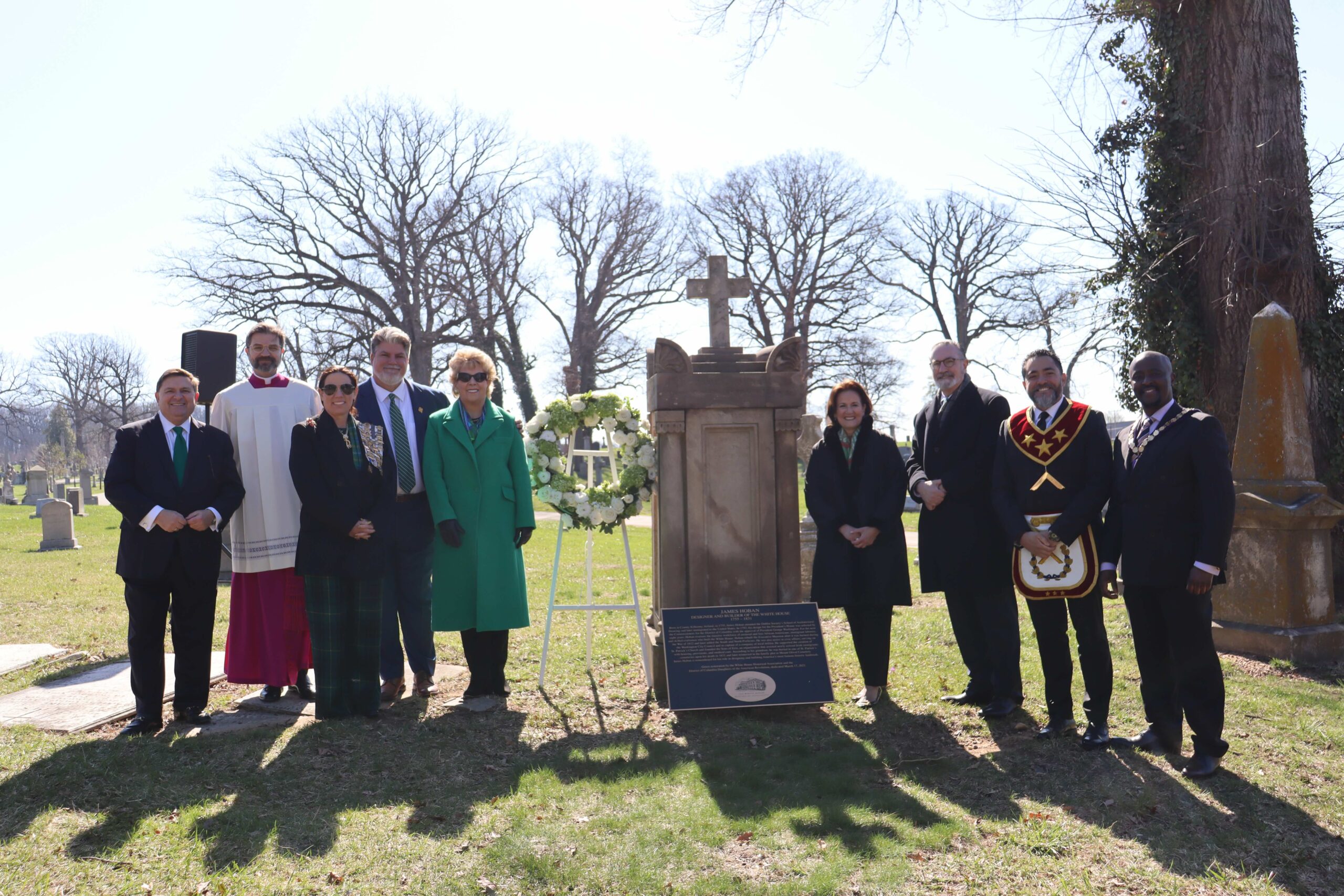
Despite the loss of Hoban’s personal papers in a fire after his death in 1831, which limits historical insights into his life, the White House Historical Society continues to honor his memory. Each year, a gathering at his grave in Mount Olivet Cemetery allows historians and admirers to celebrate his contributions. This year’s ceremony coincided with America’s upcoming 250th anniversary, featuring Friar Betheslav Tumil, who commemorated Hoban’s enduring connections with the Catholic community.
A Celebration of Irish Contributions at the Embassy
Following the wreath-laying ceremony at the cemetery, attendees moved to the embassy where Ambassador Nason extolled Hoban and other Irish patriots for their significant architectural contributions that infused “Irishness” into the ideals of a burgeoning nation. The embassy has also curated an exhibition titled “The Emerald Thread,” showcasing artifacts that illustrate the Irish diaspora’s integral role in American history, displayed throughout the summer’s 250th anniversary celebrations.
Honoring Other Irish-American Heroes
A centerpiece of this exhibition is a grand portrait of Hoban, presented by the White House Historical Society. The display also highlights other notable Irish-American figures, including Stephen Moylan from County Cork, who served in George Washington’s inner circle and aided him during the Siege of Boston. This exhibition serves as a testament to the enduring legacy of Irish contributions to the American narrative.
