


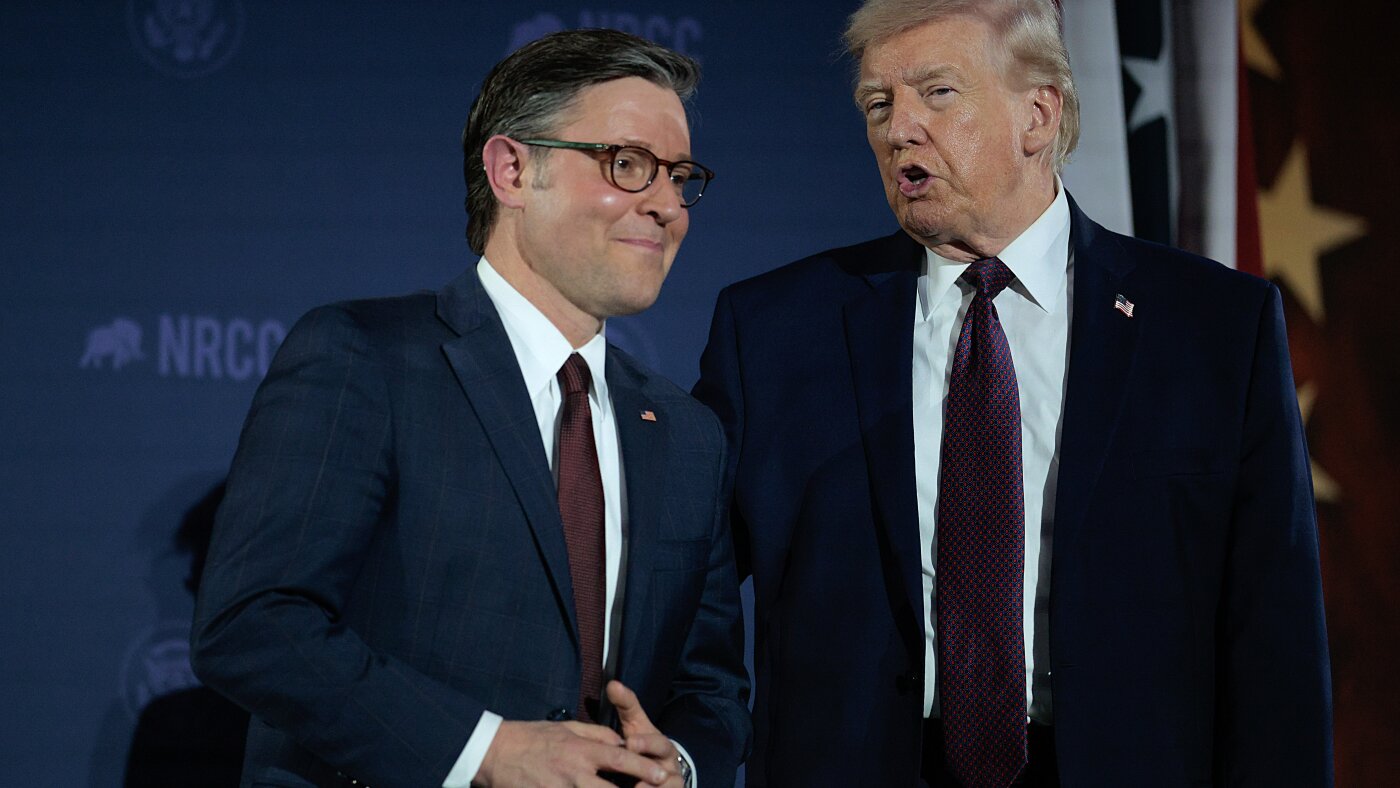
House Speaker Mike Johnson (R-LA) and President Trump attended the National Republican Congressional Committee’s annual fundraising dinner in Washington on Wednesday. Chip Somodevilla/Getty Images
The Department of Homeland Security (DHS) has announced that employees of the Transportation Security Administration (TSA) could receive paychecks as early as Monday. This development follows a memo signed by President Trump after House Republican leaders dismissed the latest proposal aimed at ending the ongoing DHS shutdown.
On Friday, the House approved a temporary funding bill for DHS, which is set to last until May 22. The vote concluded with a narrow margin of 213-203, with three Democrats breaking ranks to align with Republicans. Despite this decision, the future remains uncertain, as the shutdown at DHS persists without a clear resolution in sight.
In stark contrast, the Senate passed its own bill earlier on Friday, which aimed to restore funding across most divisions of DHS, excluding immigration enforcement operations. House Speaker Mike Johnson (R-Louisiana) criticized the Senate bill, deeming it a “joke.” The divergent paths taken by the two chambers underscore the ongoing dysfunction in Congress.
The House’s version faces significant hurdles in the Senate, especially as lawmakers have embarked on a planned recess. Additionally, Democrats have expressed staunch opposition to any funding proposals for Immigration and Customs Enforcement (ICE) without accompanying reforms. Johnson’s announcement signaled that House Republicans would not support the Senate’s funding strategy.
Conflicting Strategies Ahead
The Senate’s funding proposal explicitly excludes any additional appropriations for ICE or Border Patrol and lacks measures advocated by Democrats to regulate the actions of federal immigration agents. Following the Senate’s approval, House Republicans convened and swiftly rejected this plan, with Johnson stating publicly that the Senate’s approach was misguided.
Johnson emphasized that the House would focus on a temporary spending bill designed to maintain full financial support for DHS through May 22. He asserted that President Trump is fully aware of and endorses this approach. However, the prospects of the stopgap bill passing in the Senate appear grim, particularly as Democrats have been resistant to discussions surrounding ICE funding.
Impact of the Shutdown
The government shutdown has dramatically impacted the operations within DHS, forcing tens of thousands of employees to work without pay or seek alternate employment. Long wait times at key airports have become increasingly problematic during peak travel seasons. Acting TSA Administrator Ha Nguyen McNeil highlighted that no-show rates reached as high as 40% at some locations during the shutdown, exacerbating security concerns.
With mounting frustration, Democrats have remained unwilling to endorse any funding measures for DHS unless accompanied by reforms in response to recent violence involving federal immigration officials. The latest Senate proposal includes allocations for critical programs such as the TSA, Coast Guard, and Federal Emergency Management Agency (FEMA), although it insists on implementing stricter oversight on ICE operations.
Republican Challenges and Internal Conflicts
In an effort to find common ground, some Republican leaders have pushed for a comprehensive plan that would fund ICE while excluding certain enforcement divisions. Initial suggestions ignited lively discussions, though concerns linger about potential misallocation of funds towards enforcement efforts.
Despite ongoing negotiations, a resolution has remained elusive. With the situation at major airports growing increasingly untenable, lawmakers grapple with the consequences of their inability to reach a compromise. President Trump’s claim of a linkage between DHS funding and voting law reforms adds another layer of complexity to the negotiations as urgent action looms ahead.
