


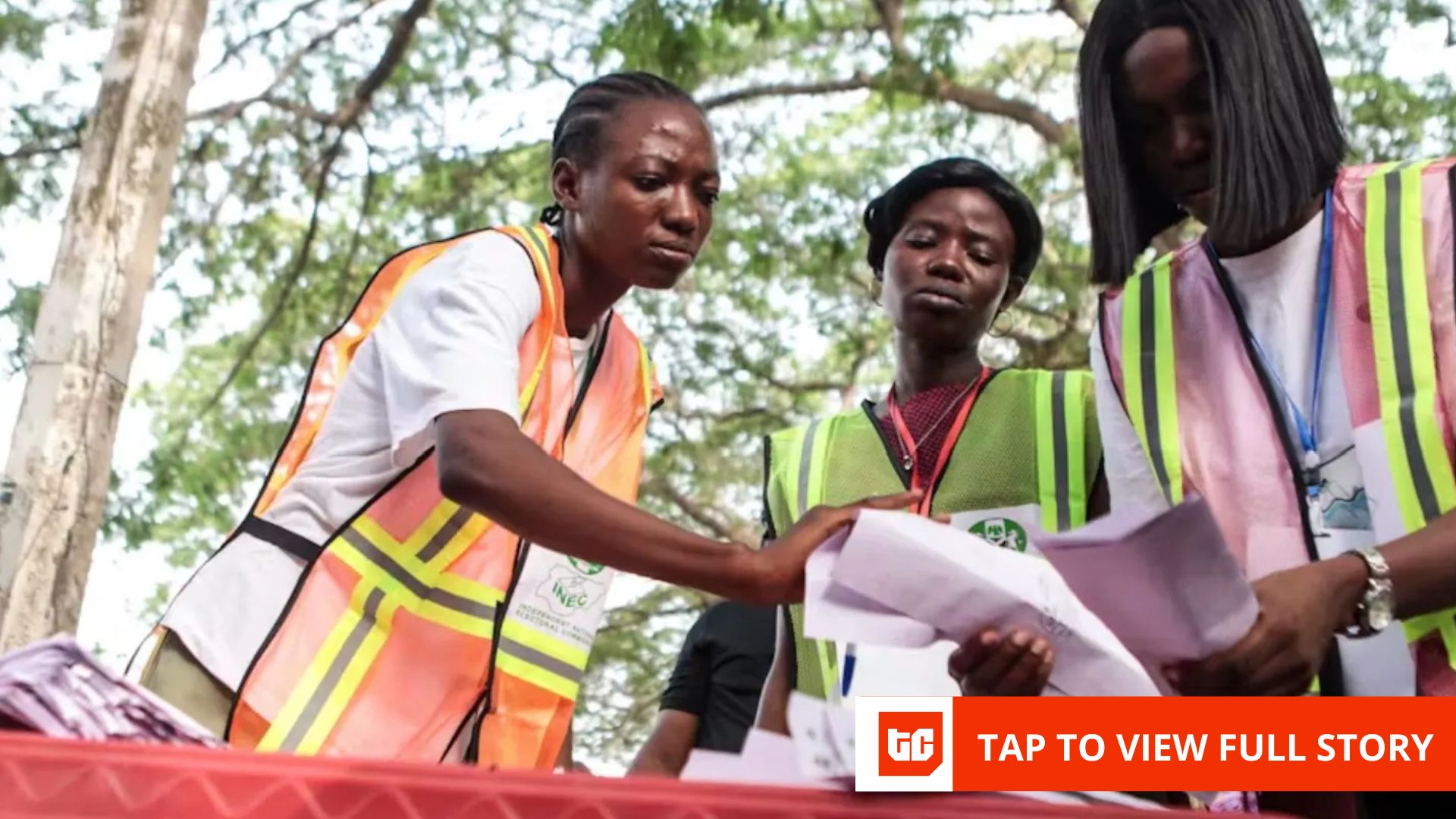
Nigeria’s 2027 election campaign has already begun. But not in the way most people expect.
While political parties prepare to go to the polls, a quieter battle is underway inside the data pipelines, recommendation algorithms and artificial intelligence (AI) tools that shape what Nigerian voters see, read and believe online. Experts say this tension may be as important as anything that happens at the polling place.
This was the central warning at the Open Data and AI Day 2026 hosted by civic technology organization BudgIT and its innovation hub CivicHive in Lagos on Wednesday, March 11.
With presidential elections scheduled for January 16, 2027, Nigeria is entering its most critical campaign season in a digital environment saturated with AI-generated content, micro-targeted political messages and deepfake videos, which experts say the country’s institutions are not yet equipped to manage.
Joseph Amenagawon, BudgIT’s Acting Country Director, opened the event by articulating the urgency.
“We can clearly see what AI can do in terms of influencing the rest of the population in terms of who they vote for and who they don’t vote for in the year before the 2026 election,” he said. “The important question now is whether the public can clearly discern what is true and what is not.”
Amenagawan warned that many people will be vulnerable in the coming months. “The coming months will be exciting, with many people across Africa exposed to misinformation and fake news,” he said.
AI is not new, but its scale is
For Gbenga Sesan, founder of digital rights group Paradigm Initiatives, concerns about AI in elections are less about novelty and more about its acceleration.
“AI is not new,” Sesan said in his keynote. “I studied engineering in 1995, and we were already working on neural networks and machine learning. What’s changed today is the scale and speed.”
The data fed into these systems has increased significantly. According to data from the Nigerian Communications Commission (NCC), Nigerians consumed 13.2 million terabytes of internet data in 2025 alone. Every search, post, and interaction leaves a digital footprint that AI systems can analyze to build a detailed portrait of voter behavior and political preferences.
“We have no idea how much content is generated online every minute,” Sesan said. “And every time we search, every time we interact online, we leave a footprint.”
The rise of data-driven campaigns
Traditional political campaigns once relied heavily on rallies, broadcast media, and extensive polling data to reach voters. There is now an increased reliance on sophisticated data analysis to understand voter behavior and tailor messages much more precisely.
In the 2022 Kenyan elections, William Ruto’s campaign abandoned traditional targeting of ethnic blocs in favor of a data-driven strategy built around economic identities.
Rather than targeting specific tribes, the campaign identified “hustlers” – small traders, boda boda riders and unemployed youth across ethnic groups – and created a message centered on “bottom-up economics” that spoke directly to their economic realities.
By 2024, the strategy will evolve further, with AI-driven sentiment analysis on platforms like TikTok and Instagram to track how Gen Z, the fastest-growing electorate, responds to policy messages in real time, according to the report.
For South Africa’s 2024 general election, an organization called Rivonia Circle deployed an AI chatbot called Thoko to answer voters’ questions about registration and policy. Analysts also warned that similar tools are being used to flood social media with automated and highly targeted messages aimed at exploiting community concerns about immigration and land.
“The data architecture of modern politics has changed,” Sesan says.
Campaign strategists can combine voter registration data, social media activity, and consumer behavior to build detailed voter profiles. AI can analyze these profiles to predict preferences and deliver highly personalized political messages.
“Based on your actions, you’ll receive specific messages tailored to you,” Sesan says.
This approach, known as microtargeting, allows campaigns to send different messages to different groups of voters. One voter may receive messages about economic policy, while another may receive content designed to appeal to cultural or religious concerns.
Such personalization can have a significant impact on how political narratives spread within society.
Deepfakes are already out there
Beyond targeting, AI is enabling something more destructive: the mass production of convincing disinformation through deepfakes.
A viral video that went viral this year on X showed President Bola Tinubu reacting defiantly to Donald Trump’s war threats, followed by an AI-generated version of Trump mocking his abilities.
Fact-checkers from fact-checking and verification organization Dubawa noted the unnatural body movements and confirmed that it was a deepfake. Another fake video showed Nnamdi Kanu, leader of the secessionist group Indigenous People of Biafra (IPOB), being served food in the prison yard in Sokoto.
“People will make you say things you never said,” Sesan warned.
Modern generative AI has made detecting such content much more difficult. And the problem lies not only with fake videos, but also with the connected networks of automated accounts that spread them. During election campaigns, such content spreads rapidly across social media platforms, potentially confusing voters and damaging reputations.
“We know for a fact that troll farms are active in shaping the public conversation before, during and after elections,” Sesan said. “Some of the comments you see online aren’t even from real people. They’re part of a moderation system designed to influence the conversation.”
A study published in the journal Nature found that AI chatbots tested during the 2024 US election and the 2025 Polish and Canadian elections were far more effective at persuading undecided voters than reinforcing the views of committed supporters, suggesting that AI influence may be most important where elections are decided.
Nigeria may not be ready
Despite growing enthusiasm for AI across Africa, researchers at the event warned that Nigeria lacks the institutional infrastructure to responsibly manage the use of AI in elections.
“Personally, I believe that Nigeria is not ready as a country to introduce AI into the electoral process because the foundations are not in place,” said Temitope Asama, a researcher at Machine Learning Collective Africa. “We don’t have the bricks to lay the foundation we need.”
Asama said responsible deployment requires independent audits, continuous monitoring and transparent governance frameworks, which Nigeria has not yet created.
“When an AI model fails, it is simply not enough to place the blame solely on the organization that deployed it,” she said. “Significant processes like elections require ongoing auditing, regulation and testing by both governments and independent bodies.”
Nigeria’s electoral body, the Independent National Electoral Commission (INEC), has set up an internal unit to look at how AI can improve electoral processes, but the unit has yet to roll out any programs. Representatives at the event pointed to potential applications such as facial recognition for voter identification and AI-assisted detection of tampered content.
Tope Adenugba, who represented the commission at the event, said, “Overall, AI provides an opportunity to improve election integrity while helping to detect and prevent fraud.”
real contest
For Sesan, the bigger risk is not that AI will be used against democracy, but that the public will disengage from a process they no longer understand or feel they can no longer influence.
“We are not passive observers,” he said. “If the public believes that only politicians can understand AI and data, they will lose their voice in the process.”
With voter turnout already declining in recent Nigerian elections, the 2027 election cycle will test whether AI can become a tool for widespread democratic participation or a mechanism to shape outcomes before most voters have made a decision.
“If you apply the scale and speed of data processing to democracy, it could end elections before they even begin,” Sesan said.
