


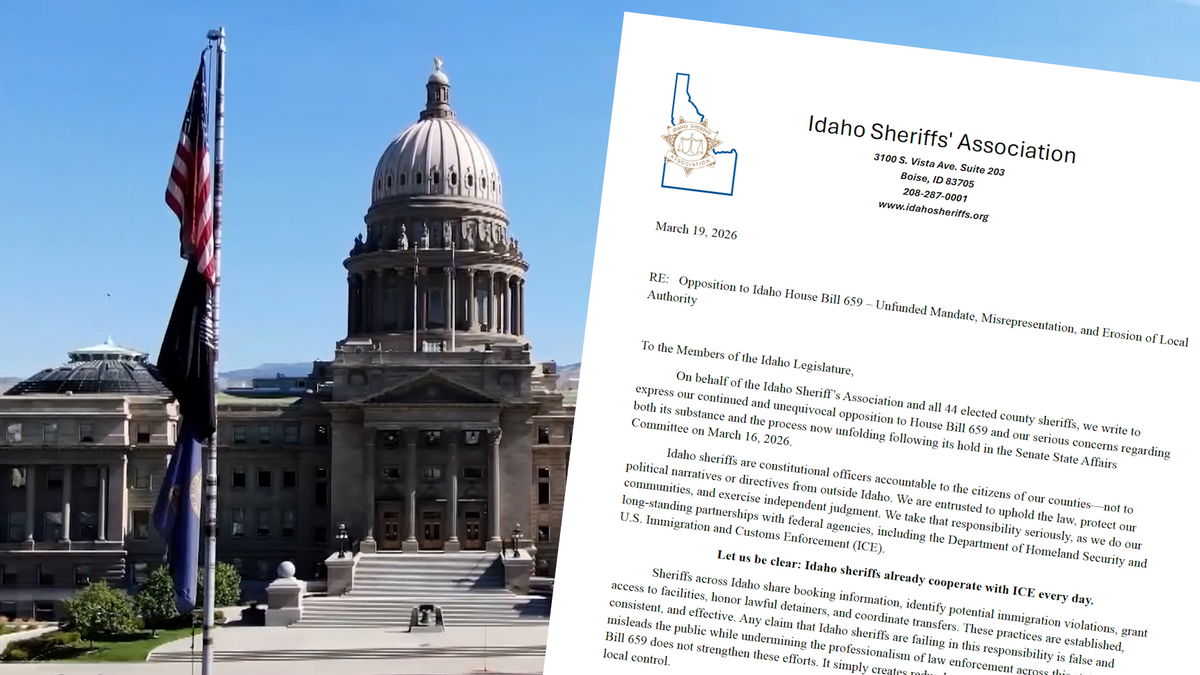
BOISE, ID (KIFI) – The Idaho Sheriffs Association (ISA) is expressing strong opposition to what it deems a “deliberate attempt” by external political figures to resurrect a contentious immigration enforcement bill that had been previously rejected by a Senate committee.
This reaction follows reports that Stephen Miller, Deputy Chief of Staff for Policy and Homeland Security, purportedly contacted Idaho’s executive and legislative leaders on March 17, urging them to reinstate House Bill 659.
The proposed legislation, which aimed to compel all local police departments to enter into a 287(g) agreement with U.S. Immigration and Customs Enforcement (ICE), failed to advance in the Senate State Affairs Committee just a day prior.
In light of these alleged interventions from Washington, D.C., the Senate State Affairs Committee moved forward with three bills concerning immigration enforcement, including the Idaho Refugee and Illegal Alien Liability Act and federal immigration detainers.
An affront to democratic processes
In a pointed letter addressed to the Idaho Legislature, ISA President Dave Hansen condemned efforts to bypass the committee’s decision. He argued that the proposed mandate is not only redundant but also costly and infringes upon local governance.
“Reviving the bill simply because the committee’s verdict was not what some wanted does a disservice to our democratic process,” Hansen stated. “Legislation in Idaho should be determined by Idahoans, not dictated by pressure from Washington, D.C.”
Canyon County Sheriff Kieran Donahue, a former president of the National Sheriffs Association, echoed these sentiments, voicing concerns over legislative overreach and its implications. His remarks highlight the tension between local authority and federal influence.
A closer look at the 287(g) program
The 287(g) program grants limited federal immigration enforcement rights to selected local officials, enabling them to identify, process, and detain undocumented immigrants pending criminal charges.
According to ICE’s official website, the program operates under three primary models:
- Prison Enforcement Model: Identifying undocumented individuals already in local custody.
- Task Force Model: Allowing local officials to exercise immigration authority alongside their daily responsibilities.
- Warrant Enforcement Officer (WSO): Authorizing local officials to execute ICE administrative warrants.
While some Idaho counties voluntarily engage in these programs, the ISA points out that many are opting out due to the associated financial and operational burdens. Sheriff Donahue underscored the lack of resources available to support such initiatives.
The hidden financial implications of mandates
Proponents of HB 659 assert that federal reimbursements for training and equipment would mitigate costs. However, Sheriff Donahue counters that these assurances fail to address the ongoing police manpower shortages within the state.
“They talk about providing resources like vehicles and overtime pay, but the reality is we still have to send officers for training,” Donahue explained. “This process takes significant time and funding. Training a new officer can exceed a year and cost upwards of $100,000 before they are ready for duty.”
Redundancy: Addressing the issue
The ISA argues that Idaho’s sheriffs routinely collaborate with federal authorities. President Hansen emphasized that local law enforcement is already effectively sharing booking information, respecting lawful detainers, and managing transfers.
“The notion that Idaho’s sheriffs are neglecting their responsibilities is unfounded and misleading,” Hansen asserted.
“There has never been an instance in Idaho where a jail, sheriff, or police department has failed to respond to calls from our federal partners, including ICE, DEA, ATF, and FBI. Our local agencies work synergistically with these entities,” Sheriff Donahue affirmed.
The ISA believes that beyond the fiscal ramifications, the proposed bill contradicts Idaho’s foundational values of local control. Not only would it impose participation in the current 287(g) program, but it would also compel local agencies to engage in any future federal immigration initiatives.
“The attempt to address a non-existent problem within Idaho is misguided,” Donahue warned. “What if future federal administrations choose not to enforce immigration laws? Local agencies would then find themselves caught in a conflict between federal and state directives.”
In its letter, the ISA urged lawmakers to reject any “hasty and opaque” efforts to revise and relaunch the bill, asserting that legislation of this scope requires thorough input from the officials tasked with its implementation.
Local News 8 has reached out to Governor Little for comments regarding the reported communication from Stephen Miller and its impact on the legislative process. We will provide updates as more information becomes available.
