


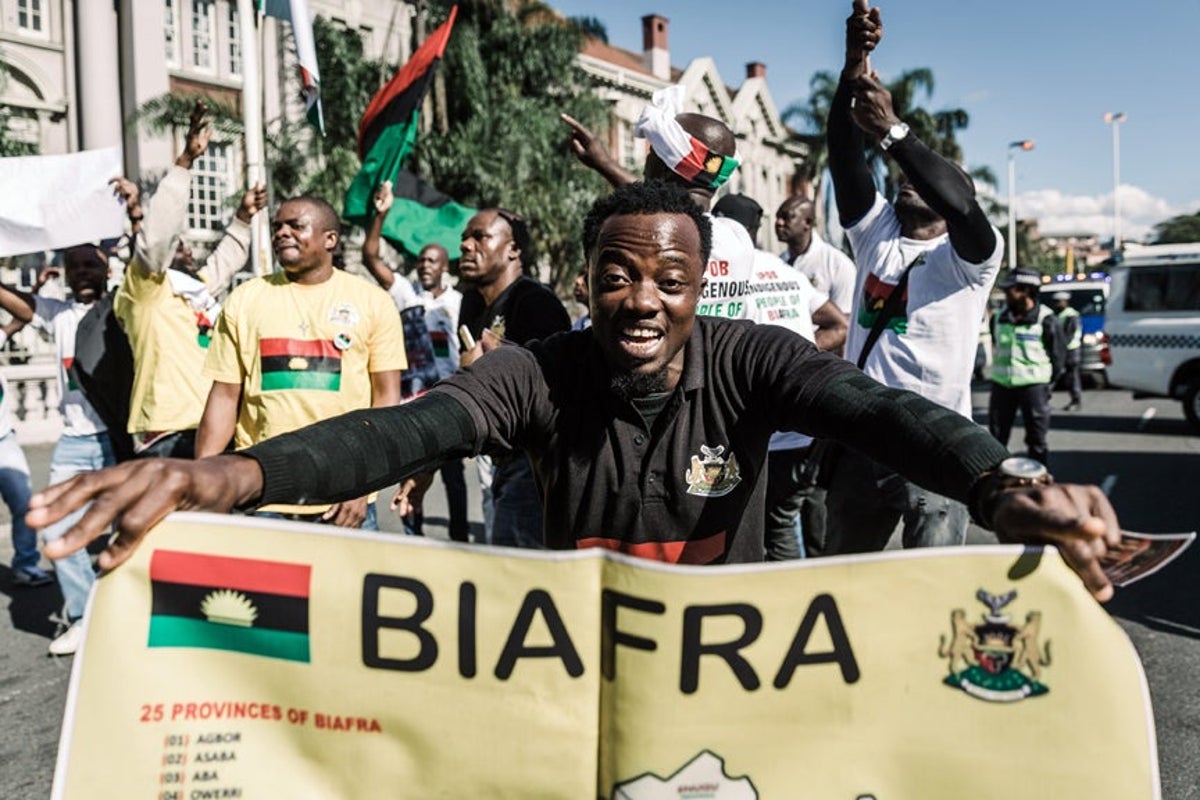
The Biafran War never disappeared from the national memory. It is important that we continue to remember that even after we fought a war for 30 months and a million people died, our problems remained unresolved. Those who fought the war and won the Biafrans actually believed that their sacrifices had built a new Nigeria. I don’t know which one is worse now. The crisis and insecurity in 1967, when the war began, and the crisis and insecurity in 2023, when Nigeria is not officially at war.
When the Civil War began, at least most people knew where the battle lines were. Now, no one knows where the front lines are. On Sunday, January 15, 2023, the 53rd anniversary of the end of the Nigerian civil war, Father Isaac Achi, a Catholic priest in Niger State, was captured and killed by terrorists, and his body set on fire. During Nigeria’s civil war, no one burned a priest at the stake.
One of the places where our leaders tried to prevent civil war was at a summit in Aburi, Ghana, in January 1967. Of all the major figures who attended that important party, I think General Yakubu Gowon is the only one who is still on this side of the great divide. Of all these actors, only General David Ejoor wrote a published autobiography. After Biafran leader Colonel Chukwuemeka Odumegwu Ojukwu returned from exile, my TELL colleague Demola Oyinlola and I met with him at his home in Lagos for an in-depth interview. He promised to finish the manuscript of his long-awaited memoir soon. After his death, I was in Enugu and met some of Ojukwu’s close friends and associates. No one can say for sure about the status of Ojukwu’s memoir. General Yakubu Gowon, who led the federation, has hinted that he is writing a memoir. We are waiting for its historical explanation. It would be interesting to know what actually happened with Aburi.
By the time the soldiers went to Aburi, it was clear that Ojukwu, then military governor of the eastern region (he had been appointed governor by General Thomas Aguiyi-Iensi), had many reasons to be angry. Therefore, Ojukwu’s colleagues were ready to compromise with him in order to ease tensions and help the homeland recover. Some of them believed that the more time passes, the more turbulent the country’s future will be. Gowon told his colleagues that the military has a self-imposed mission to stabilize the country. They had no power to dissolve the union. The general consensus among the upper echelons was that the military should retire from the scene by 1969.
However, by the end of 1966, the seeds of conflict had already been planted by the brutal counter-coup of July 1966, when General Yakubu Gowon seized power. After the riots and killings in North Korea, Gowon directed that all soldiers, except those in Lagos, be stationed in their hometowns. All the Igbo soldiers headed east. Therefore, by the time Ojukwu led his delegation to Aburi, it could be counted that most of the soldiers in the east were made up of Igbo, Ibibio, Anangu, Ija and other ethnicities. They were men with similar stories of atrocities inflicted by fellow soldiers. Their only crime was that they were suspected of being Igbos who may have sympathized with those who carried out the first coup that brought JTU General Aguiyi Ironsi to power.
The irony is that Mr. Ironsi could not have become Nigeria’s first army chief without the support of northern political forces, symbolized by slain Prime Minister Abubakar Tafawa Balewa and Northern Prime Minister Ahmadu Bello. Cornered and inspired by politicians, the northern insurgents decided that all the people of the former eastern region, especially the Igbo, must pay for the crimes of the few officers who carried out the first coup. However, the list of victims of the first coup roughly followed what later became known as the federal personality principle.
The northerners killed were Mr. and Mrs. Ahmadu Bello, Hafsatu Bello, Zalmi Sardauna, Ahmed Pategi, Tafawa Balewa, Ahmed Ben Moussa, Brigadier General Zakariya Maimalari, Colonel Abogo Lagema, Colonel James Pam and Colonel Kul Mohammed. Killed from the west were Prime Minister Ladoke Akintola, Brigadier General Samuel Ademregun and his pregnant wife Latifat Ademregun, Sergeant Daramola Oyeegoke (shot dead at his Sardauna residence), and Colonel Ralph Shodeinde. Only the Minister of Finance, Chief Festus Okotie-Eboh, who was from the Midwest region at the time, was killed. Two easterners were killed: Colonel Arthur Unegbe and one Akpan Anduka, who was shot dead at his Sardauna residence.
The coup that brought Lt. Col. Yakubu Gowon to power was said to be revenge for these killings. In the end, Gowon realizes that it is better to seize power than take revenge. However, Ojukwu wanted something bigger for the losses of the eastern region. He wanted regional autonomy and the right of regions to secede. His colleagues objected. Mr. Ojukwu decided to boycott the meeting of the Supreme Military Council (SMC), rightly stating that he could not put his life in the hands of the soldiers in Lagos. Eventually, the Lagos authorities decided to change tack. They moved the SMC meeting to Benin so that Mr. Ojukwu could attend. He only had to pick up a helicopter from Enugu and return the same way. The military situation in the Midwest would also be safe for him. Many of the officers and soldiers were Igbo people from the Midwest and were sympathetic to their relatives and relatives across the Niger River. The man who opened Pandora’s Box, Major Nzeogwu, was a Midwestern Igbo from what is now Delta State.
Mr. Ojukwu boycotted the Benin summit of the SMC. Three other military governors also attended the meeting. Military leaders, including Hassan Usman Katsina in the North, Adeyinka Adebayo in the West and Ejor in the Midwest, decided to take far-reaching decisions. They divided Nigeria’s four regions into 12 states. There are six in the north and six in the south, with the north accounting for 75 percent of Nigeria’s landmass. There were now six states in the northern region. The former Eastern Region now had three states: East Central, Southeastern and Rivers. The former Western region was divided into three regions: Western, Lagos, and Midwest (previously created by a civilian government in 1963).
As expected, Mr. Ojukwu rejected the SMC’s Benin decision. A few days later, he declared the independence of the Republic of Biafra and took over all the territory in the former eastern region. Although no referendum was held, he believed he was acting in accordance with the will of the people. Gowon dismissed Ojukwu from the army and appointed naval officer Alfred Diet Spiff as the first military governor of Rivers State and air force officer Jacob Eswen as military governor of Cross River State. Eventually, Dr. Ukpabi Ashika, an Igbo lecturer at the University of Ibadan, became the administrator of East Central Province. These governors and administrators were unable to fully hold office until the end of the war in 1970, after Ojukwu’s defection.
Soldiers who fought on both sides of the war made great sacrifices. The Biafran army fought against all odds, but was ultimately overwhelmed by superior firepower and numbers. Last Sunday, January 15, 2023, Nigerians marked the 53rd anniversary of the end of the war when Major General Philip Effiong led the remaining forces of the Biafran High Command to surrender to General Gowon at the Old State House, Doddan Barracks. They were brought in by Colonel Olusegun Obasanjo, then the Chief of Staff (GOC) of the 3rd Marine Special Forces Division. Obasanjo was the man who held the instruments of Biafran surrender on the battlefield. Gowon refused to award any honors or medals for the Biafran war in the spirit of a “no victors and no losers” policy.
One of the war’s beneficial outcomes for Nigeria was the 12-state structure. If that structure had survived till today, Nigeria would be a different and better country. Many of the governors of the 36 states in subsequent years would not have appeared on the governor lists of the previous 12 states. Imagine that during the Second Republic, you had to choose just one governor for the Western Province from a list that included Chief Bola Ife, Chief Bisi Onabanjo, Chief Adekunle Ajasin and others. There would have been a more rigorous process for hiring leaders.
You can’t go back to the 12-state structure, but you can create new regional groups as centers of development. This will shift the focus away from the Aso rock bigwigs and bring real development to the people. These new arenas of development are the new Biafra that we should strive to create. Each new regional group is Biafra and has a future that will save its people from poverty and eternal crisis. No one wants a Biafra stuck in its present pursuit of reckless nostalgia and senseless violence.
