


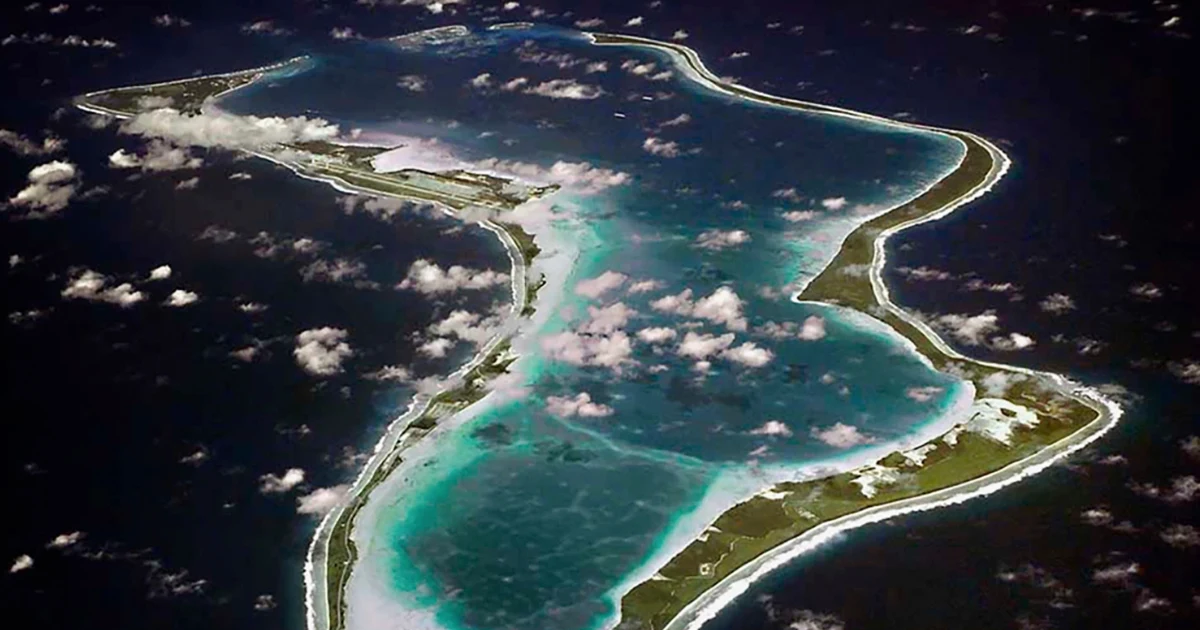
Iran Claims Long-Range Missile Capability with Attack on Diego Garcia
LONDON—Iran has launched a missile strike targeting the joint Anglo-American Diego Garcia military base in the Indian Ocean, asserting that this action demonstrates its capability for longer-range attacks than previously acknowledged.
A spokesperson from the British Ministry of Defense confirmed that the missile attack was unsuccessful on Saturday. The spokesperson stated, “Iran’s reckless actions, which have endangered the Strait of Hormuz, pose a significant threat to British interests and our allies.”
According to Iran’s semi-official Mehr news agency, Tehran fired two intermediate-range ballistic missiles at the Chagos Islands base, a British overseas territory located over 3,000 miles from Iran. Although the missiles did not hit the base, neither Iran nor Britain has disclosed the proximity of the missiles to Diego Garcia.
The distance of this attempted strike raises questions about Iran’s long-range capabilities, which it has previously denied possessing. The base is situated a similar distance from Iran as much of central Europe. However, since neither missile reached its target, it remains uncertain whether they had a payload or what the true extent of such an attack could reach.
During a recent interview with NBC News’ “Meet the Press,” Iranian Foreign Minister Abbas Araghchi commented that Iran intentionally maintains its missile range below 1,250 miles to avoid threatening other nations. The Wall Street Journal reported, citing multiple officials, that one missile was intercepted by a U.S. warship, while the other failed to launch.
Military analyst Maher emphasized that targeting Diego Garcia was a significant demonstration of Iran’s missile range potentially exceeding adversaries’ expectations. One analyst suggested that the intercepted missile could be regarded as a candidate for the longest-range missile ever downed by the United States.
Tom Karako, director of the Missile Defense Project at the Center for Strategic and International Studies, noted that Iran has been testing “large, solid-state missiles” for years, making the attack unsurprising. Speculation has long existed regarding Iran’s capability to strike beyond its claimed 1,250-mile limit, with Karako indicating that the recent event could signal Iran’s willingness to reveal those capabilities.
Military Developments and Diplomatic Strains
Friday’s missile strike occurred just before Britain announced it would permit the United States to utilize its bases, including Diego Garcia, for operations targeting threats near the Strait of Hormuz. The announcement by Prime Minister Keir Starmer’s office followed weeks of conflict, with ministers agreeing to allow U.S. military action for “defensive operations” to protect shipping in this crucial waterway.
Approximately 20% of the world’s oil supply is transported through the Strait of Hormuz, which plays a critical role in global energy trade. Since the onset of the conflict in late February, however, commercial shipping through the strait has been severely disrupted.
Former President Donald Trump has criticized the British response, describing it as slow, while questioning the competence of Starmer’s leadership by comparing him unfavorably to historic figures like Winston Churchill. Recently, he referred to NATO allies as “cowards” for not contributing warships to reopen the maritime route, despite previously stating that assistance was unnecessary.
In sharp response, Iranian Foreign Minister Abbas Araghchi accused Starmer of jeopardizing British lives by allowing the military base’s use. He emphasized that the majority of British citizens oppose involvement in what he characterizes as a conflict instigated by Israel and the U.S. Araghchi stressed that Iran would assert its rights to self-defense in light of perceived aggression.
Geopolitical Implications of Diego Garcia
Starmer has faced a challenging balance in handling Iran, attempting to maintain diplomatic relations with U.S. officials while safeguarding British interests in the Mediterranean and refraining from direct military involvement in a war that polls indicate is widely unpopular among the British public.
Diego Garcia Air Base, located approximately 3,360 miles from Iran, serves as a strategic military asset capable of hosting U.S. long-range bombers. The base’s location in the Chagos Islands not only raises military concerns but is also entwined in ongoing disputes between Britain and the Trump administration regarding the sovereignty of the territory.
In this context, President Trump has alternated between supporting the agreement to relinquish sovereignty over the islands to Mauritius and criticizing Starmer for potential concessions regarding Diego Garcia. Mauritius, an ally of China, has claimed it was coerced into ceding the islands in exchange for independence from British rule. In a landmark decision, the International Court of Justice sided with Mauritius in 2019, ruling that Britain’s occupation was unlawful.
As part of the ongoing negotiations supported by Starmer, the UK and U.S. are poised to maintain a 99-year lease on the Diego Garcia military base, further entrenching international military relationships and geopolitical dynamics in the region.
