


International Leaders Voice Concern Over Restriction of Religious Ceremony in Jerusalem
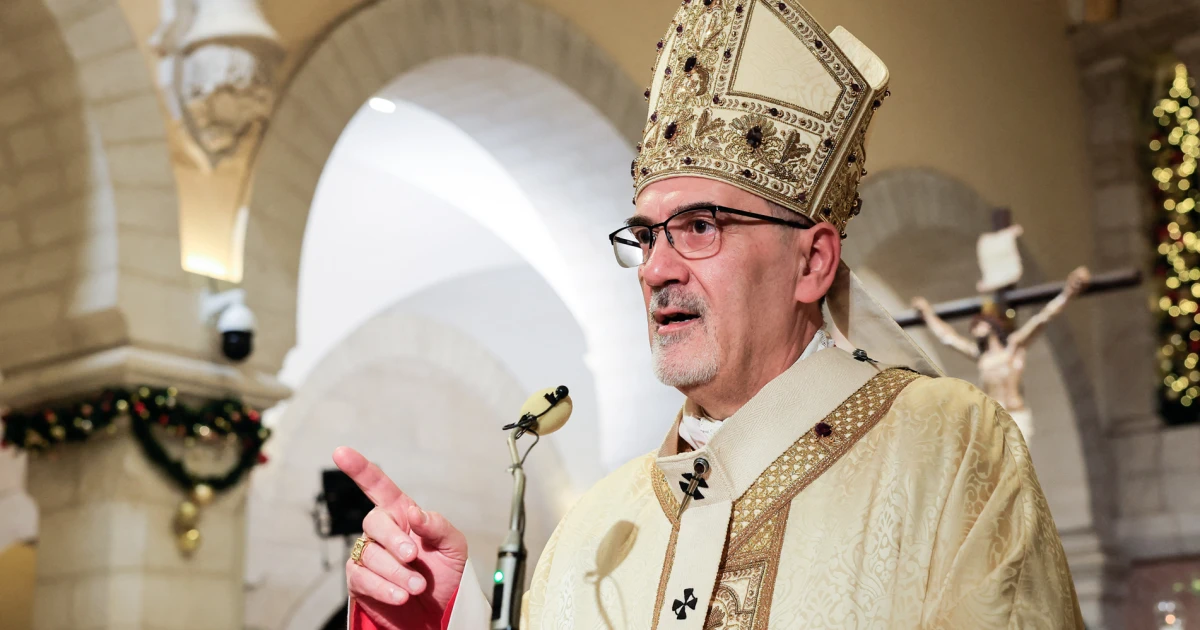
World leaders expressed alarm on Sunday after Israeli police barred Cardinal Pierbattista Pizzaballa, the Latin Patriarch of Jerusalem, from entering the Church of the Holy Sepulcher. The incident occurred as Pizzaballa was attempting to reach the historic church in Jerusalem’s Old City alongside the church’s custodian, Rev. Francesco Ierpo, to celebrate Palm Sunday mass.
The Latin Patriarchate of Jerusalem reported that the two were halted midway through their journey and ordered to turn back, an unprecedented occurrence marking the first time in centuries that Palm Sunday mass was not held at this pivotal site of Christian faith, believed by many to be the location of Jesus’s crucifixion.
In a statement, Israeli Prime Minister Benjamin Netanyahu’s office explained that police intervention was motivated by “special concern for his safety,” asserting that there was “no malicious intent whatsoever.” The statement referenced heightened tensions following the outbreak of war with Iran in February, which led to the closure of all holy sites in the Old City for worshippers, regardless of faith.
“Iran has persistently targeted the holy sites of the three Abrahamic religions in Jerusalem with ballistic missiles,” Netanyahu’s office highlighted. They noted a specific incident in which missile fragments landed perilously close to the Church of the Holy Sepulcher.
Israeli police emphasized in their statement that “freedom of religion continues to be maintained, subject to necessary restrictions.” The formal Palm Sunday procession, typically attracting thousands of Christian worshippers, had already been canceled last week due to an Israeli-imposed ban on large gatherings, a situation cited by the Latin Patriarchate as part of the “restrictions due to the conflict.”
The Latin Patriarchate characterized Pizzaballa and Ierpo’s actions as “private,” devoid of any ceremonial significance or characteristics of a public procession. A local newspaper described the police’s actions as setting a “grave precedent” and disregarding the sensitivities of billions observing the events in Jerusalem.
Political Leaders Unite in Solidarity with Cardinal Pizzaballa
Italian Prime Minister Giorgia Meloni issued a statement expressing solidarity with Pizzaballa, Ierpo, and others affected by the police intervention, condemning the refusal of entry to key religious figures as a violation of faith and a broader affront to religious freedom during significant occasions like Palm Sunday. French President Emmanuel Macron also condemned the Israeli police’s decision, labeling it an “alarming violation” of the status of Jerusalem’s holy sites.
Ahead of the incident, Pope Leo XIV began his Palm Sunday address at the Vatican by emphasizing his prayers for Christians in the Middle East. He later reiterated this message on social media following the events in Jerusalem. Meanwhile, Italy’s Deputy Prime Minister Matteo Salvini condemned the situation as “unacceptable and offensive,” while Foreign Minister Antonio Tajani announced plans to summon the Israeli ambassador for clarification on the issue.
International reactions continued with Germany’s ambassador to Israel, Steffen Seibert, labeling the incident as “suffering for all Christians.” European Parliament Vice-President Pina Picerno described the situation as a “grave, unprecedented, and unacceptable violation of religious freedom.” In light of these protests, Netanyahu’s office announced plans to establish guidelines that would allow church leaders to conduct worship at holy sites for the remainder of Easter week.
Palm Sunday commemorates Jesus Christ’s entry into Jerusalem, a day marked by the laying of palm branches in his path by his followers. As tensions persist in the region, this incident underscores the delicate interplay between political dynamics and religious expression in one of the world’s most sacred locales.
