


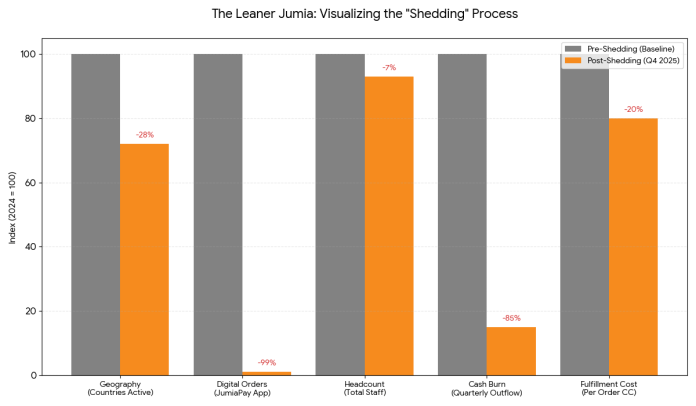
Jumia (NYSE: JMIA) has long aspired to become the “Amazon of Africa,” chasing ambitious goals across various industries and markets. However, the company’s latest report for the fourth quarter of 2025 signals a definitive pivot away from relentless expansion towards a more calculated approach under the leadership of CEO Francis Dufay. The emphasis has shifted from flashy growth metrics to sustainable unit economics, which includes making strategic cuts to its operations.
Although Jumia’s headline figures appear robust, with revenue increasing 34% year-over-year to $61.4 million and gross merchandise value (GMV) rising 36%, the underlying narrative reveals a conscious dismantling of lesser-performing areas.
Strategic Decrease in Digital Services
A critical takeaway from Jumia’s report is the deliberate downsizing in certain sectors, most notably the digital services arm, JumiaPay. The app that once processed 1.6 million orders in Q4 2024 saw its activity plummet to near zero by Q4 2025. This tactic was part of a strategy to eliminate low-margin digital transactions that only inflated transaction volumes without contributing meaningfully to revenue.
By moving away from what they termed “low-quality revenue,” Jumia refined its GMV. The 31% rise in orders for physical goods, such as electronics, fashion, and home products, indicates a more engaged and stable customer base. This is further highlighted by an increase of 422 basis points in repurchase rates, reflecting a healthier consumer relationship with the brand.
Exit from Algeria and Focus on Core Markets
Continuing its trend of geographic optimization, Jumia announced its decision to cease operations in Algeria by the first quarter of 2026, following its previous exits from South Africa and Tunisia in 2024. Algeria represented around 2% of the overall GMV, and while this decision led to initial layoffs and lease terminations, it permitted the company to funnel resources back into its core markets, particularly Nigeria, where GMV surged by 50% amidst challenging macroeconomic conditions.
This strategy underscores Jumia’s commitment to preserving and expanding its most promising markets while shedding those that unnecessarily strain its working capital.
Logistics as a Competitive Advantage
Jumia’s logistics network stands as its most significant defense against potential global competitors. According to the latest report, 61% of orders in Q4 2025 originated from inland areas—secondary cities and rural locales rather than crowded metropolitan zones. This approach differentiates Jumia from rivals; while capital cities are saturated with competition, Jumia is invested in infrastructure to serve less accessible areas. This strategy effectively shields the company from competitors who may shy away from Africa’s complex logistics landscape.
Financial Prudence and Cash Management
The company has made noteworthy strides in financial discipline, boasting liquidity of $77.8 million. Notably, net cash used in operations dropped from $26.5 million in the same period last year to just $1.7 million in Q4 2025. This improvement can be attributed to a positive working capital contribution of $9.6 million, demonstrating Jumia’s adept management of accounts payable and receivable—a hallmark of a mature retail operation.
Expansion into China’s Wholesale Market
An often-overlooked aspect of Jumia’s strategy is its recent expansion into China. The establishment of an office in Yiwu, the world’s largest wholesale market for small goods, is a significant move. In Q4, sales from overseas sellers rose by 82% year-over-year, allowing Jumia to directly source products from Chinese manufacturers. This capability not only provides the company with a competitive edge over pure marketplace platforms but also alleviates supply constraints that have previously hindered growth in various product categories.
Improved Customer Engagement Metrics
Diving into customer engagement, Jumia reported that 46% of new customers who made their first purchase in Q3 2025 returned for a second order within 90 days—up from 42% the previous year. Additionally, the company saw a 26% year-over-year increase in quarterly active customers to 3 million, while orders for physical goods jumped 32% to 7.5 million during the quarter. Further, orders from inland regions now comprise 61% of total transactions, up from 56% a year prior, validating Jumia’s long-held belief that secondary cities hold significant potential for e-commerce.
Overall, Jumia’s latest release highlights a noteworthy positive working capital contribution of $9.6 million, emphasizing the importance of cash management in a retail environment. By focusing on operational efficiency and shedding non-profitable activities, the company has positioned itself to pursue a path toward profitability, aiming for adjusted EBITDA breakeven by the fourth quarter of 2026. With an adjusted EBITDA loss of $7.3 million for the quarter—down from $13.7 million last year—Dufay’s focused approach suggests that Jumia is ready to embrace a new narrative: one centered on sustainable growth rather than rapid expansion.
