


Forecasts Suggest End to Nigeria’s Disinflationary Trend
Nigeria’s nearly year-long disinflationary trend may soon come to a halt, as new predictions indicate a resurgence in inflationary pressures primarily driven by rising fuel costs and ongoing global disruptions stemming from conflicts in the Middle East.
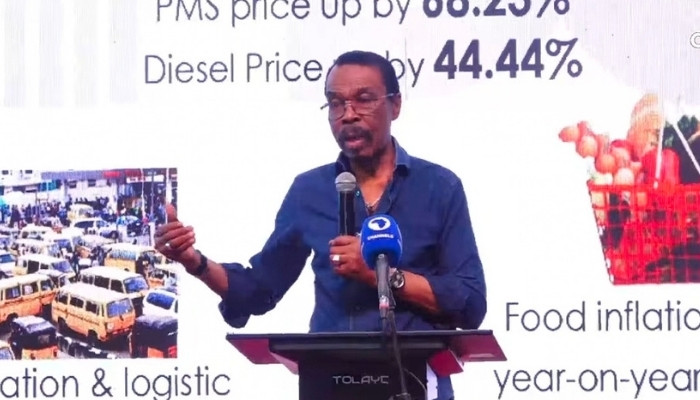
At the 2026 Economic Summit in Lagos, Bismarck Lewane, Chief Executive Officer of the Financial Derivatives Company (FDC), highlighted that inflation could escalate from 15% to approximately 19% by May. This increase poses a challenge for Nigeria’s central bank as it navigates its monetary policy.
Lewane explained the economic implications of fuel price increases: “For every 1% rise in gasoline prices, transportation costs and overall inflation climb by 0.079%.” Given that gasoline prices have surged by 42%, this equates to an inflation increase of about 3-4%. Consequently, inflation is projected to rise to around 19% in the coming months.
The impact of geopolitical tensions is palpable, particularly following the first coordinated attack on Iran by the United States and Israel. The closure of critical oil and commodity trade routes, such as the Strait of Hormuz—which accounts for 20% of global oil trade—has sent shockwaves through international markets. The ongoing conflict, now in its fourth week, has resulted in significant economic hardship.
Effects of Rising Fuel Prices on Economic Stability
In Nigeria, the economic landscape is shifting, with diesel prices now rising over 44% and petrol prices increasing by more than 68%. The FDC reports that logistics and transportation costs have surged by approximately 20%. As a result, consumer purchasing power is being severely strained, particularly as food inflation has also risen to just above 12% year-on-year, with month-on-month acceleration noted by the National Bureau of Statistics. Global supply disruptions are further exacerbating domestic price volatility, leading to heightened financial strain on households.
This confluence of factors has placed central banks in a precarious position. Policymakers will convene on May 19 and 20 to deliberate on the Monetary Policy Rate (MPR), which was decreased by 50 basis points to 26.5% in February. Lewane anticipates that justifying further rate cuts will be challenging if inflation continues to spike. He predicts that the Central Bank of Nigeria (CBN) may need to emulate the strategy of the US Federal Reserve by maintaining lower interest rates. “With inflation on the rise, the probability of the CBN further reducing interest rates is minimal,” he cautioned.
Moderate Economic Growth Amid Inflationary Pressures
Despite the challenging inflation outlook, Lewane forecasts that Nigeria’s economic growth will remain moderately positive throughout the year, with GDP expected to expand by 3.08% in the first quarter of 2026. However, he emphasized the necessity for significant structural adjustments and fiscal rebuilding to sustain growth, especially as external shocks become more pronounced.
In the short term, the naira is likely to stabilize within a range of 1,400 to 1,450 naira to the dollar, as authorities endeavor to defend the currency. Lewane expresses concern that persistent inflation and global economic headwinds will continue to exert pressure on exchange rates. Additionally, the Nigerian stock market, which has recently seen substantial gains, may begin to retract in alignment with broader global trends.
