


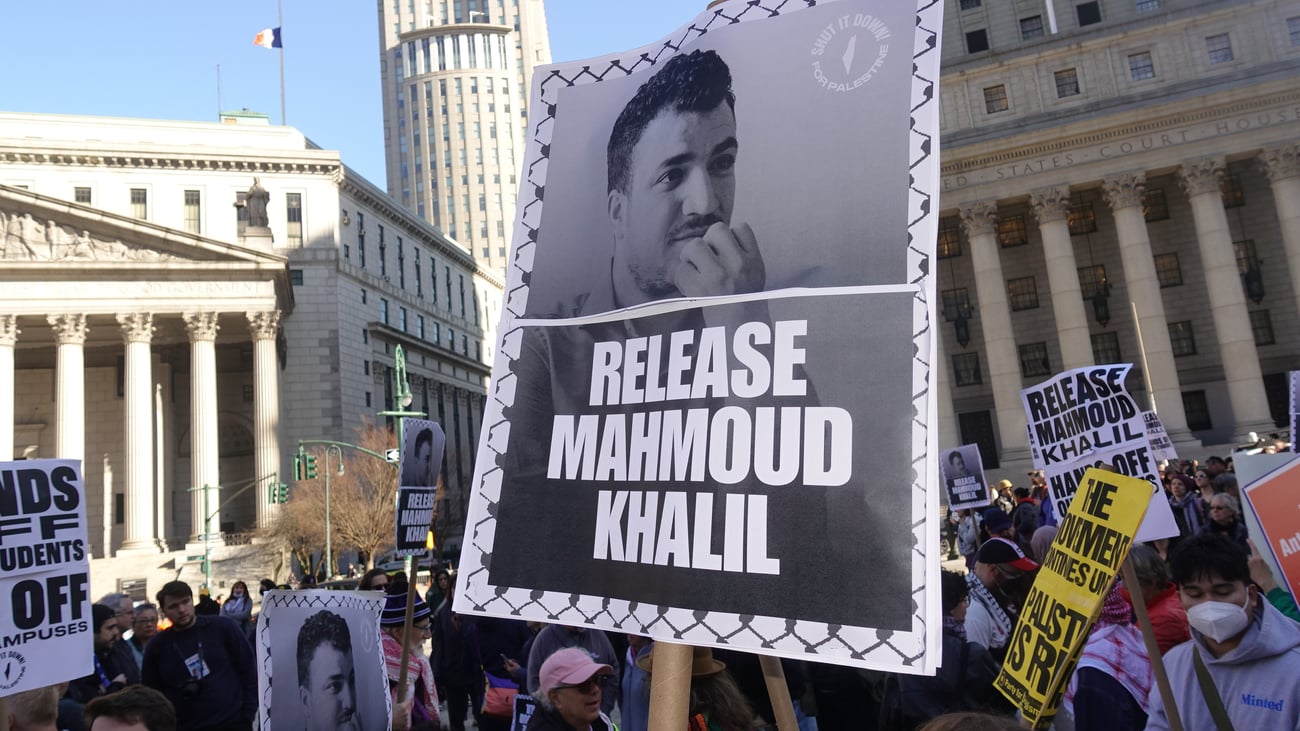
Conflict of Interest Allegations in Immigration Case
PHILADELPHIA – Mahmoud Khalil, a former Columbia University student activist, is appealing to the Third Circuit for an en banc rehearing to contest his immigration detention. Central to his appeal is the removal of Emile Bove, a judge appointed by President Trump, whose past involvement with the Justice Department raises concerns about potential conflicts of interest in Khalil’s case.
Judicial Rulings on Detention
A federal judge in New Jersey found in June 2025 that Khalil’s prolonged detention by federal authorities, as they sought to deport him, likely violated constitutional rights. However, this decision was reversed in January by a three-judge panel of the Third Circuit, which determined that the lower court lacked the jurisdiction to consider Khalil’s release—stating that only immigration judges hold that authority.
Petition for Reconsideration
Khalil, a 31-year-old green card holder with a U.S. citizen wife and son, is pursuing a motion for en banc reconsideration, labeling the matter “extremely important” for the full court’s review. In addition to this request, he filed a motion the following day to exclude Judge Bove from participating in the reconsideration process.
Concerns About Judge Bove’s Role
Khalil claims that Bove’s previous role in the Justice Department, particularly in overseeing investigations related to student protests, poses a significant conflict. He pointed out that Bove was involved in supervising the federal investigations surrounding pro-Palestinian protests, including those at Columbia University, where Khalil allegedly played a significant role.
Evidence of Involvement in Investigations
Khalil referenced public records and Bove’s own statements to suggest that Bove was actively directing the government’s inquiries into student activities tied to pro-Palestinian advocacy. These investigations have drawn significant media attention, leading Khalil to assert that the public perception would be one of bias regarding Bove’s participation in his case.
Recusal Request and Judge’s Nomination Process
In his motion, Khalil observed that while only Judge Bove can decide whether to recuse himself, he urged Bove to take that step. Khalil reminded the court that during the judicial nomination proceedings, Bove expressed an intention to recuse from cases where he had personal involvement.
Community Support and Historical Context
Bove’s transfer to the Third Circuit in September 2025 faced significant backlash, with over 75 former state and federal judges and upwards of 900 ex-Justice Department attorneys opposing his appointment. Notably, during his time as attorney general, Bove oversaw the dismissal of corruption charges against former New York Mayor Eric Adams and has been accused by multiple whistleblowers of deliberately violating federal court orders related to immigrant deportations.
Background of Khalil’s Detention
Khalil was taken into custody by Immigration and Customs Enforcement in March 2025 due to his advocacy for pro-Palestinian causes and served as the chief negotiator for student protests, promoting engagement with universities and encouraging students to take a stance against Israel. The State Department invoked a rarely utilized provision of the Immigration and Nationality Act, seeking to deport him based on claims that his activism adversely impacted U.S. foreign policy.
Lebanon-born Khalil was eventually released after U.S. District Judge Michael Fabiaz, appointed by President Biden, determined he presented no risk of flight or danger to society. Despite the setback from the Third Circuit’s decision to reverse the lower court ruling, the panel provided Khalil with an opportunity for immediate reconsideration, ensuring he would not be held while the matter is pending.
