


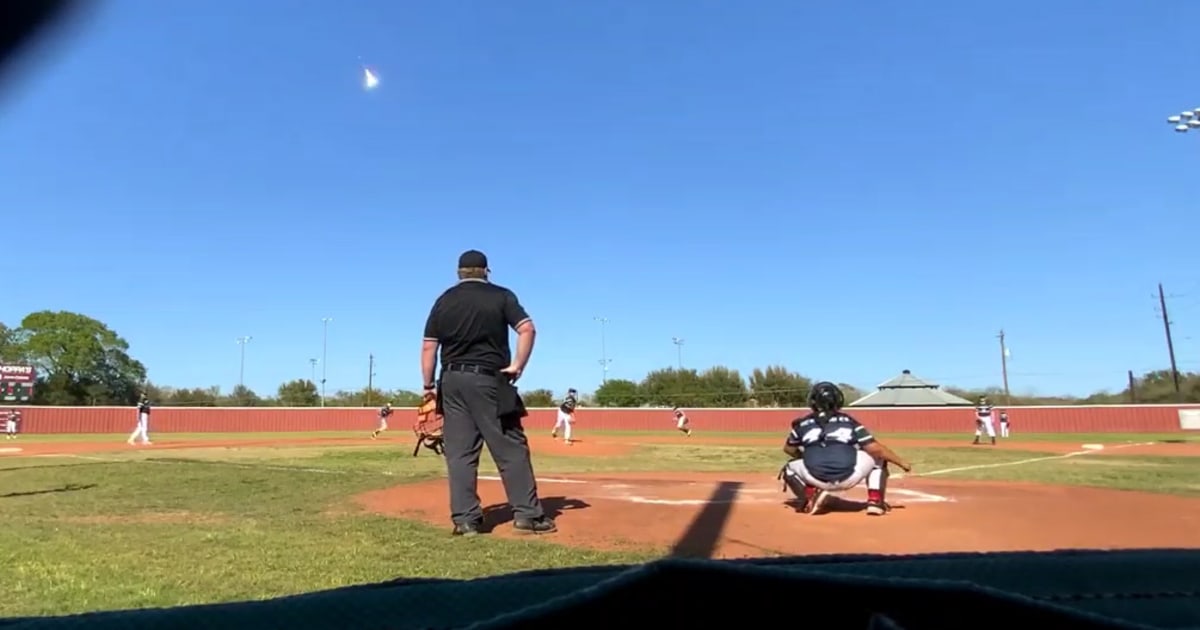
Meteor Event Confirmed Over Southeast Texas
A luminous fireball observed over southeast Texas on Saturday afternoon has been identified as a meteor that likely disintegrated over the Houston area, according to NASA.
Eyewitness Accounts Capture the Event
Residents across the greater Houston area provided numerous accounts of the event, including footage from doorbell cameras, car dash cams, and even video captured during a Little League baseball game. These recordings showcased bright streaks of light racing across the clear blue sky. The meteor event was first observed at 4:40 p.m. local time in Stagecoach, located in northwest Houston.
Meteor’s Path and Sonic Boom
The meteor traveled southeast at an astonishing speed of 35,000 miles per hour before breaking apart at an altitude of 49 miles above Bummel, just west of Cypress Station, as noted in a post from NASA on social media.
Estimated Size and Impact of the Meteorite
Initial assessments indicated the meteor was approximately three feet in diameter and weighed around one ton. Upon entering Earth’s atmosphere, the meteor created pressure waves that generated a sonic boom audible to some in the vicinity.
Residential Damage Reported
Shelley James, a resident of the Houston area, reported that debris from the meteorite may have crashed through her home’s roof that same afternoon. While in her bathroom, James heard loud thuds emanating from her daughter’s room. Upon investigation, she discovered damage to the floor and a significant hole in the ceiling.
Discovery of the Meteorite
Next to her daughter’s bed, James found what she described as a “large black rock.” Intrigued, she reached out to her grandson to share her find, questioning if it could be a meteorite. Despite the dramatic nature of the incident, she confirmed that none of her family members were injured as a result of the falling debris.
Tracking and Analysis of the Meteor Event
The American Meteor Society reported receiving over 140 sighting reports related to meteors on Saturday, covering areas from south-central to southeastern Texas, including Houston, Katy, College Station, San Antonio, and Austin. NASA’s Doppler weather radar indicated that the meteorite may have impacted a stretch of Houston between Willowbrook and Northgate Crossing.
Recent Meteor Activity
This sighting follows closely on the heels of another fireball observed just four days earlier in parts of northeastern Ohio and Pennsylvania. Bill Cook, head of NASA’s Meteor Environment Office, explained that this prior event was initiated by a small asteroid weighing about seven tons and measuring six feet in diameter. The asteroid’s disintegration released energy comparable to 250 tons of TNT as it shattered over Valley City, Ohio, likely producing smaller meteorites around Medina County.
Rarity of Large Meteor Events
Although large meteors that create striking fireballs are relatively unusual, they are not completely uncommon. NASA notes that tiny space rocks, dust particles, and remnants from old rockets enter Earth’s atmosphere daily, but most incinerate harmlessly before reaching the ground.
