


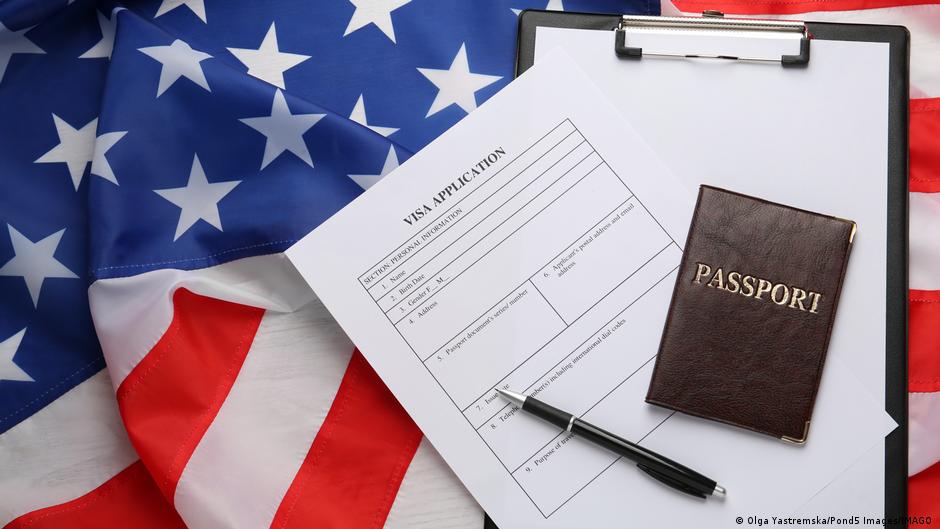
The United States is further tightening its immigration policies after President Donald Trump’s administration decided to suspend visa processing for applicants from 75 countries, a third of them in Africa.
Affected African countries include Egypt, Ethiopia, Tanzania, Uganda, Somalia, Sudan, and South Sudan. In West Africa, Ghana, Cameroon, Ivory Coast, Gambia, Liberia, Togo, Nigeria, Sierra Leone and Senegal also face U.S. visa restrictions.
The visa ban goes into effect on January 21, 2026, and applies to individuals who wish to live and work in the United States permanently.
With the move, Washington says it will end “abuse of the immigration system by those seeking to line their own pockets at the expense of the United States.”
“President Trump has been clear that immigrants must be economically self-sufficient and not become an economic burden on Americans,” State Department spokesman Philip Assis, director of the Africa Regional Media Hub in Johannesburg, told DW.
Are only wealthy immigrants welcome?
“The State Department is currently conducting a comprehensive review of all policies, regulations, and guidelines to ensure that immigrants from these high-risk countries do not claim Social Security or become dependent on government assistance in the United States,” Assis said, adding that tourist visas will not be affected.
The period of suspension of activities is unknown. However, Assis says nationals of the affected countries can still submit visa applications.
However, entry visas will not be issued to these nationals during the suspension period.
“Other visas, such as tourists, athletes and their families, and media members visiting the United States for the FIFA World Cup, are not affected,” he added.
The United States will host the 2026 World Cup along with Mexico and Canada. Additionally, Los Angeles is slated to host the 2028 Olympic Games. The United States is touting the Games as a moment that unites humanity.
At the same time, President Trump is continuing the policy he began last November to “permanently block immigration from low- and middle-income countries.”
In December, the US government suspended entry applications for citizens of 18 countries and imposed entry bans on citizens of seven countries. Some affected countries, including Mali and Burkina Faso, responded with similar restrictions on the entry of U.S. citizens.
Nationalism shapes Trump’s MAGA movement
“We must not forget that Trump campaigned on the slogan ‘Make America Great Again’ (MAGA), and that nationalism and self-sufficiency are central features of this movement,” said Fredson Gilleng, a political scientist at the Rosa Luxembourg Foundation’s South Africa office.
He explained that the MAGA movement is focused on protecting American workers and taxpayers. “Immigrants are portrayed by the current administration and Trump as a threat to American society, so it’s important that they gain more support within their own movement,” Gilleng told DW.
Experts see US immigration policy as a setback for the long-standing relationship between the two continents. “For Senegal, the implications are profound. Plans to study, work and reunite with families will be thwarted. This decision sends the wrong signal and requires a diplomatic response and a strong defense,” said Boubacar Sayet, president of Horizons Without Borders, a Dakar-based migrant rights non-governmental organization.
“The ‘overstay’ argument (on visas) is greatly exaggerated,” Sayet said, referring to the US government’s purported concerns about immigration. “It punishes an entire group for the actions of a minority (…) This justification is primarily used to enforce restrictive immigration policies.”
Nevertheless, the United States is a country that offers opportunities at many levels, even for those who are unqualified, Sayet added.
“Visa restrictions are dangerous for all young people, whether they come from Latin America or Europe, but especially for us in the Sahel and the affected countries,” Ahmedou Ould Abdallah, former Mauritanian foreign minister and ambassador to the United Nations and now director of the Center 4S Institute, told DW.
Is President Trump targeting the Sahel Alliance?
U.S. visa regulations appear to be particularly targeted at countries that make up the Sahel alliance, Ould Abdallah said. “This is not good news for young people in these countries because they are generally not politicized and they don’t have elections to know who to vote for or not to vote for,” he said.
He added that this policy does not seem wise for African countries.
Immigrants are not about hiding from political difficulties, he explained, but “more about being able to work more freely, succeed and compete on a level playing field, without being bound by religious, tribal, regional or family affiliation.”
The Democratic Republic of Congo is also affected by the visa ban. Fred Bauma, executive director of the Ebteri Institute in Kinshasa, finds this contradictory. “It’s not just Congo (the Democratic Republic of the Congo) where you see this contradiction,” Bauma said. “There are other countries that are rich in resources and desperately needed by the United States, but are excluded from any movement,” he told DW.
Bauma cited Angola as an example of a resource-rich country that is subject to U.S. visa restrictions. “The Lobito Corridor infrastructure project makes Angola central to U.S. strategy in the Southern African region.”
He added that such strategies reinforce the idea that competition for resources is more important than cooperation with states. “This is clearly a dangerous and prejudicial view for countries in the Global South who want to go beyond simple exchange of goods.”
But Gilleng says cultural identity politics also play a role. “These restrictions demonstrate a desire to preserve ‘American culture’ by allowing fewer and fewer people with different identities to come and settle in America,” Gilleng calls this “exclusionary populism.”
As a result, people suffer from exclusion. According to him, immigration is not an economic burden. But in return, they contribute to economic growth and society. “It’s not true that suspending (admission to the U.S.) 75 countries will protect the U.S. economy. It could have the opposite effect.”
This article was originally written in German.
Editor: Crispin Mwakideu
