


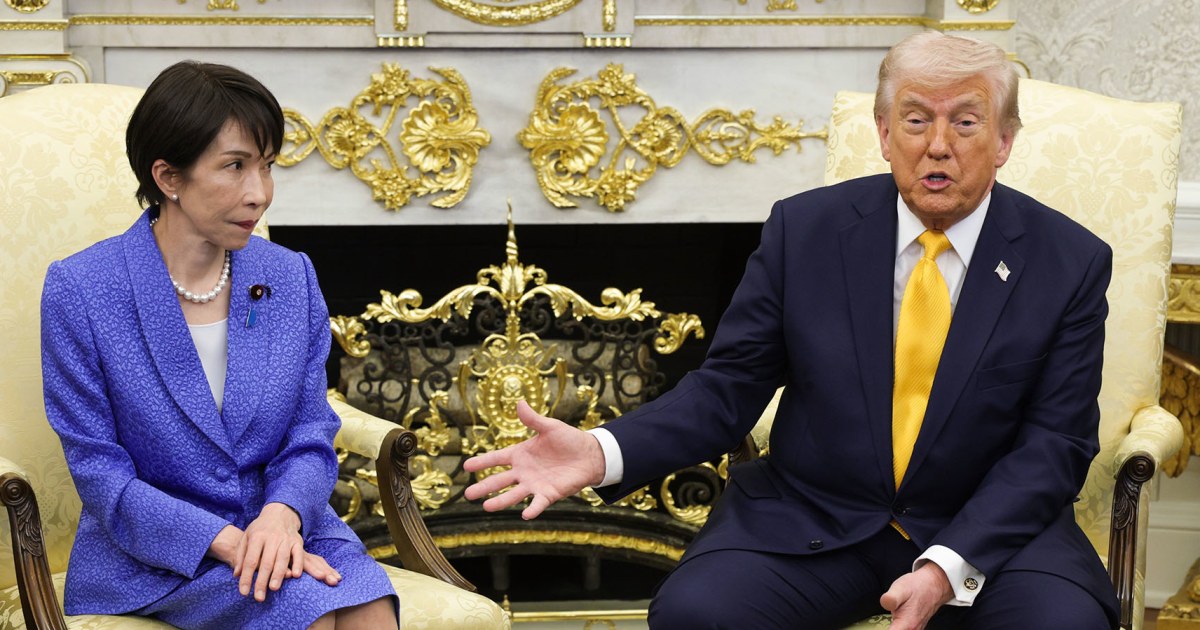
President Discusses U.S. and Israeli Operations in Iran During Meeting with Japanese Prime Minister
President Donald Trump addressed the recent U.S. and Israeli military operations against Iran in a meeting with Japanese Prime Minister Sanae Takaichi at the White House. He referenced Japan’s infamous attack on Pearl Harbor in December 1941, highlighting the element of surprise in military strategy.
When reporters inquired why the U.S. did not inform Japan or its other allies about the impending strike on Iran, Trump remarked, “We worked very hard, but we didn’t tell anyone about it because we wanted a surprise. Who knows more about surprises than Japan? Okay, why didn’t you tell me about Pearl Harbor?”
Trump continued by emphasizing the importance of surprise in military operations, stating, “I think you believe in surprise attacks more than we do,” while referencing Japan’s actions during World War II, which ultimately led the United States to enter the conflict.
Despite their past as adversaries, the U.S. and Japan have maintained a strong alliance since signing a peace treaty in 1951 following World War II’s conclusion, which included the dropping of atomic bombs on Hiroshima and Nagasaki.
His comments sparked laughter in the Oval Office, where Vice President J.D. Vance, Secretary of State Marco Rubio, Defense Secretary Pete Hegseth, and other officials were present along with members of the Japanese delegation and the press corps.
Trump explained that the element of surprise was crucial in the ongoing military actions against Iran, which began last month with coordinated strikes by the U.S. and Israel. “We had to surprise them, and we did. Because of that surprise, we probably beat 50 percent of what we were supposed to do in the first two days — a lot more than we expected,” he elaborated.
Additionally, President Trump characterized the military campaign as significantly effective, stating to NBC News in a phone interview that U.S. airstrikes had “completely destroyed” much of Kharg Island, a key strategic location off Iran’s coast. He humorously added that further strikes could be conducted “just for fun.”
During this bilateral meeting, discussions also covered future military funding and the impact of the ongoing conflict on global oil prices. The Washington Post reported that the Pentagon anticipates requesting $200 billion from Congress to support military operations in Iran.
Trump acknowledged the reported figure, commenting that the high funding demand was influenced by broader geopolitical instability beyond just the situation in Iran. “This is a very unstable world, and the power of military equipment, some of the weapons, is unimaginable,” he noted, suggesting that if necessary, he could bring the situation to a swift conclusion.
The president addressed concerns over rising oil prices, noting that they have not escalated as dramatically as initially feared. His remarks coincided with rising prices following Iran’s effective closure of the Strait of Hormuz, a crucial maritime route. “Everything was going great, the economy was great, oil prices were very low, gas was going down,” Trump stated, reflecting on the economic implications of the conflict. He did, however, express a belief that oil prices would inch higher as a result of U.S. military actions, albeit acknowledging that the overall impact might not be as severe as once anticipated.
