


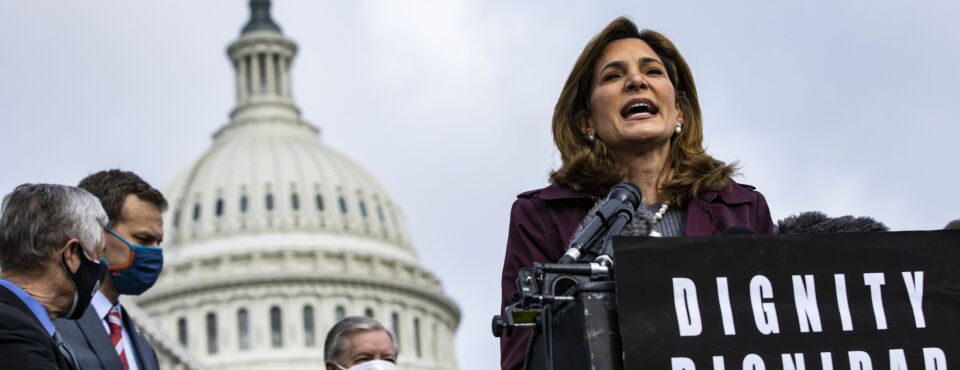
Bipartisan Immigration Bill Fuels Republican Divide
This week, an unexpected bipartisan immigration proposal ignited a conflict within the Republican Party, showcasing the deepening divide between hardliners and moderates. The rift has been exacerbated by widespread criticism of President Donald Trump’s deportation policies.
The tensions became apparent on social media, where Republican lawmakers engaged in sharp exchanges while discussing the bipartisan initiative spearheaded by Rep. Maria Elvira Salazar (R-Fla.). The proposal aims to offer legal status to certain undocumented immigrants residing in the U.S.
Aaron Reichlin-Melnick, a senior fellow at the American Immigration Council, described the situation as a conservative struggle between traditional immigration values and a more rigid, uncompromising stance. This internal conflict highlights the various approaches within the Republican Party regarding immigration reform, with some lawmakers advocating for compromise in response to changing public sentiments, while hardliners firmly oppose any initiatives perceived as lenient on deportations.
The Dignity Act, known informally as “Dignidad,” gained prominence recently after Rep. Mike Lawler (R-N.Y.) championed it in a Fox News interview. Lawler asserted that the bill, initially introduced in 2023 and reintroduced the following year, boasts substantial bipartisan support, claiming that more lawmakers are backing it this time due to an increasing public acknowledgment of the immigration problem.
Lawler’s comments quickly faced backlash from pro-Trump Republicans, including Rep. Brandon Gill (R-Texas), who labeled the proposal as “amnesty,” triggering heated online disputes among party members. The criticism extended to prominent conservative figures who argued that the bill’s title, not being in English, warranted rejection from all Republicans.
In response to her critics, Salazar asserted that her bill does not constitute amnesty, arguing that it enforces accountability through fines and penalties. She emphasized that the Dignity Act incorporates stringent measures and presents a fairer alternative to the current immigration system. Supporters of the bill contend that the rising endorsement from legislators and business entities reflects a shift in the political landscape.
Growing Bipartisan Support for Immigration Reform
Although a vote on Salazar’s bill (HR 4393) is not anticipated this year, it has emerged as one of the few bipartisan immigration initiatives currently under discussion. Moderates from both parties are increasingly recognizing the need for legislative solutions to the escalating border and immigration issues that threaten political stability. Notably, 20 Republicans and 20 Democrats have signed onto the bill.
The proposed legislation would create a pathway to legal status for specific undocumented immigrants, contingent upon fines, restitution, background checks, and sustained employment. In tandem with these provisions, the bill includes enhanced enforcement measures, such as improved border security and workplace verification.
Despite its growing traction, opposition remains, particularly from conservative factions. Lora Reese, director of the Heritage Foundation’s Border Security and Immigration Center, noted a significant backlash against the Dignity Act, asserting that it detracts from the party’s commitment to Trump’s mass deportation agenda.
In contrast, Todd Schulte, president of the advocacy group Fwd.us, asserted that the bill represents a meaningful compromise as lawmakers navigate the political realities in the run-up to the next election. Recent polling data underpins this urgency; a joint poll conducted by ABC News, The Washington Post, and Ipsos revealed an almost even split in public opinion regarding coercive immigration tactics.
Deborah Fleischaker, a former senior official at the Department of Homeland Security and current member of the nonpartisan civil rights group UnidosUS, pointed to declining approval ratings as indicative of growing public concern over enforcement strategies. She argued that the Dignity Act serves as an acknowledgment of these realities, reinforcing the pressure on lawmakers to respond to constituent feedback.
Signs of Potential Change in Republican Immigration Policy
The ongoing disputes within the Republican Party may, according to some analysts, indicate potential progress in immigration discourse. Sarah Pearce, director of social policy at Third Way, remarked that this backlash could prompt a more constructive dialogue on the path forward.
Both Pearce and Reichlin-Melnick noted that many Republicans are becoming increasingly mindful of shifting polling insights, Democratic gains in key states, and contentious debates surrounding immigration enforcement funding. Fleischaker emphasized that rising deportation rates during the Trump administration might further amplify public dissatisfaction and exert additional pressure on lawmakers to adapt.
Nonetheless, hardline opposition is poised to remain significant. Representative Nancy Mace (R-S.C.) defiantly stated, “We will not bend. We will not break. No to the DIGNIDAD Act,” underscoring the ongoing challenge for legislators seeking to navigate the contentious immigration landscape within their party.
