


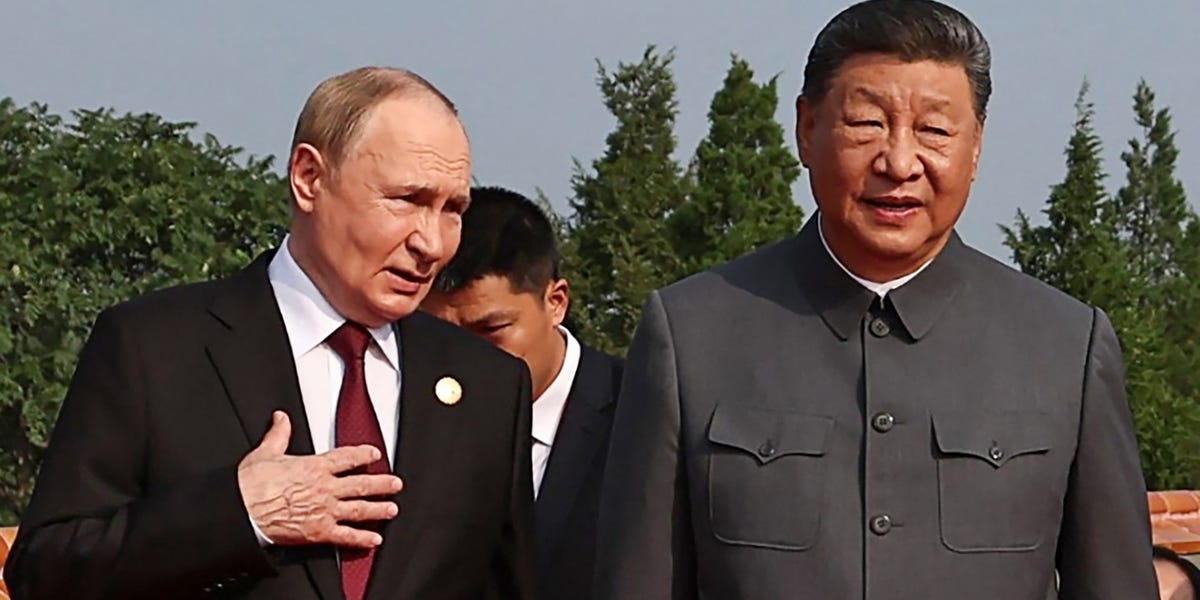
The Kremlin’s wartime pivot to Beijing helped keep the Russian economy afloat under the weight of widespread Western sanctions, but it also came at a high cost.
This line, which now looks like a lifeline, could lock Russia into a long-term role as Beijing’s junior economic partner. Russia now relies heavily on China for key industrial products and advanced inputs that are currently blocked by Western sanctions, according to a report released Friday by the Atlantic Council think tank.
“Economically and politically, Russia-China relations are at the same time highly asymmetric and mutually beneficial,” wrote Elina Rybakova, non-resident senior fellow at the Peterson Institute for International Economics, and Lucas Reisinger, economic analyst and non-resident researcher at the Kyiv School of Economics.
China is buying large amounts of Russian oil at discounted prices to make up for lost European customers, while Russia is buying machinery, vehicles and electronics from East Asian giants amid Western boycotts and sanctions.
“This is a complete and embarrassing reversal in relations compared to the 2000s, when Russia exported more value-added products to China,” the analysts wrote.
Since Russia’s full-scale invasion of Ukraine in February 2022, the Kremlin has steered the country’s economy to a wartime state. Heavy defense and government spending has helped maintain sales resilience despite sanctions and export restrictions.
However, rifts are emerging as energy export revenues have fallen sharply in an environment of low oil prices. Inflation remains high and consumer demand is sluggish.
Russia needs China more than China needs Russia
Currently, China accounts for the majority of Russia’s imports, and the majority of trade with China is settled in Chinese renminbi.
Russia will become China’s largest crude oil supplier in 2023, but will only account for one-fifth of China’s crude oil imports. Meanwhile, oil and gas revenues account for a real third of Russia’s budget inflows.
Indeed, China needs global buyers for its large-scale manufacturing, and Russia is one of them. Still, the benefits are “much more important to Russia than to China,” the analysts wrote, because Beijing is not as dependent on Moscow as Europe was on Russian energy.
He added: “From an economic point of view, China is not a better trading partner for Russia than the European Union. China buys oil and gas at lower prices, invests much less in Russia, and Chinese products are often technologically inferior.”
This strained relationship gives the Chinese government significant leverage in negotiations and transactions. China buys Russian oil at deep discounts, knowing that Moscow’s alternatives are limited.
“Although Russia has not become a client state of China, at least not to the extent that it would attack NATO just to distract the alliance from the Taiwan war, Russia is certainly a junior partner in an ‘open-ended’ partnership,” the analysts wrote.
