


Written by Nasir IM Jagaba
December 21, 2025
jagabanasiru@gmail.com
For more than a decade, Nigeria has endured a relentless wave of terrorism and large-scale banditry that has claimed tens of thousands of lives, displaced millions and left entire regions in ruins. From the kidnapping of schoolgirls in Chibok to mass murders and bombings in the Middle Belt.
The vast majority of victims on the Abuja-Kaduna passenger train were unarmed civilians.
The root cause of Nigeria’s tragedy is not a lack of military strength. The country has a trained military, intelligence assets, and international partnerships. What has consistently failed is political resolve, compounded by the role of influential voices that have normalized, legitimized, and indirectly sheltered terrorists under the language of dialogue, ethnicity, or religious fraternity.
At the center of this troubling pattern are Sheikh Ahmad Gumi and Professor Usman Yusuf. These are two public figures whose words, actions and relationships demand more scrutiny than respect.
Documenting the presence of terrorists in shelters
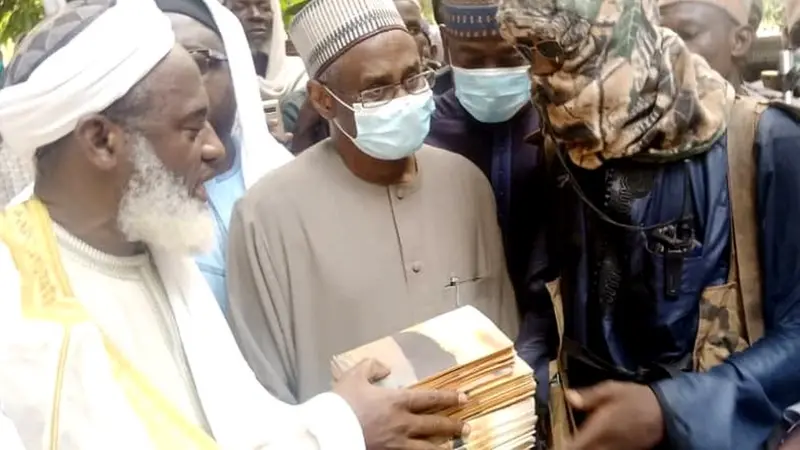
Before discussing motives and rhetoric, a basic fact must be clearly stated. Sheikh Ahmad Gumi and Professor Usman Yusuf have been seen numerous times in photos and videos holding court with armed terrorists inside forest shelters across several states in Nigeria. These were not chance encounters or hand-me-downs. These were direct, documented meetings held deep in areas controlled by bandit and terrorist groups.
Such repeated access establishes an inescapable reality. Anyone who can constantly encounter terrorists within their base knows who they are, where they are, and how to get to them. In a country where security agencies frequently cite information gaps as a constraint, this level of familiarity raises serious questions. If these individuals have such access and knowledge, Nigerians have the right to ask why this access did not lead to the exposure, disruption, and dismantling of terrorist networks, but was instead matched with public advocacy that appeared to soften, excuse, and rationalize their violence.
From mediation to legitimation: The group problem
Since around 2020, Sheikh Ahmad Gumi has openly entered bandit-controlled forests throughout Zamfara and neighboring states, calling himself a mediator. These visits were not secret. They were widely broadcast and recorded by BBC Hausa (June 2021), Channels Television (July 2021) and Daily Trust (2021).
Importantly, these encounters produced photographs and video footage showing Gumi openly sitting with armed bandit leaders in forest enclaves. These images contain an inescapable meaning. Anyone who repeatedly encounters terrorists within their base knows who they are, where they operate, and how they reach them.
However, rather than using this access to expose terrorist networks, Gumi consistently positioned himself as their public interpreter, often describing them in collective and possessive terms such as “our boys” and “our warriors” (mayakham) in television interviews.
In any anti-terrorism doctrine, such language blurs the line between mediation and moral support. It raises fundamental questions for Nigerians to answer.
If these people knew so much about terrorists, why were the people not clearly and unambiguously informed about how these groups would attack villages, massacre civilians, and wage war on the Nigerian state?
Negotiation for murderers, silence for victims
Despite repeated “peace negotiations”, violence did not decrease. It escalated. Kidnappings spread from remote villages to highways, schools and railway infrastructure, culminating in the attack on the Abuja-Kaduna train on March 28, 2022.
In return for disarmament, the terrorists received:
Open to the public
sympathetic public voice
political and ideological covers
Fundamental moral questions arise when negotiations are conducted with murderers. Who is responsible for the blood that has already been spilled?
When Sheikh Gumi and his allies talk about bandits using Hausa’s inclusive pronouns “we” and “us,” they inadvertently frame mass atrocities as collective grievances rather than criminal acts.
Such a framework risks transforming terrorism into an ethnic or communal cause rather than its original purpose of organized violent crime and war against civilians.
Groups with growing concerns
The arrest of Tukur Mam, Gumi’s close aide and self-proclaimed negotiator, heightened public concern. On September 7, 2022, Mam was arrested in Cairo, deported to Nigeria, and detained by security agencies. Authorities said he was found with items allegedly related to terrorist logistics (Premium Times, September 2022, Channels TV, September 2022).
Mamu appeared next to Gumi many times during the “peace conference” with the bandits. However, kidnapping incidents continued unabated throughout this period. This inevitably raises the following worrying questions:
Were these engagements aimed at ending terrorism or controlling terrorism?
Previously, Sheikh Gumi himself had attracted international attention. In 2010, Saudi authorities detained Umar Farouk Abdulmutallab, a Nigerian man involved in the attempted Christmas plane bombing, following intelligence concerns related to him (New York Times, January 2010). Most recently, Saudi Arabia reportedly denied him entry for Hajj in May 2025.
Such actions by foreign governments may be controversial, but taken together they form a pattern that merits investigation rather than dismissal.
Usman Yusuf and the ethnicization of terrorism
Professor Usman Yusuf, former director-general of the National Health Insurance System (NHIS), has emerged as a vocal critic of military operations against armed terrorist groups.
Yusuf opposes decisive action, branding counterterrorism efforts as an attack on “Fulani people.” This argument is not just flawed; That’s dangerous.
Traditional rulers in the north, security briefings, and media surveys have repeatedly acknowledged that a significant proportion of bandit groups are Fulani, although they do not suggest that Fulani identity itself is criminal.
Terrorism is not ethnic. It’s a crime.
According to Yusuf’s logic, opposing military action against armed militias on the grounds of ethnic identity means that such groups have the implicit right to raid villages, displace other ethnic communities, and commit mass murder without resistance. This is morally and legally absurd.
selective mercy, selective justice
Professor Yusuf’s public records have also drawn scrutiny. During his tenure at NHIS, he faced allegations of financial mismanagement reported by Premium Times (October 2018) and The Punch (December 2018). Although he has denied any wrongdoing and no final conviction was recorded, these unresolved issues remain part of the public record.
It is therefore natural to ask why a former civil servant facing unresolved liability issues is now positioning himself as a defender of armed groups, even as civilians continue to die.
When terrorism becomes a political asset
Media investigations by Daily Trust (June 2020) and Premium Times (February 2021) document state-level arrangements that reward bandit leaders with rewards and settlements in exchange for temporary ceasefires. Security analysts cited by The Guardian (August 2021) and International Crisis Group (2020-2023) warned that such deals often preserve terrorist networks as political leverage, especially during election periods. If armed groups are maintained as a bargaining tool, terrorism becomes more than just a security failure, it becomes a political strategy and a grave betrayal of the Nigerian people.
Tinubu’s moment of truth
President Bola Ahmed Tinubu faces a decisive test. Ending insecurity requires putting national survival above political calculations, resisting elite pressure from those whose peace is threatened, and supporting unquestionably professional military leadership.
The defense leadership under General Christopher Musa is focused on coordination, discipline and results. Such efforts will not succeed while influential voices undermine operations through ethnic or religious narratives.
Calls for investigation and accountability
Criticism alone is no longer enough. Research is essential.
Nigeria’s security and judicial institutions should investigate:
Public advocacy that appears to normalize or defend armed groups
Financial and logistics networks that support terrorism
The role of a mediator who advocates for peace while violence continues.
International partners should also consider credible evidence under frameworks such as the Global Magnitsky Act and the Leahy Act where facilitation of terrorism is established.
Holy robes must not become shields for unholy alliances.
Conclusion:
Please stop violent negotiations
The victims of Nigeria’s war on terror, schoolchildren, farmers, commuters, and worshipers, were not combatants. they were citizens. This war will not be won by ethnicizing crimes, glorifying murderers, or negotiating from moral weakness. It will be won through truth, accountability and political courage.
Nigeria must stop negotiating with terrorism and start defeating it.
