


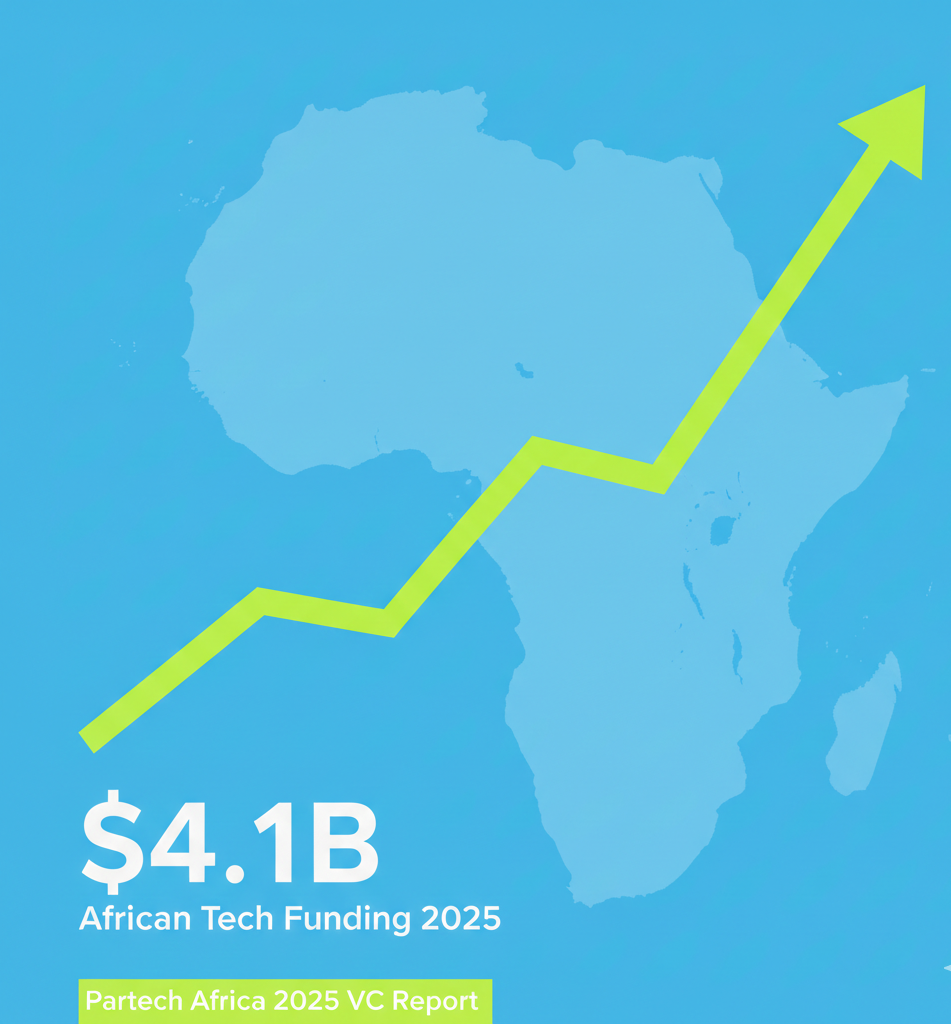
After two years of significant decline, African technology funding is staging a comeback. According to Partec Africa’s 2025 Africa Tech VC Report, total investment within the continent’s startup ecosystem is projected to reach $4.1 billion in 2025, marking a 25% increase from the $3.25 billion raised in 2024. This represents the highest funding levels since 2022. However, beyond the headline figures, the underlying narrative is more complex, structured, and ultimately more intriguing.
This revival does not mirror the exuberance of 2021; rather, it reflects a healthier and more sustainable landscape.
Funding Figures Demand Clarification
The $4.1 billion figure reported by Partec Africa combines both equity and debt financing. While equity—typically the preferred method of venture capital wherein investors acquire stakes in companies—saw only modest growth to $2.4 billion, an 8% rise from the previous year, the number of transactions remained notably stable, with only a 1% year-on-year increase.
The surge in funding news, however, is attributed to debt financing.
A historic $1.64 billion in debt financing was secured by African tech startups in 2025, a remarkable 63% increase from the prior year, marking the highest level ever recorded on the continent. Debt financing accounted for 41% of total funding in 2025, a significant rise from just 17% in 2019. This marks a shift in the funding landscape, suggesting a maturation of African startups rather than a mere return to optimistic investor sentiment.
Capital Concentration Across Key Markets
As observed in previous years, capital remains heavily concentrated within four main markets: Kenya, South Africa, Egypt, and Nigeria, which collectively received 72% of total funding in 2025, up from 69% in 2024. These nations also closed 68% of all deals across the continent. However, noteworthy variations exist within this elite group.
Kenya emerged as a leader in 2025, leveraging its debt advantage to facilitate four of Africa’s nine mega deals, totaling $1.04 billion—an impressive 72% year-on-year growth. Notably, these four transactions accounted for approximately $610 million, or 60% of Kenya’s total funding.
South Africa reclaimed its position as the frontrunner in equity raised, securing $643 million—a 41% increase year-on-year—and showing a 27% rise in the number of equity deals with 85 rounds. Notably, only one transaction surpassed $100 million, signifying widespread rather than isolated growth.
Egypt sustained its reputation as one of Africa’s most active markets, maintaining a steady pipeline of 100 deals—up 4% year-on-year—and experiencing an increase in ticket sizes. Conversely, Nigeria was the sole market among the top four to experience a decline, with equity funding down 21% and deal volume reduced by 19%. This suggests a return to more normalized conditions following a peak in substantial transactions in 2021.
Fintech Dominance and Sector Shifts
Fintech remains the largest sector by both funding and number of deals, raising $1.49 billion across 150 transactions. However, its share of total equity financing dipped markedly from 60% in 2024 to 32% in 2025. This decline is indicative of a normalization process rather than a downturn, with other sectors beginning to attract substantial investment alongside it.
Cleantech emerged as a standout performer, nearly doubling its funding to $1.18 billion—an astounding 99% increase year-over-year. Other sectors such as Enterprise Software ($274 million, up 74% year-over-year), e-commerce ($312 million, up 74% year-over-year), and Health Tech ($224 million, up 232% year-over-year) all surpassed $200 million in annual equity fundraising for the first time since the 2021-2022 boom. This growth across a more diverse set of sectors indicates that business models are maturing and investor confidence is deepening.
The Unseen Challenges of Startup Growth
Despite these encouraging trends, the pipeline for seed funding—the lifeblood of a thriving startup ecosystem—continues to shrink. The number of seed deals in 2025 stood at 311 rounds, reflecting a 1% decrease from the previous year and a substantial 38% drop from the peak in 2022. The capital allocated to seed funding also decreased by 4%, amounting to $462 million. This contraction poses a potential threat to future Series A and B deal flows between 2027 and 2028, as fewer companies are entering the pipeline at early stages.
Moreover, conversion rates present a growing concern. Of the cohort that received seed funding in 2021, only 5.1% went on to secure Series A funding within two years; this figure dropped to 4.2% for the 2022 cohort. While there are early signs of recovery among the 2023 and 2024 cohorts, substantial hurdles remain.
Integrating AI into the Funding Landscape
One notable trend obscured by the $4.1 billion figure is the growing role of artificial intelligence (AI) within the funding landscape. African startups are leveraging AI for diverse applications, including credit scoring, fraud detection, health screening, logistics optimization, and productivity tools for small businesses. Many of these ventures attracted significant funding in 2025. However, capital markets typically classify these companies as fintech, health tech, or enterprise rather than explicitly as “AI startups.” Consequently, AI-enabled financing in Africa is often understated in data reports, despite its integral role in numerous business models.
Africa’s technology funding landscape in 2025 reflects a steady recovery rather than a speculative boom. The market is stabilizing and expanding, with debt becoming a fundamental element of the ecosystem. While the leading four markets maintain their dominance, South Africa’s resurgence in overall leadership and the emerging significance of sectors beyond fintech indicate a broader diversification within the ecosystem. The gradual thawing of the fundraising winter implies that the forthcoming developments will heavily depend on revitalizing the seed pipeline to sustain growth in subsequent funding stages.
