


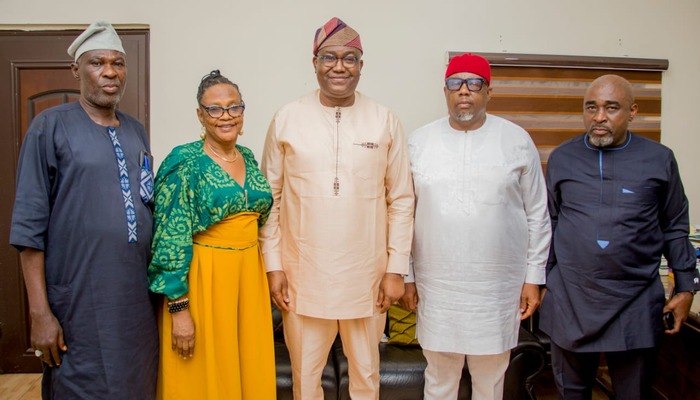
Meeting with Accord Party Leaders in Abuja
Gbenga Hashim, the presidential candidate for the Peoples Democratic Party (PDP), is ramping up bipartisan discussions aimed at forming a coalition to address what he perceives as a dangerous shift towards a one-party system in Nigeria. This initiative reflects Hashim’s commitment to fostering a diverse political landscape amidst growing concerns of political centralization.
The meeting took place in Abuja with leaders from the Accord Party, including national chairman Maxwell Magbudem and key figures like national secretary Adebukola Abiola Ajaja and Secretary of State for Finance Saladeen Abdulzeez Oyeniyi. The dialogue underscored the importance of consolidating efforts among opposition groups to maintain a balanced democratic environment.
Hashim’s call for unity resonates in light of his recent comments on Channels TV, where he voiced apprehension about the perceived encroachment on Nigeria’s democratic framework, allegedly driven by the ruling All Progressives Congress under President Bola Ahmed Tinubu. He emphasized the emerging challenges faced by opposition parties, which are becoming increasingly fragmented due to both internal strife and external pressure.
In a pointed critique, Hashim condemned the Independent National Electoral Commission (INEC) for what he labeled an unconstitutional imposition of an election schedule. He referenced Article 29(1) of the Election Law, which mandates that political parties submit their candidate lists at least 120 days prior to elections. He argued that such stipulations suggest August or September as reasonable deadlines for party primaries. However, INEC’s directive to complete these primaries by May compresses this timeline significantly, creating unnecessary strain on opposition parties already dealing with internal disputes and legal challenges.
While acknowledging a recent postponement of the deadline for submitting party registers by INEC, Hashim argued that the core issues surrounding the tight election schedule remain unaddressed. This meeting is part of a broader strategy to engage with various political factions in Nigeria. Earlier this year, Hashim also met with Omoyele Sowore, the presidential candidate for the African Action Congress (AAC), as part of efforts to forge opposition alliances.
During their meeting, Sowore remarked on Hashim’s mentorship during their time at the University of Lagos, illustrating the importance of educational influences on political activism. This ongoing series of discussions reveals Hashim’s determination to safeguard Nigeria’s democracy through collaboration among political entities committed to transparency, accountability, and a competitive multi-party system. He warned against any measures that might concentrate power in ways that could diminish democratic choice.
Political analysts view these negotiations as a significant move towards deepening ideological discourse and enhancing coalition-building among opposition forces. Given the climate of political consolidation and diminishing democratic freedoms, ongoing conversations in the coming months will likely center on finding cooperative pathways leading up to future elections.
