


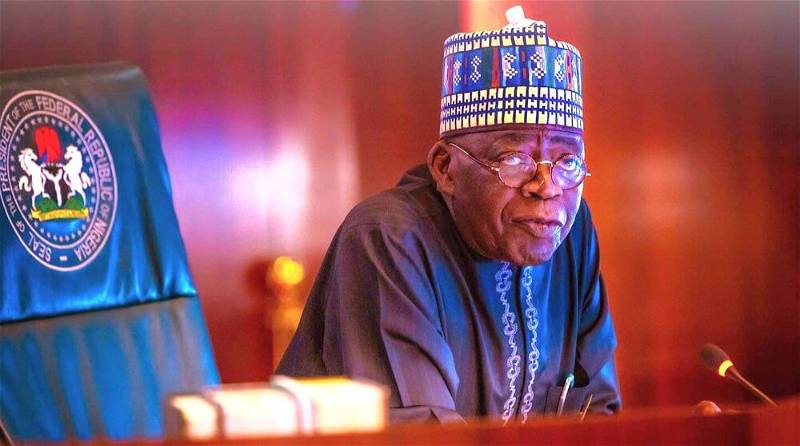
President Supports Airstrikes Amid Rising Security Concerns
Desi Elmoye in Abuja
During an emergency meeting held at the Abuja State House on Monday afternoon, President Bola Tinubu convened top military and security officials, including the Chief of Defense Staff (CDS), the three service chiefs, the Inspector General of Police (IGP), and leaders of various intelligence agencies. This meeting comes in response to increasing anxiety surrounding the nation’s security, particularly concerning a series of attacks on military targets in Borno State.
Attendees included CDS General Olufemi Oluyede, Army Chief of Staff Lt. Gen. Waidi Shaib, Chief of Naval Staff Vice Admiral Idi Abbas, Chief of Air Staff Air Marshal Sunday Anele, Department of State Security (DSS) Secretary Oluwatosin Ajayi, Director General of the National Intelligence Agency (NIA) Ambassador Mohammed Mohammed, and IGP Tunji Disu. National Security Advisor (NSA) Malam Nuhu Ribadu was also present, along with other senior security personnel.
This critical meeting follows a controversial airstrike carried out by the Nigerian Air Force in Yobe State, which allegedly resulted in the deaths of over 100 civilians. The strike, executed on Saturday at Jiri market along the Borno-Yobe border, aimed at what was believed to be Boko Haram targets.
While the Nigerian Air Force confirmed that it conducted “precision sweep airstrikes against identified terrorist sites” in the Jiri Axis region, it did not acknowledge civilian casualties or any impact on market activities. However, the presidential office defended the operation, claiming the market had been compromised by rebel activities.
Tope Ajayi, Senior Special Assistant to the President on Media and Publicity, stated that the location had become a “legitimate military target” due to its utilization as a logistics and trade hub by Boko Haram and ISWAP militants.
The urgency of the meeting was heightened by a travel advisory from the U.S. State Department, which permitted non-emergency government personnel and their families to voluntarily leave the Abuja embassy. Issued on April 8, the advisory classified 23 of Nigeria’s 36 states as high-risk (Level 4: Do Not Travel), citing a “deteriorating security situation” that now includes newly flagged states such as Plateau, Jigawa, Kwara, Niger, and Taraba.
U.S. officials have raised concerns regarding various threats pervasive in Nigeria, from insurgency in the northeast to banditry in the northwest and north-central regions, as well as ongoing violence in southern regions, including oil-producing areas. In light of these concerns, the U.S. embassy in Abuja has suspended visa bookings, while the consulate in Lagos continues to provide both regular and emergency services.
In reaction to the U.S. travel advisory, the Nigerian federal government characterized it as a routine precaution reflecting U.S. domestic protocols, arguing that it does not accurately portray the security conditions across the country. Minister of Information and National Orientation Mohamed Idris emphasized that, despite some isolated incidents, “there has been no general breakdown of law and order,” asserting that large regions of Nigeria remain stable.
